

Melibe colemani, the Grail of nudibranchs

 EN
ENName: Melibe colemani. This little sea animal is the star of Romblon, Philippines. Divers are ready to travel thousands of miles to admire this strange sea slug!
A transparent nudibranch
March 2017. I am on the island of Romblon, in the Philippines. "Here we have the Holy Grail of nudibranchs "Philipp, from the diving center, proudly announces The Three P.
The Holy Grail of nudibranchs? Really? What's so special about it? "It's a newly discovered nudibranch, very hard to find and truly amazing. But you have to see for yourself. You know, we have divers from all over the world who come here just to photograph it. Its name is Melibe colemani. Tell the guide you want to see some, and he'll show it to you..."
And it's true, you have to see it to believe it... This sea slug is translucent! You can see its organs right through it! 😮


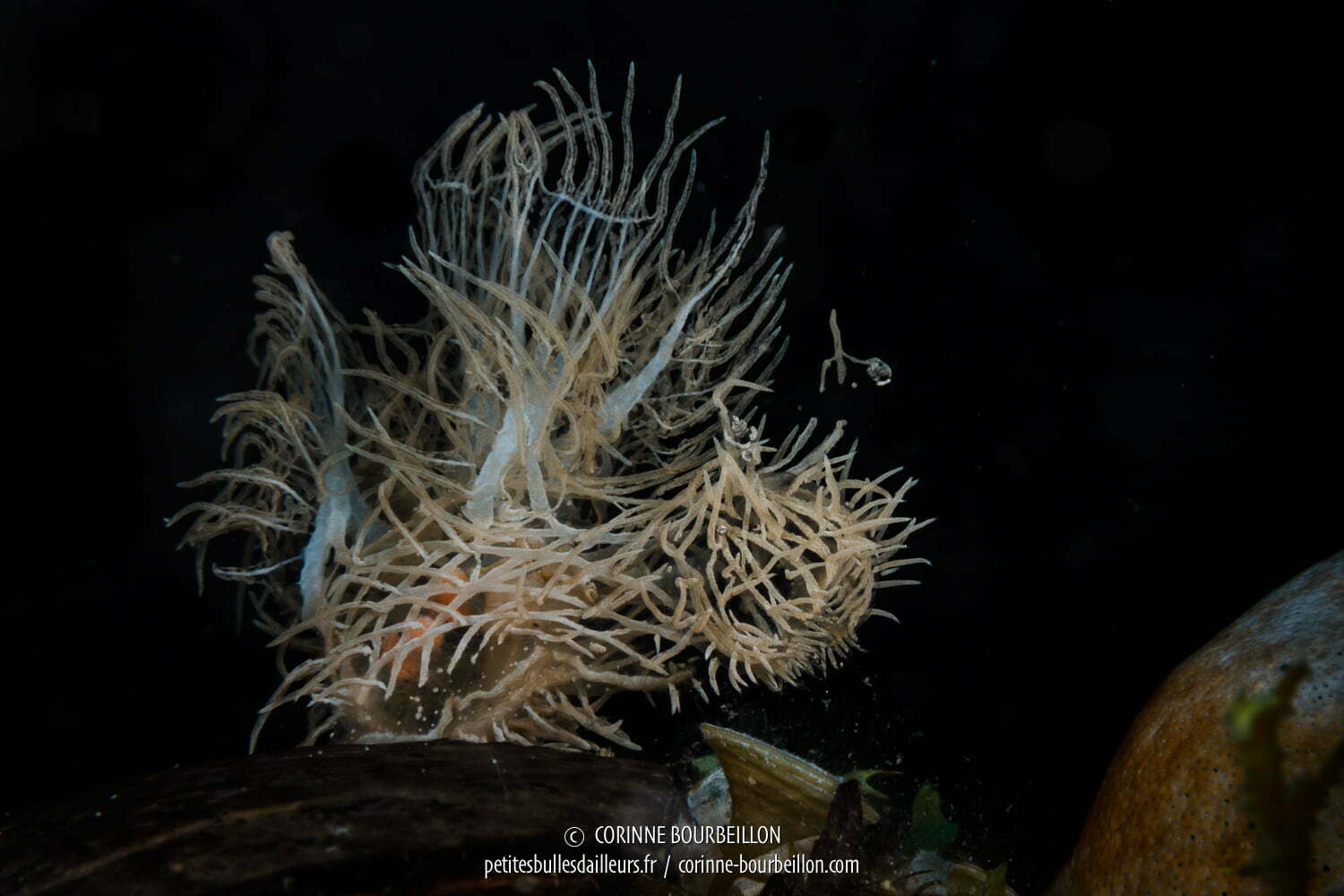
That's not the only oddity. Its body is made up of a network of whitish-beige tubes, which are in fact digestive glands. On its back, they extend into imposing excrescences, called cerata.
I admit, I didn't know any of this until I saw my first Melibe colemani... 😍 In fact, even when I first look at it, I can't see a thing!
Very difficult to spot
Joseph alias "Erap", my Filipino guide, points insistently at something, first with two fingers to his eyes, then with his index finger to a clump of soft coral. Seeing that I can't see a thing, he makes a circle with the tip of his pointer over the polyps, where I'm supposed to be looking, then gently pulls apart the "stalks" waving in the current.
But I still don't see anything. Nothing at all. In fact, I don't even know what the thing I'm supposed to see looks like.
And then, finally, it's here!!! I SEE it!


It takes me a while to spot the front and back of the beast, which must be about 4-5 centimetres long. What's more, this nudibranch is on the move. With each movement of the swell, it too undulates, moves forward, straightens up, raises its head... Is that its head? Wahoooou... I'm hallucinating.
Its mouth is like a reticule, a mini net that I guess is capable of capturing tiny, invisible prey that it just has to digest. It's a gelatinous monster. A multiform slug. A phantom nudibranch.

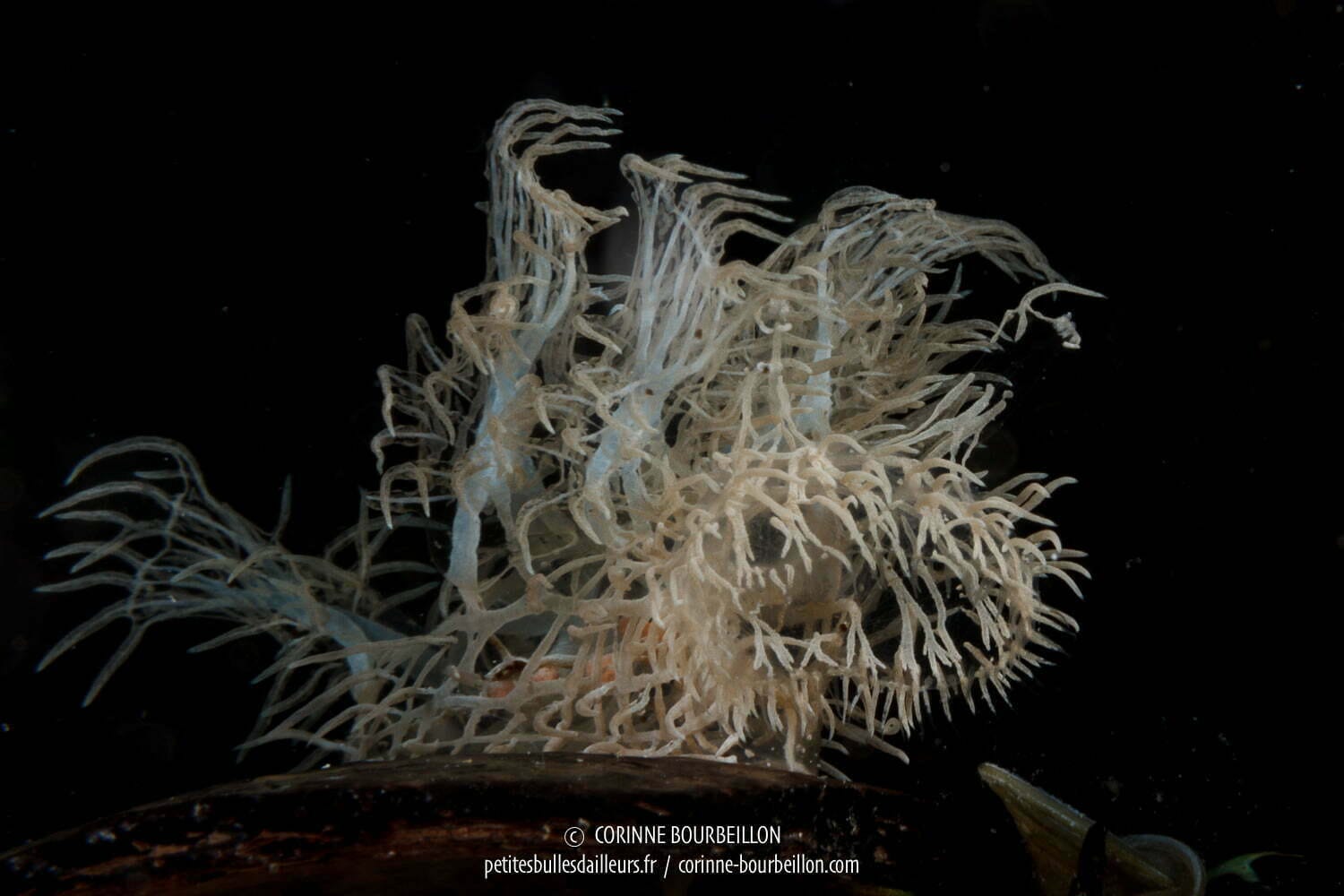
What's more, there isn't just one... Joseph draws my attention to his little translucent comrades. Underwater, there are nudibranch corners, just as there are mushroom corners in the forest! 😂
Without the eye of my guide and his knowledge of the site (I spoke about it in a previous article on muck-dive), I would never have succeeded in observing and photographing this natural wonder... Melibe colemani is so light, so vaporous, that it must be approached with infinite precautions. Because a simple movement of the hand above the small animal is enough to create a current capable of lifting it from the substrate and to make it float in the water. It does not look like anything anymore. One would easily confuse it with a vague spongy debris carried away by the current.
On this dive - and a few others in the days that followed, when I again asked to see the Melibe colemani - So I spend a very long time stuck on the spot, to observe and photograph the tiny and fascinating animal. A game of patience ...
Melibe colemania recent discovery
Melibe colemani is a filter-feeder nudibranch named after its discoverer, the Australian naturalist and photographer Neville Coleman (1938-2012). A find made at Mabulthe neighboring island of Sipadanin Malaysia, near Borneo: Coleman published the very first image of it in 2008, in its Nudibranchs Encyclopedia.
I love his account of the dive during which he first spotted and photographed this curious creature, previously unknown to scientists. It also took him a while to really see what he was looking at... The story is reported here on this American enthusiast website:
➜ The Slug Site: Melibe colemani


The nomenclature and scientific description of the species was only established in 2012 (one month after Coleman's death) by two marine biologists specializing in nudibranchs, the Spanish Marta Pola and the American Terrence Gosliner. For science buffs, here are two links to their study:
➜ An extract from the study here
➜ PDF download here
(Coincidence: I discovered while checking The Three P dive center's Facebook page that Terrence Gosliner also spent a week in Romblon not long ago, in April 2017, for his scientific research!)
In addition to Mabul in Malaysia, Melibe colemani has also been observed in Indonesia at Komodo and Lembeh. In the Philippines, RomblonThe Three P divers first spotted it in 2013.
The species is probably widespread in the waters of the Coral Triangle. But this nudibranch is so hard to see, it's no wonder it was only recently discovered. Particularly coveted by macro photographers, it is considered a rarity. The good thing about Romblon is that the guides know where to find them.
In any case, for me, underwater is ecstasy. Melibe colemani is unlike any nudibranch I've come across before. It's something new, something strange. What an extraordinary creature! The Grail. So I've been told...
👌 😉


Fantastic !!! pictures at 105 macro?
I'll be going to Anilao at the end of 2017 ( romblon full for my dates) , hopefully ...
@Jean Claude : here I am indeed with my new toy, a 100mm macro lens, which I was talking about here in a previous post:
→ Diving into another world in the Philippines
I don't think Olivier fromAsiaqua.comwho lives in Anilao and organized my trip to Romblon, has already seen Melibe colemani in Anilao. Apparently it's really in Romblon that we're sure to find them. But as you say, with a bit of luck... 😉
Ha phew... it was the last long weekend of May, we were hot otherwise we had to wait for July 14 for the article to come out... 😉
My Panini album is missing this one, congratulations for the pictures, the rendering is very clear, very isible, we finally wonder how you did not see it on this black background... 😀 😀
@Ludovic : procrastination is my middle name... At this little game, I'm even stronger than you 😀 Making it "readable" is the whole difficulty with this damn Melibe c. I've been taught a few techniques 😉
Hello Corinne
After 9 months diving in the Philippines, I've never seen anything like it.
Obviously, it must be very difficult to distinguish it ......
I'm leaving in January for a little over three months and I'm going to observe the funds with another look .......
Hello Corinne,
I'm going back to the Philippines in June. In Tubbataha ... Did you go to Palawan?
@ Anne06: Tubbatahatop !!! You'll see, it's magnificent
Palawan, I only passed through there, in fact, during my report on board the Tara last February:
https://petitesbullesdailleurs.fr/tara-expeditions-philippines-palawan-20180504/
What is most interesting for divers, it seems, are the wrecks of Coron, but I was told that the view is often poor.
Thank you Corinne for your answer! 🙂