

Underwater Photography and Diving: My Equipment

 EN
ENI travel to do underwater photography. So, in addition to my clothes, I pack all my equipment in my luggage. That includes a mirrorless camera (Canon EOS R7), its waterproof housing, two underwater strobes, and a full set of diving gear!
Clarification: I'm not sponsored by ANY of the brands listed below when I detail my photo and diving equipment. I've equipped myself little by little, over the years, according to my needs and my budget.
My evolution: compact camera, SLR, MIL
I took up underwater photography in 2005-2006. My first camera was a disposable, with silver film inside, housed in a yellow-bottomed transparent plastic waterproof case. You could find these in tourist stores...
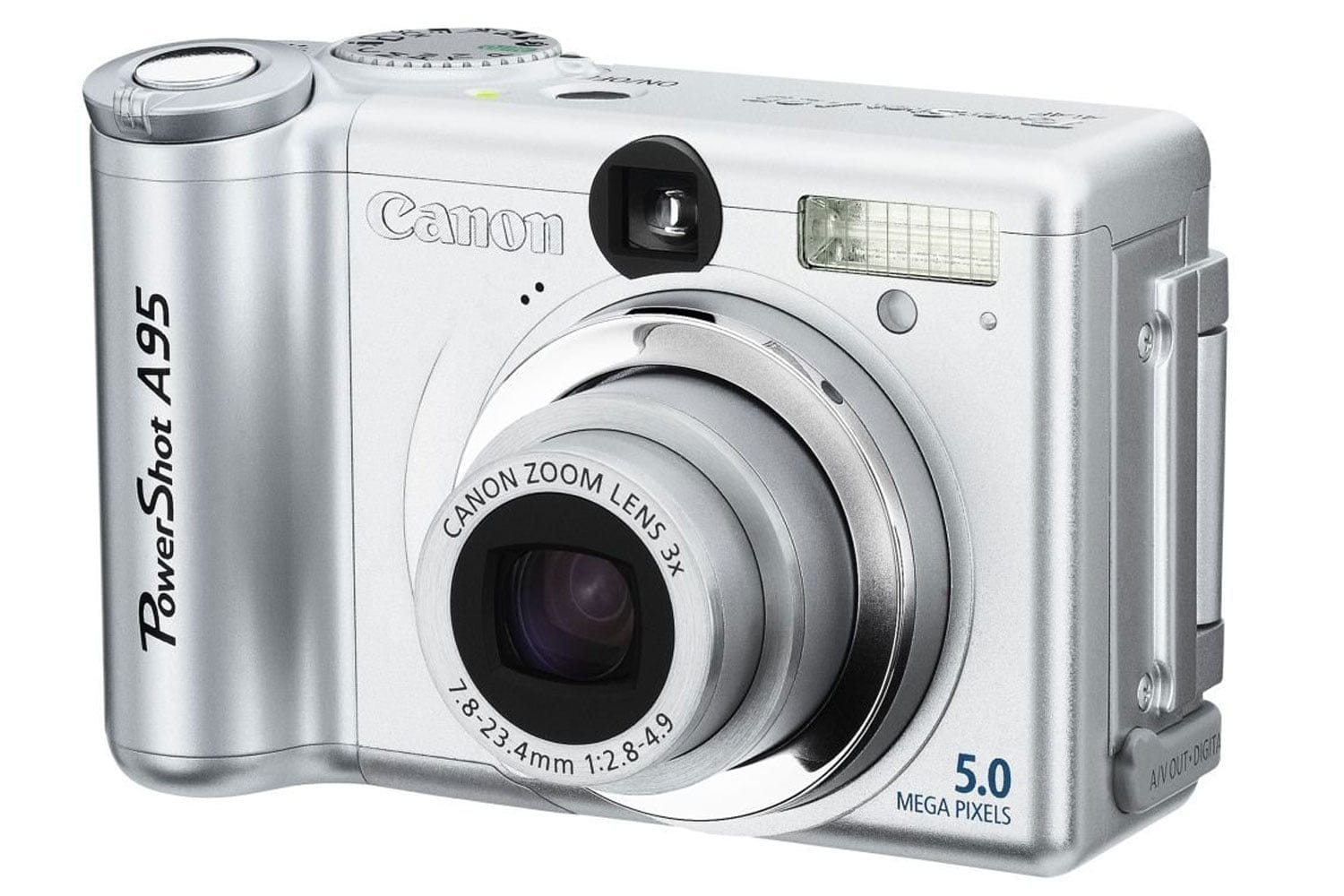
I liked it so much that I immediately bought a digital camera (APN) and its little underwater housing. At first, I tried my hand (and eye) at this modest compact, the Canon Powershot A95from 2005 to 2009. I learned a lot about underwater photography with this "basic" APN, which was all I needed to get started.
I finally got to grips with its possibilities, then the camera died... I then switched to an SLR in early 2010 with the Canon Eos 7D and an Ikelite housing. Thirteen years later, in 2023, I changed my camera again and invested in a mirrorless interchangeable lens (MIL) one, the Canon EOS R7, and a Nauticam housing.
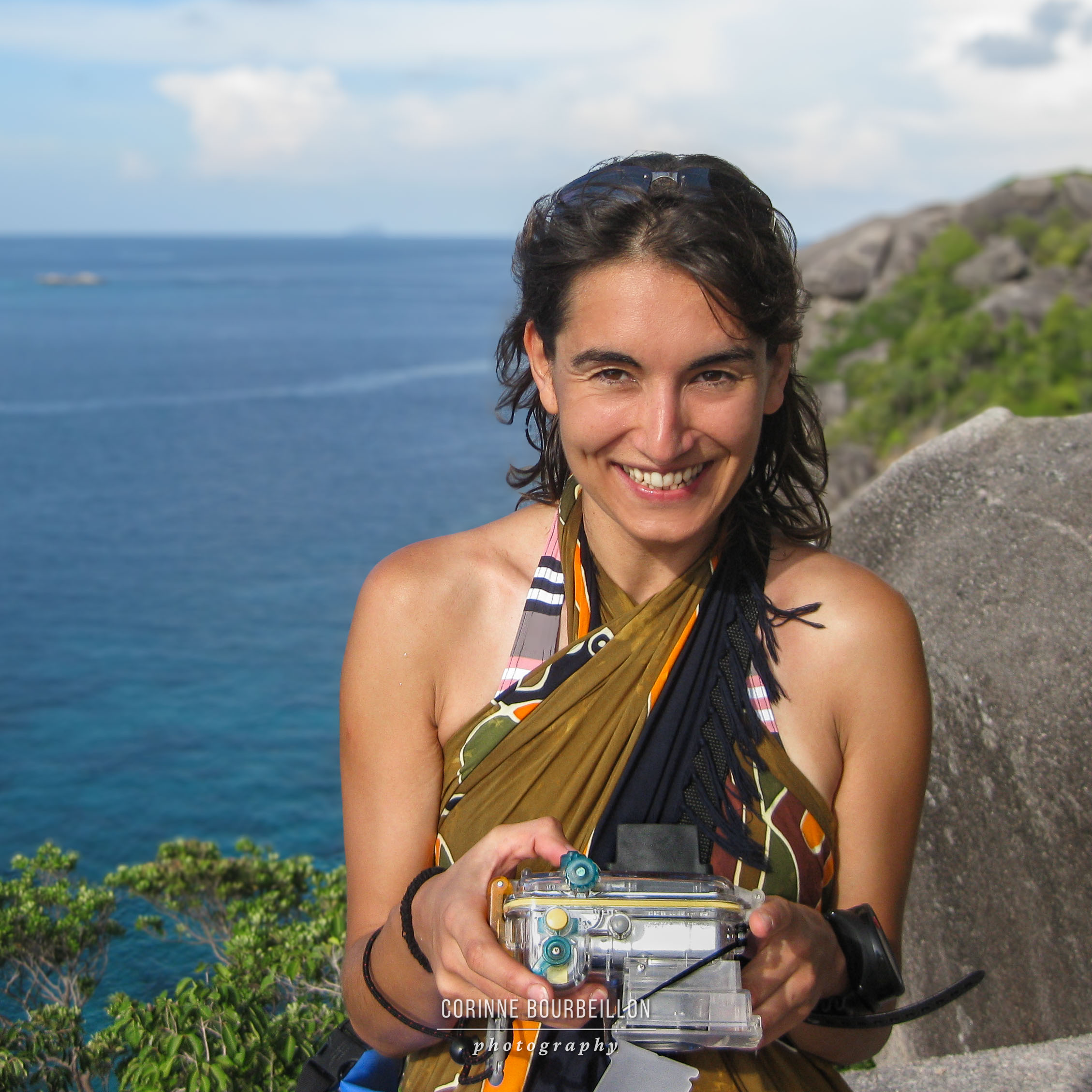
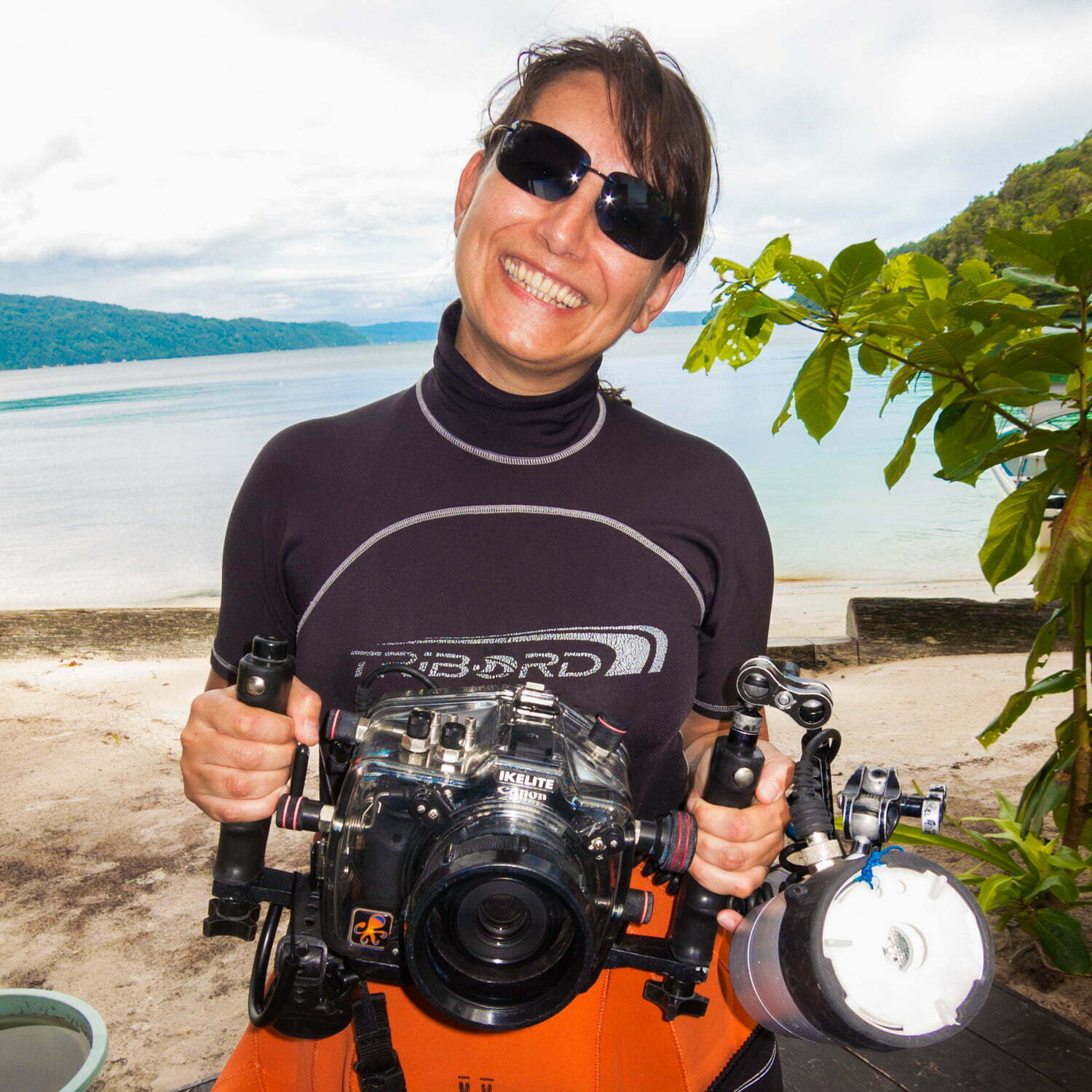
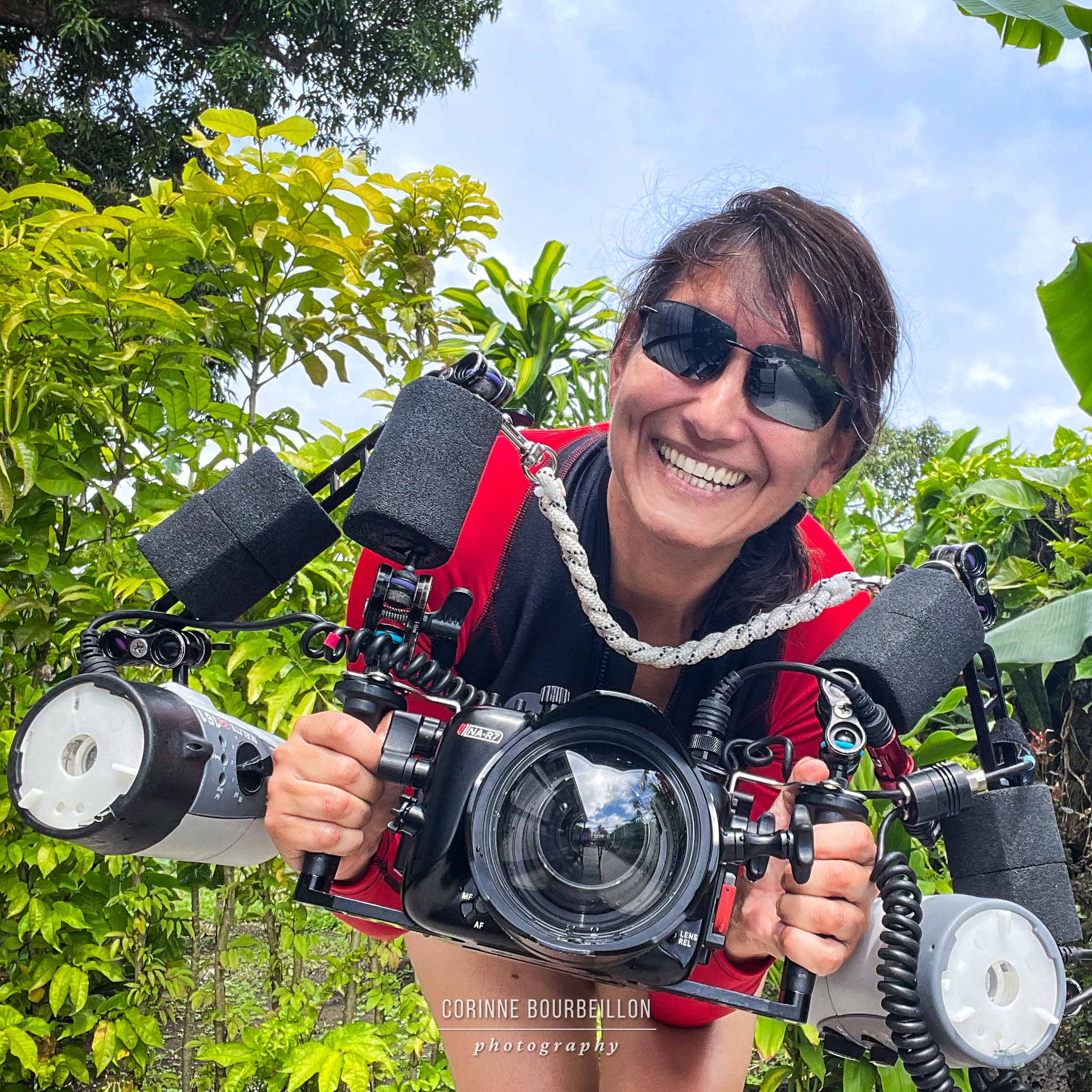
With the experience I've acquired over the years, my technique has improved and my images have gained in quality. But even today, I'm still perfecting my technique and developing my skills... Underwater photography is a never-ending learning process!
Read more ➜ See my Instagram feed @cbourbeillon
Read more ➜ Luggage: which dive bag to choose for travelling?
Read more ➜ How I got into underwater photography on my own
Since 2023: Canon Eos R7
In 2023, I tried out a new camera, the Canon EOS R7. A so-called "MIL" digital camera. Quite a technological change from my old SLR (Canon Eos 7D, see below).
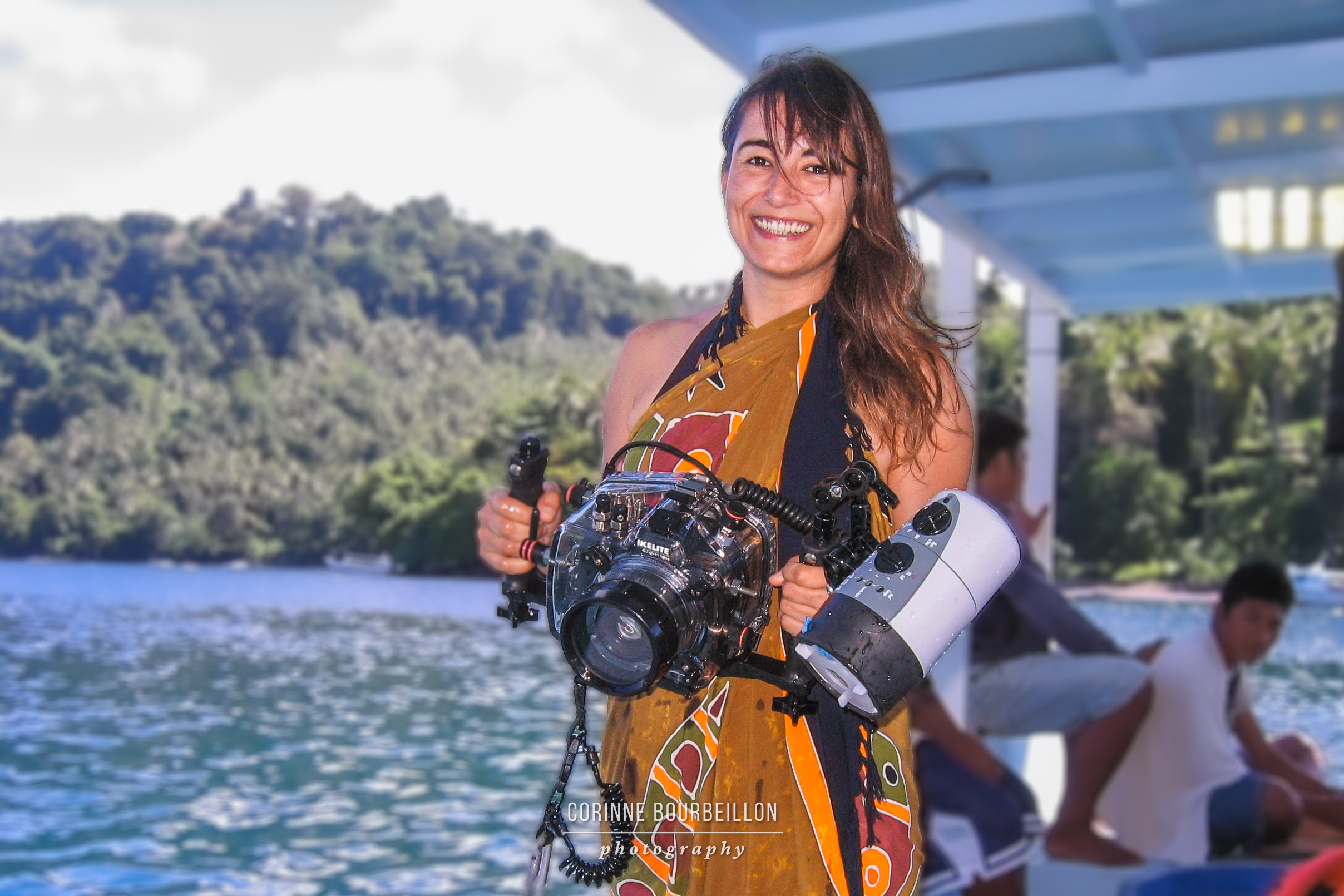
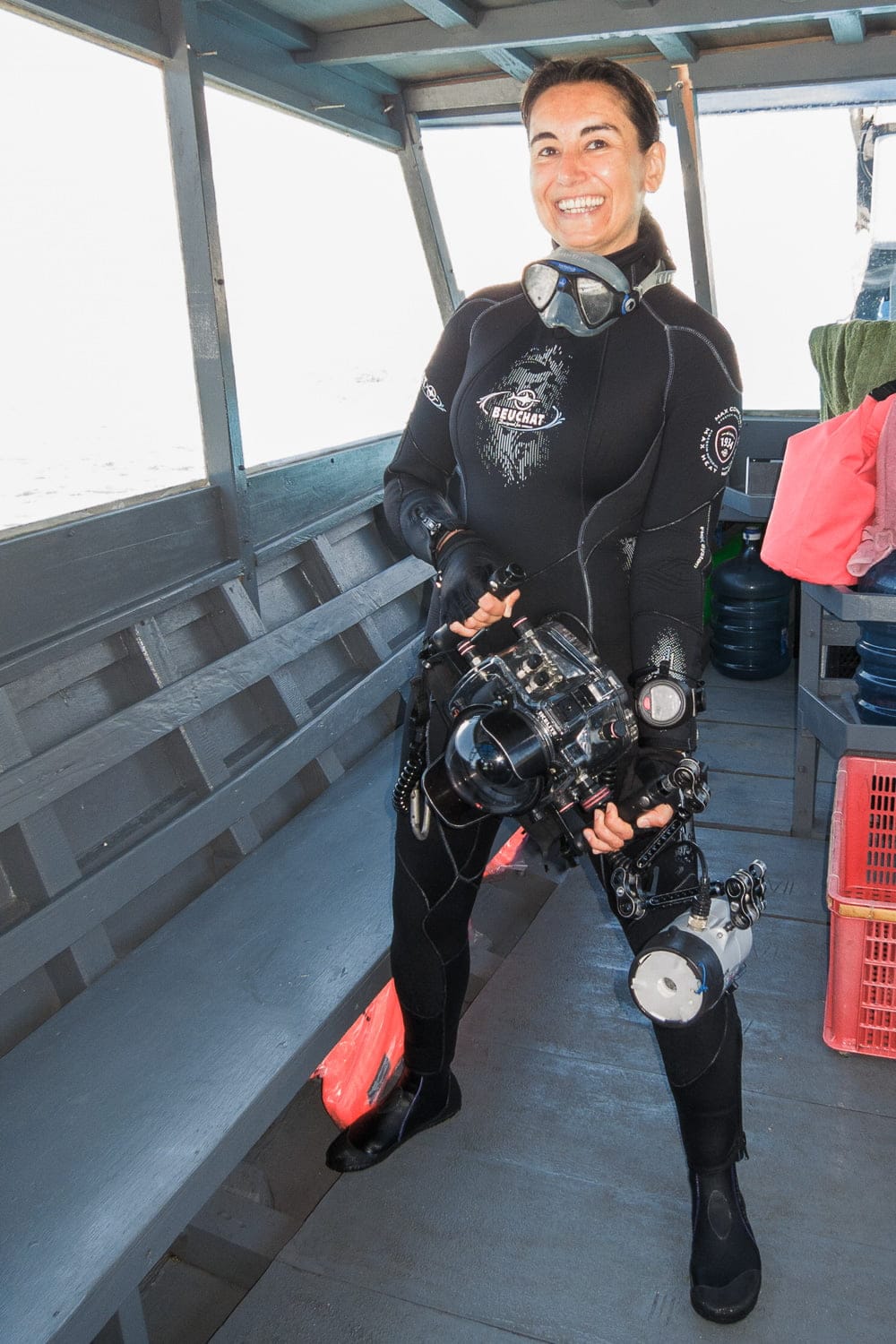
I invested in a Nauticam housing to take it underwater (photo below). The whole thing is more compact and lighter, and much easier to handle than my previous configuration.
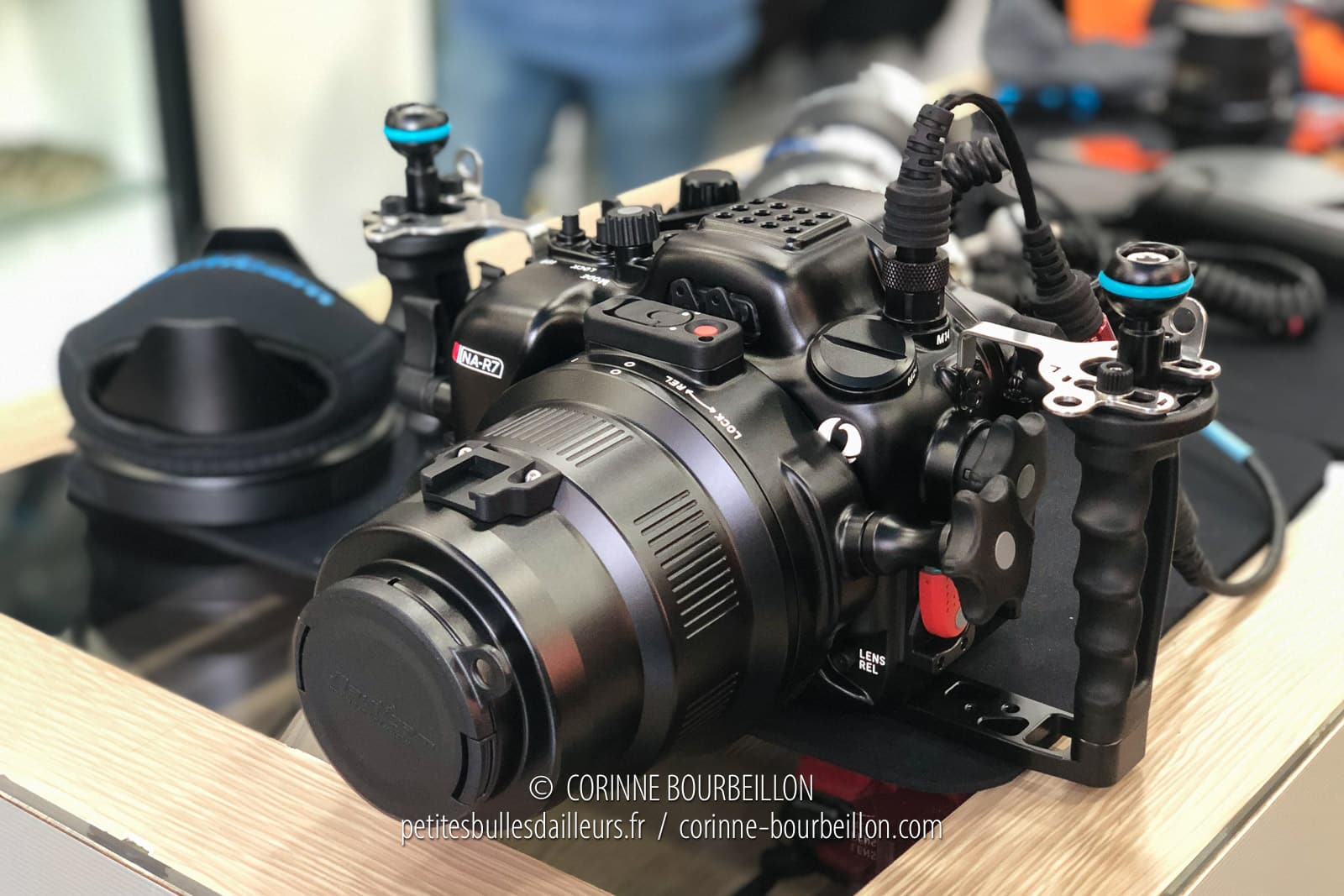
I use it for wide-angle (with a mini-dome) and macro (with a porthole). I was able to keep the lenses I had previously used on the SLR, thanks to an adapter ring.
I've also kept my Ikelite strobes, which work very well. As they can also be used in headlamp mode, I use them for lighting during night dives or sometimes in Breton waters when visibility is reduced, so that my little friends can see me better.
When they're out of action and I have the budget, I'll reinvest in the new models with fiber-optic connection. Below are the elements of my current configuration:
• Macro lens: Canon EF 100mm f/2.8L Macro IS USM
• Fisheye lens: Tokina AT-X 107 DX 10-17mm f/3.5-4.5
• Two strobes: Ikelite DS161 and DS160 II
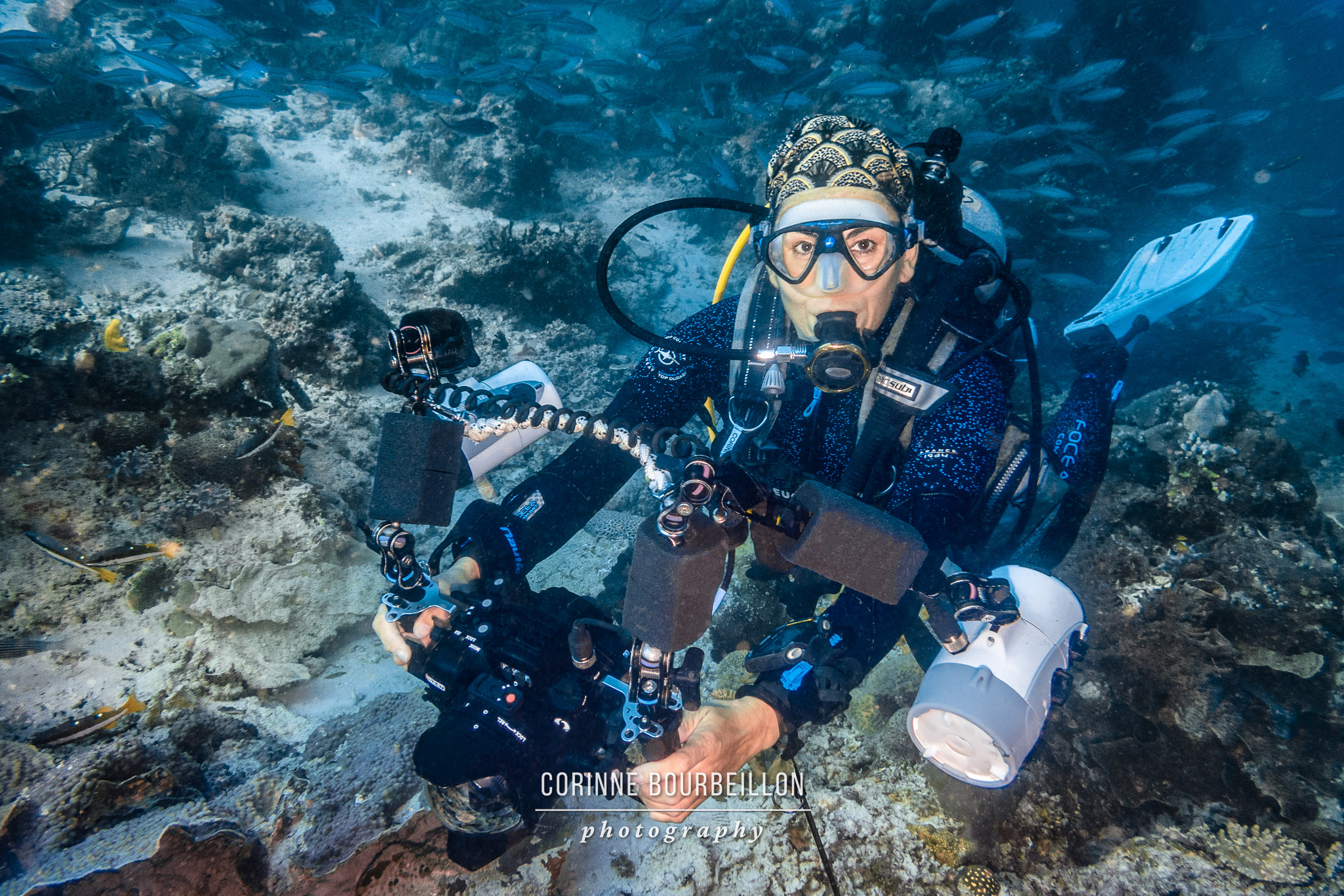

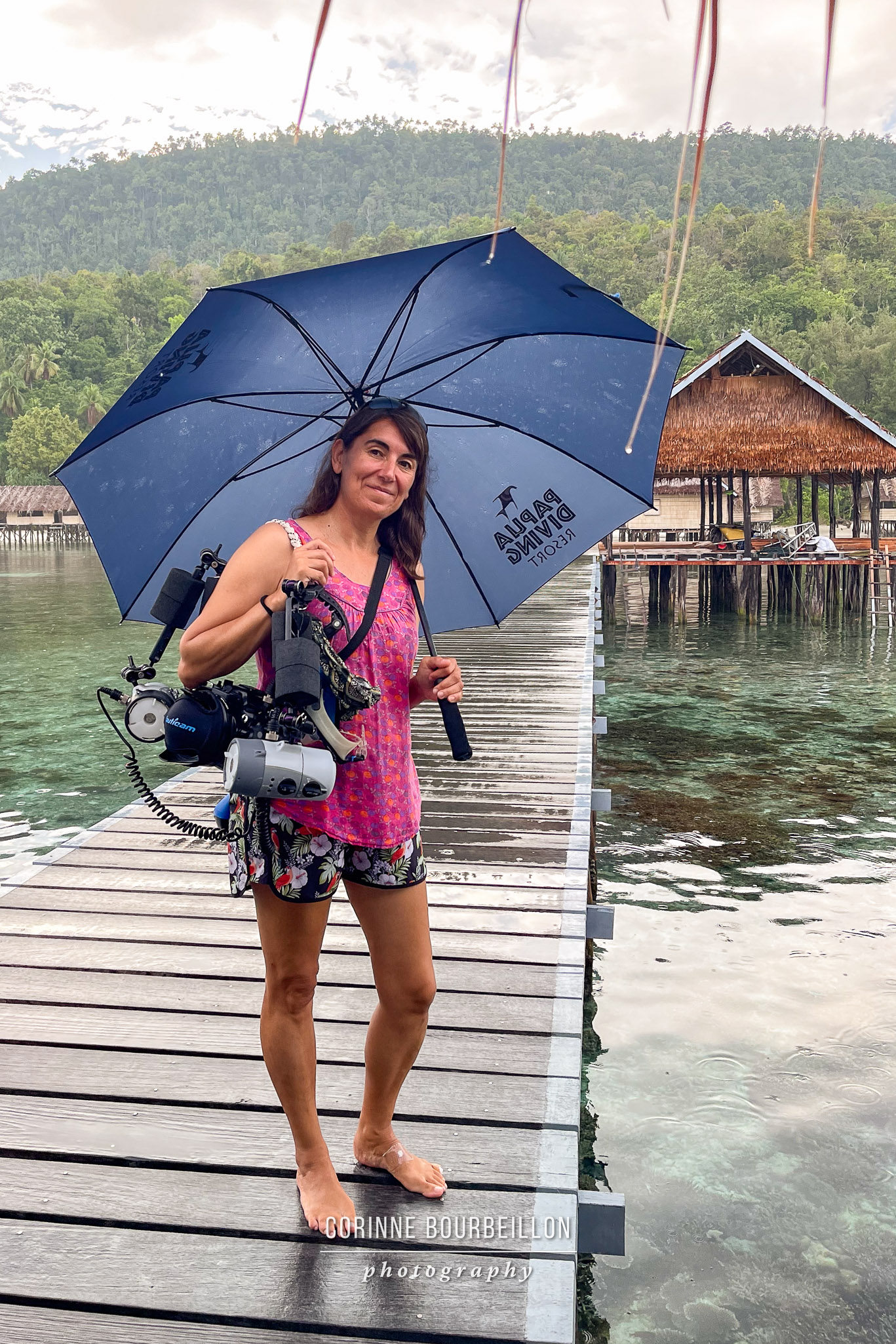
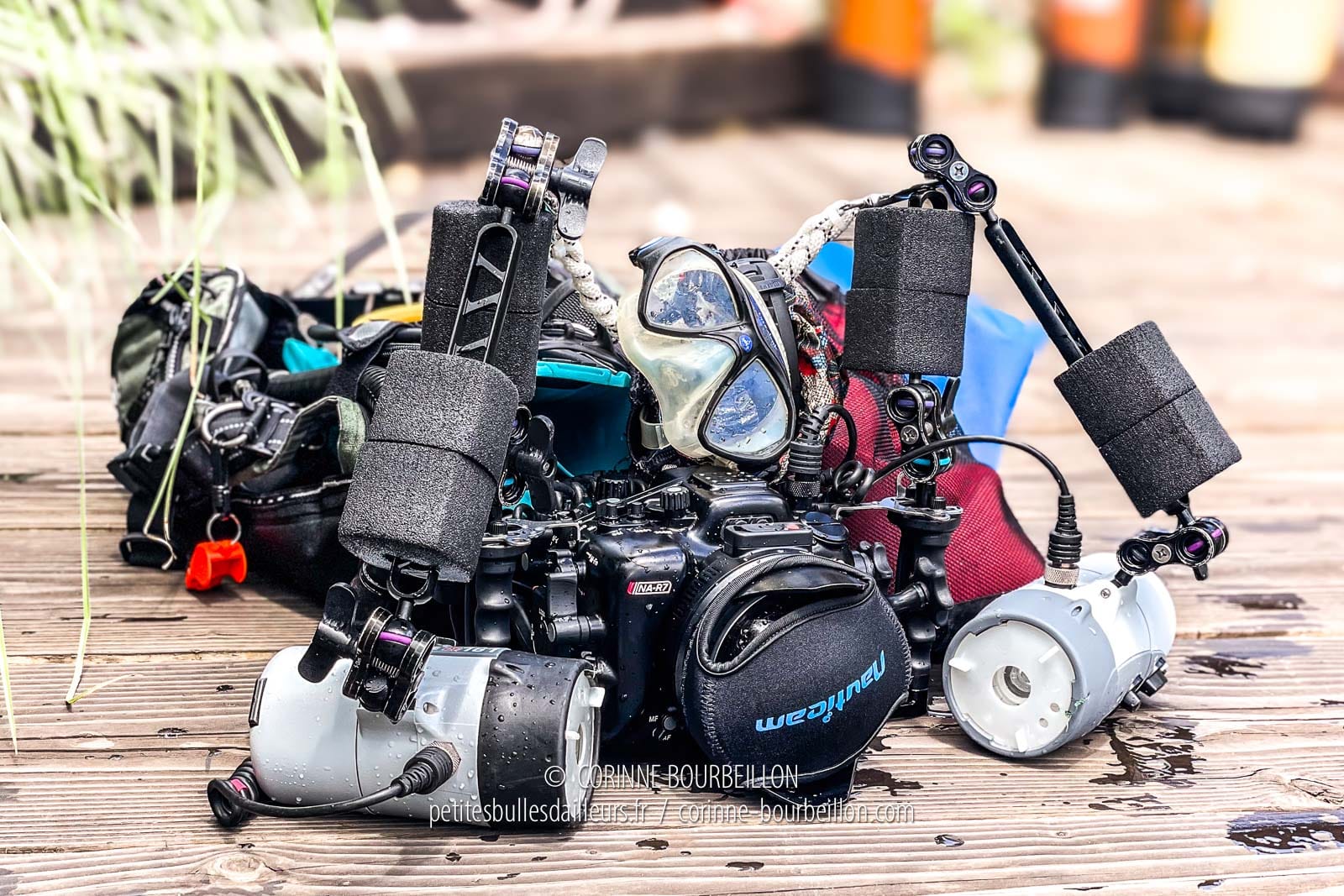
In equatorial rain, only my housing remains waterproof... 😂 So here's my usual configuration since 2023 (here in wide-angle, with the mini-dome in front of the lens).
From 2010 to 2022: Canon Eos 7D
From 2010 to 2022, I did some photography on land and underwater with the Canon Eos 7D. Twelve years, then... You could say that I knew how to make the pleasure last and avoid overconsumption. I had a lot of fun with it. It's a great device, and I was very happy with it. Its only drawback was that it was a bit heavy. But today's SLR technology is outdated, and the exceptional autofocus performance of hybrid APNs has prompted me to finally change my camera body in 2023.
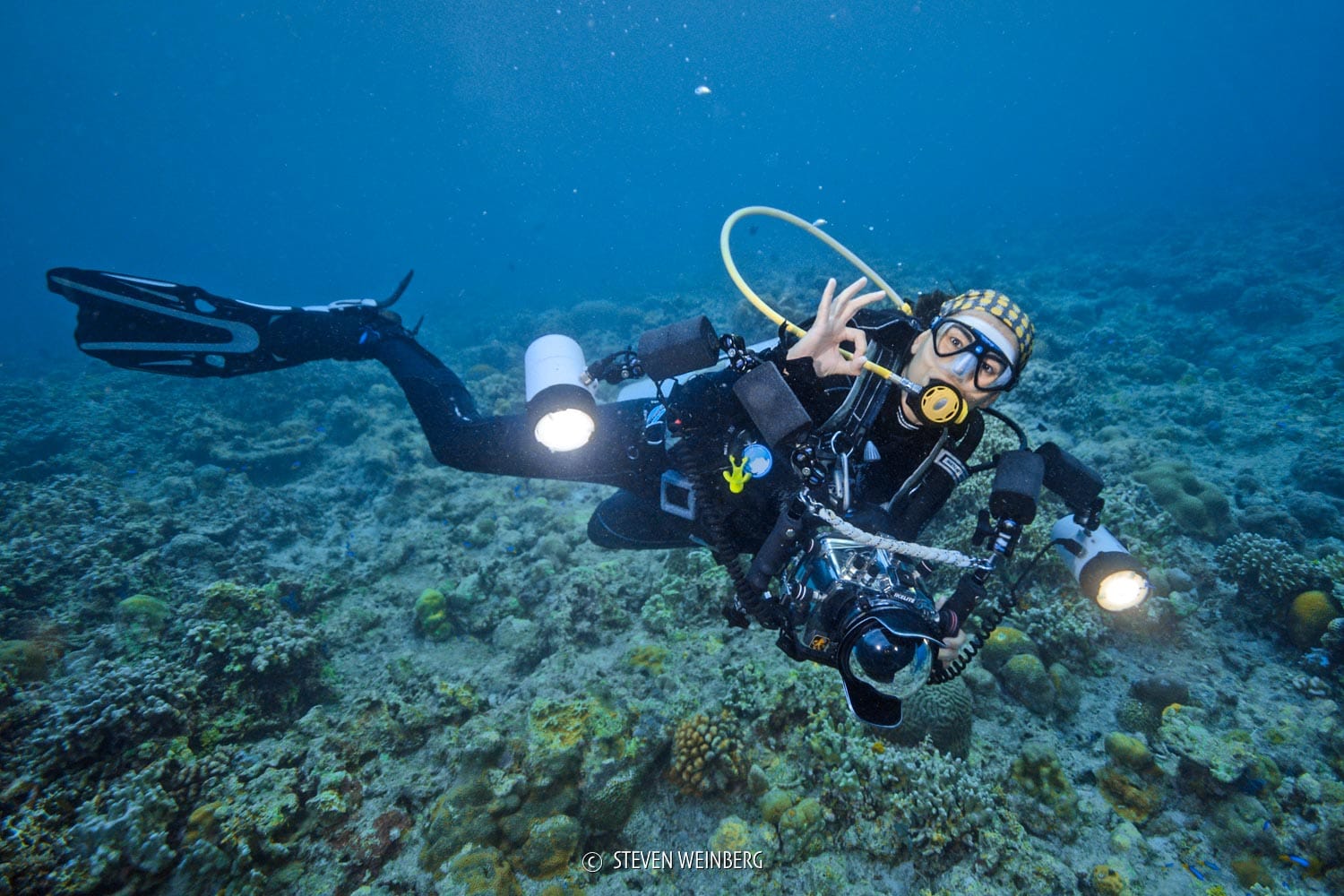
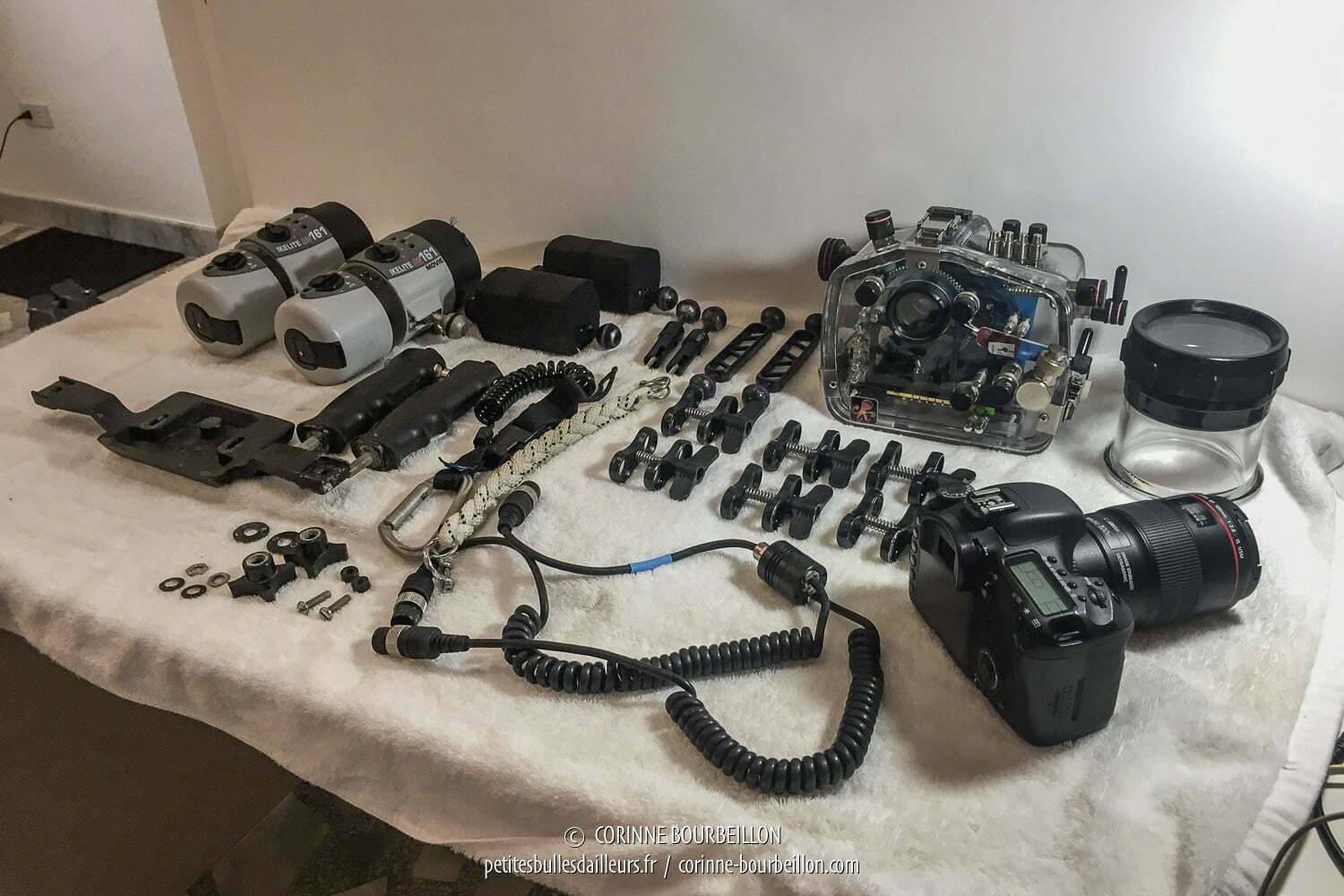
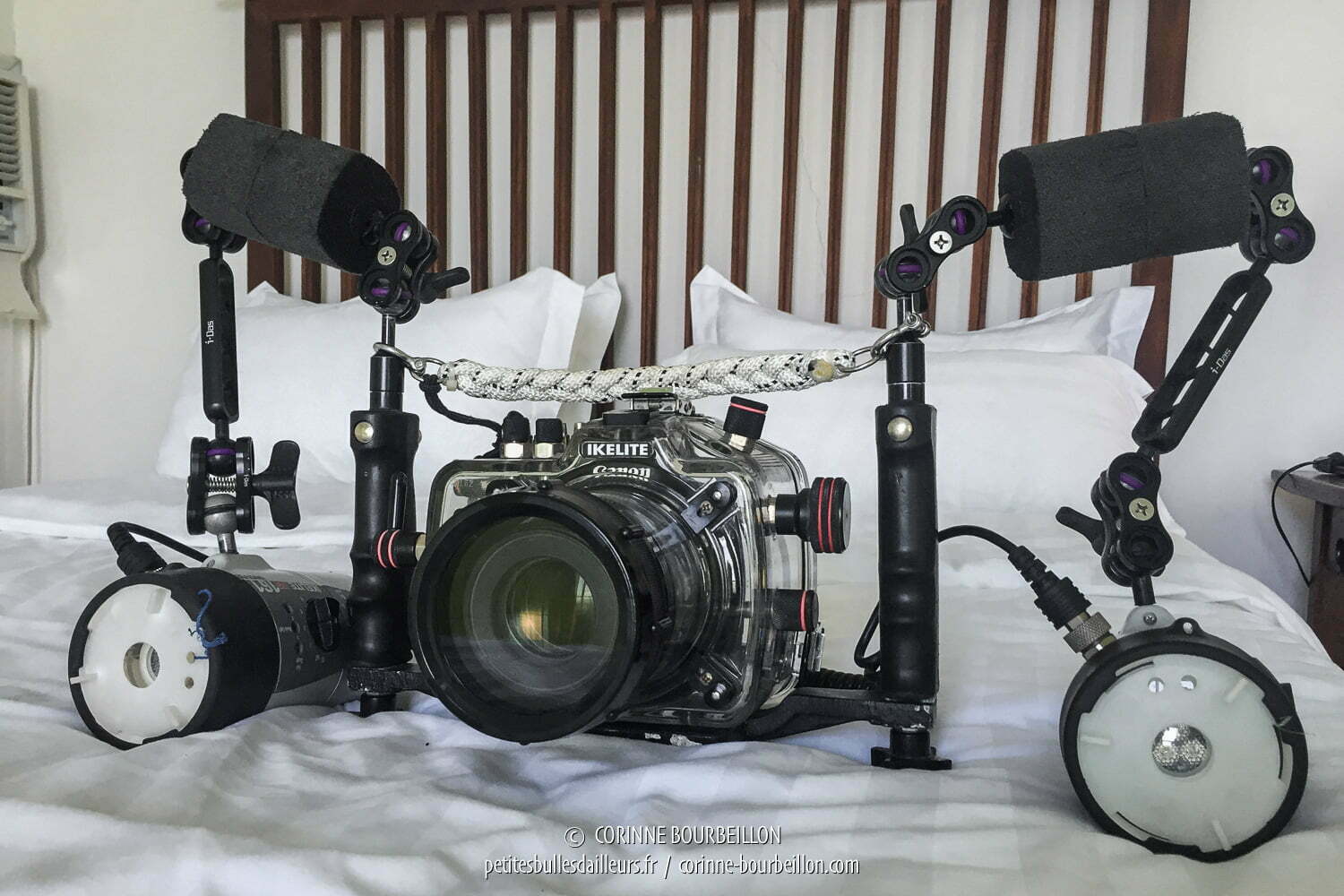
I took the 7D underwater in an Ikelite waterproof housing. I had a wide-angle, or more accurately fisheye, configuration (10-17 mm), and two macro configurations (60 and 100 mm):
- Waterproof housing : Ikelite for Canon 7D
- Flashes: Ikelite DS161 (I acquired the second one in 2016)
- Macro porthole 1 : Ikelite Flat Port #5502
- Macro porthole 2 : Ikelite Flat Port #5505.45
- Wide-angle mini-dome : Dyron Cristal 4.8 inches (small size, ideal for travel)
- Macro lens 1 : Canon EF-S 60mm f/2.8 Macro USM
- Macro Objective 2 : Canon EF 100mm f/2.8L Macro IS USM (top)
- Fisheye lens: Tokina AT-X 107 DX 10-17mm f/3.5-4.5 (Re-top)
On land, while traveling, I mainly used the following lenses with the 7D:
- Canon 15-85mm f / 3.5-5.6 (IS USM) (supplied with the 7D at the start, zoom rather practical for most situations when travelling)
- Canon 50mm f / 1.8 (STM) (light fixed lens, cheap, bright, top for portraits)
- Canon EF-S 10-18mm f/4.5-5.6 IS STM (cheap wide angle, very correct, good for traveling)
Yes, I used to lug all that around! Not forgetting, of course, all the chargers, batteries, cords, memory cards, etc. that go with it... Now, for terrestrial photos, I don't bother with extra equipment anymore, my current iPhone does the job perfectly.
🙃
Before 2010: the Canon Powershot A95, my first underwater camera
My pre-2010 camera equipment was a compact APN. The Canon Powershot A95 accompanied me everywhere, for several years. He has stopped working in 2009... I took it underwater for my underwater shots, with the waterproof housing designed for this model: the WP-DC50.
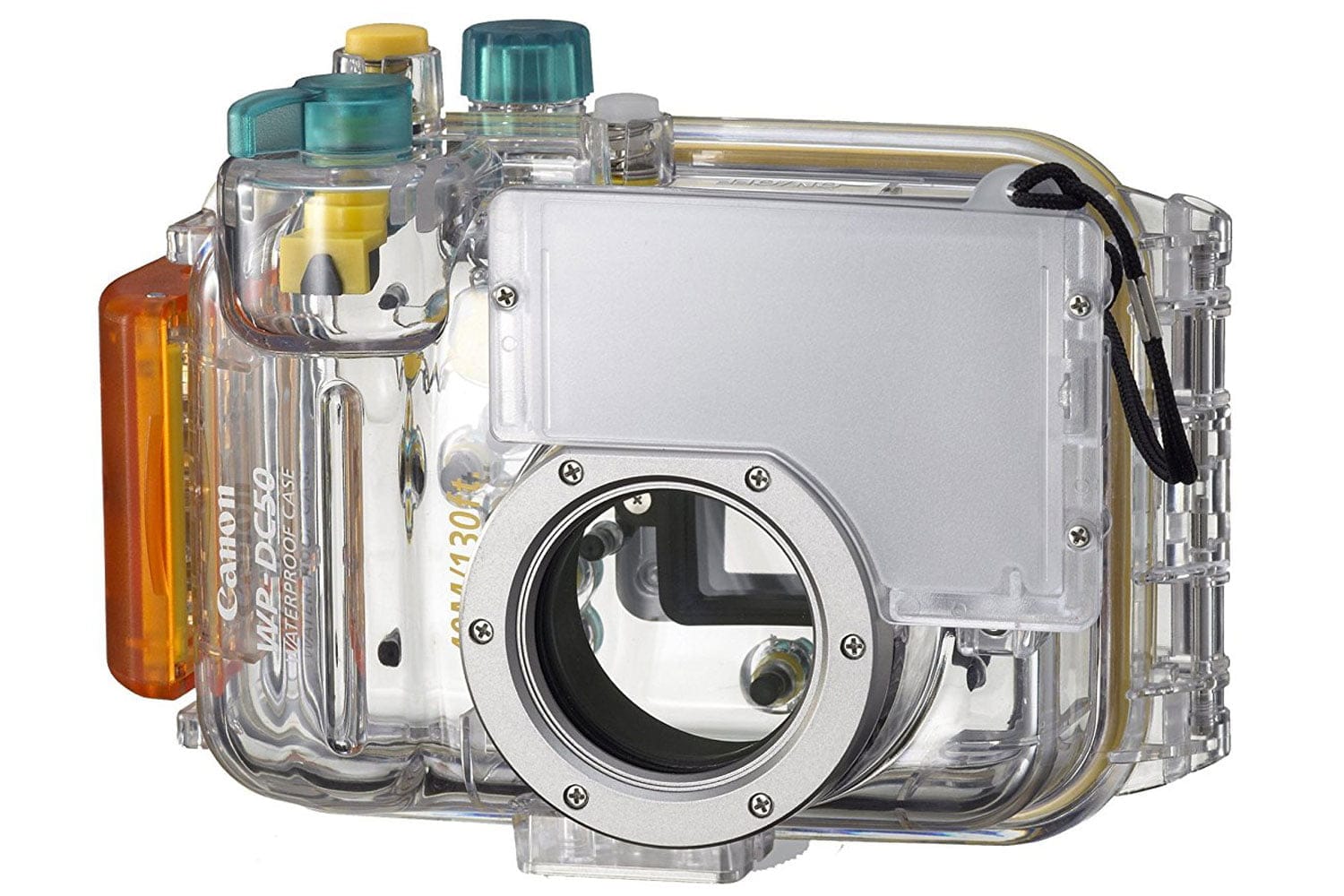
I didn't have any additional lighting at the time, I only used the built-in flash. This limited me to underwater macro photography.
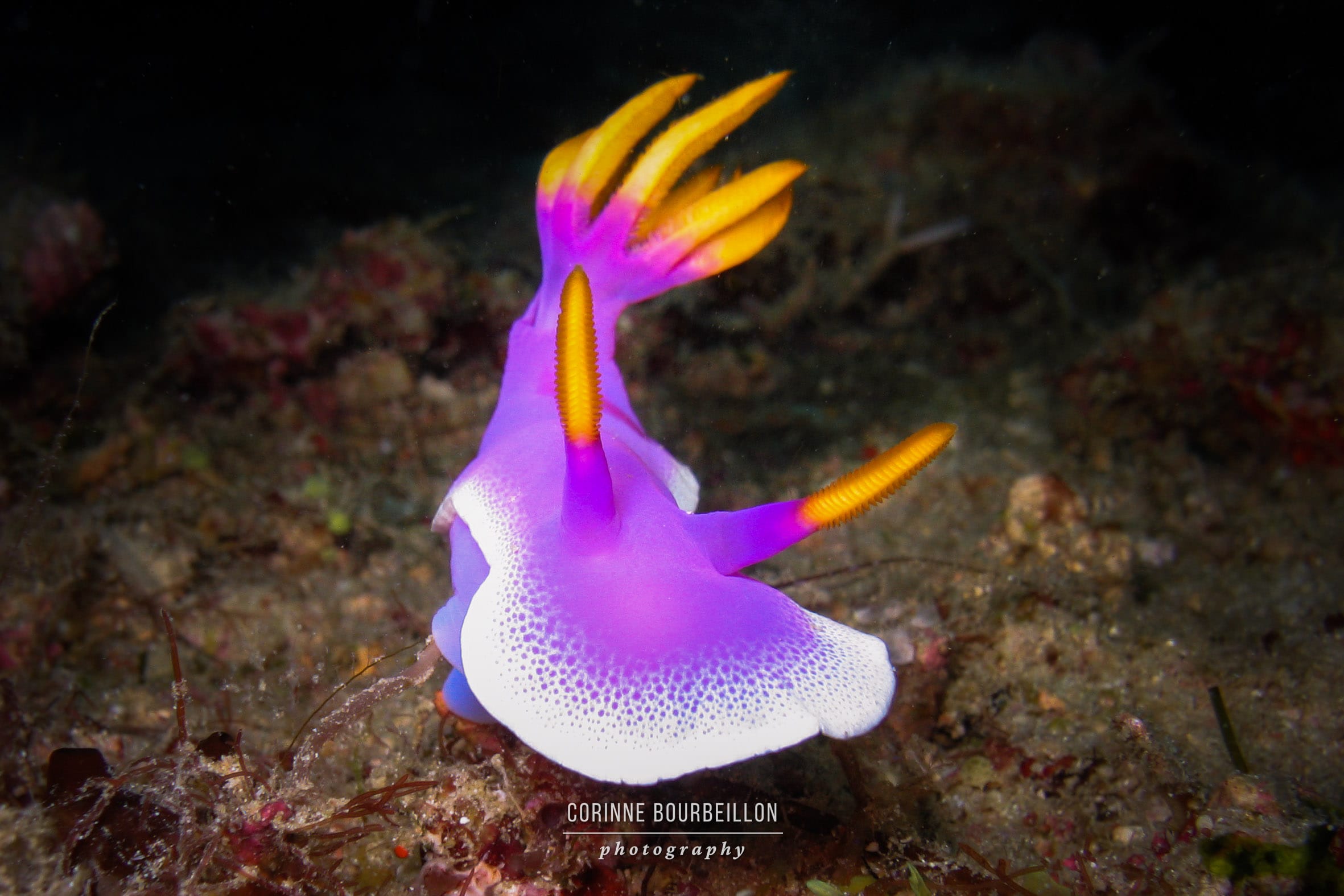
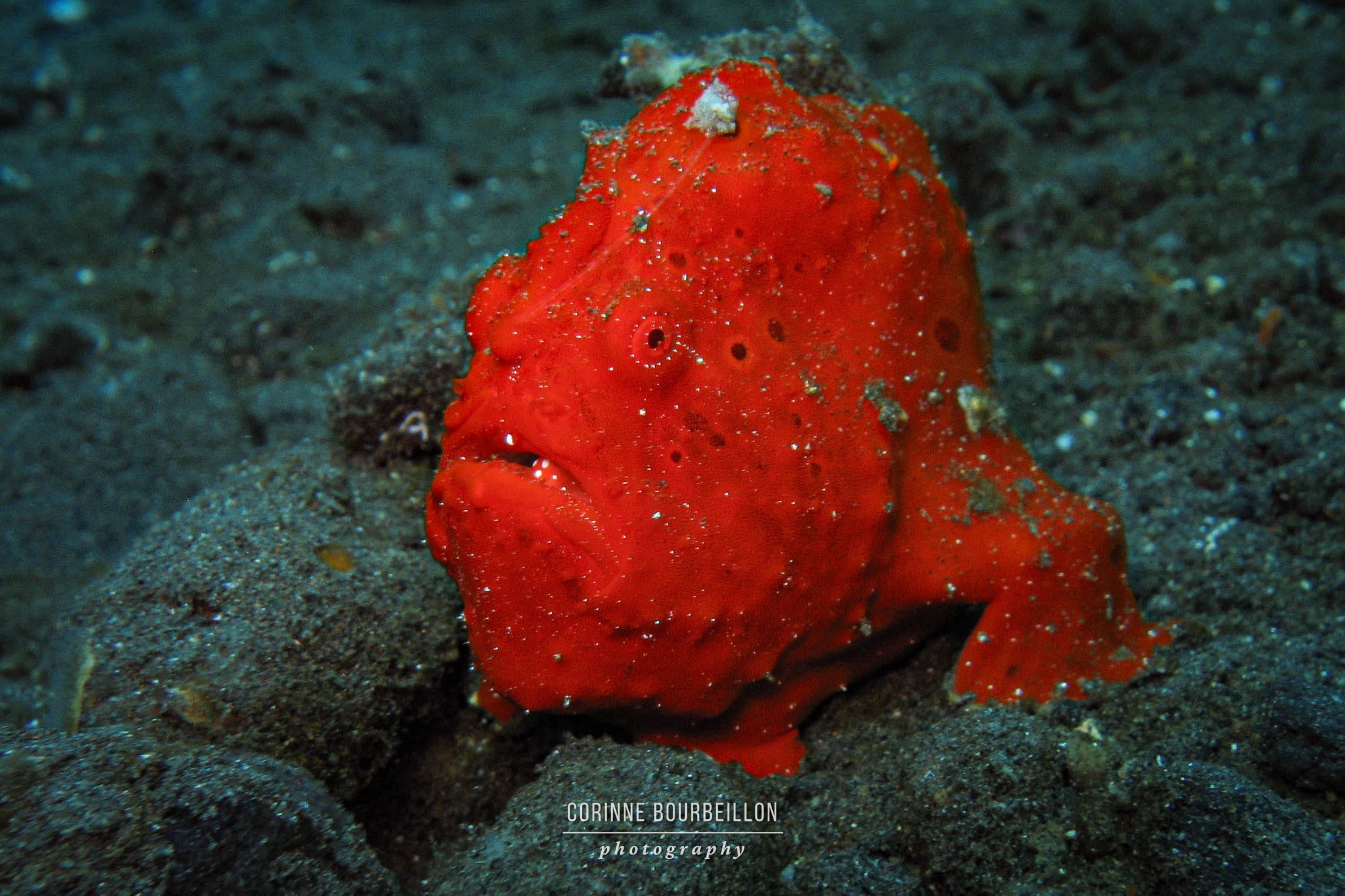
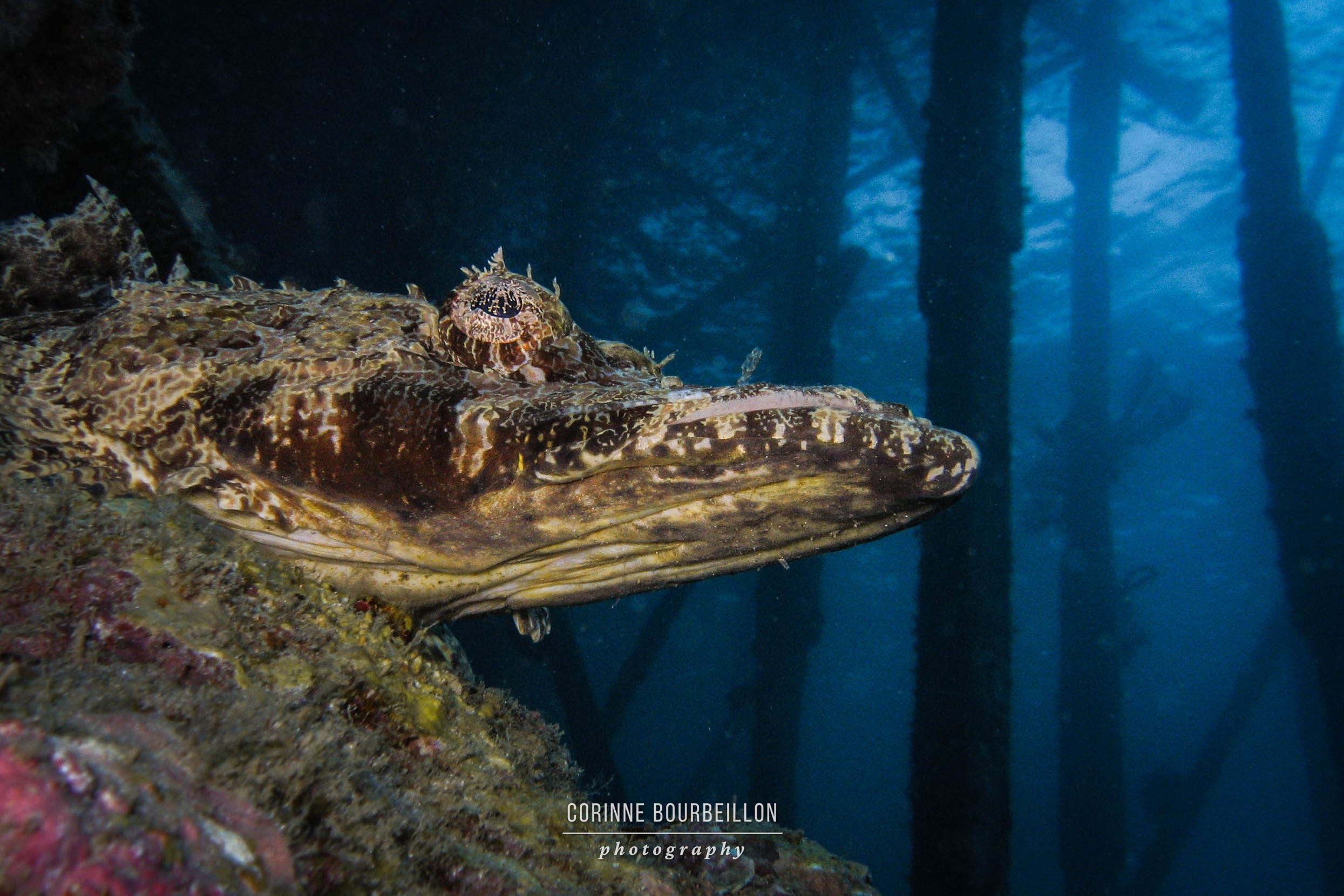
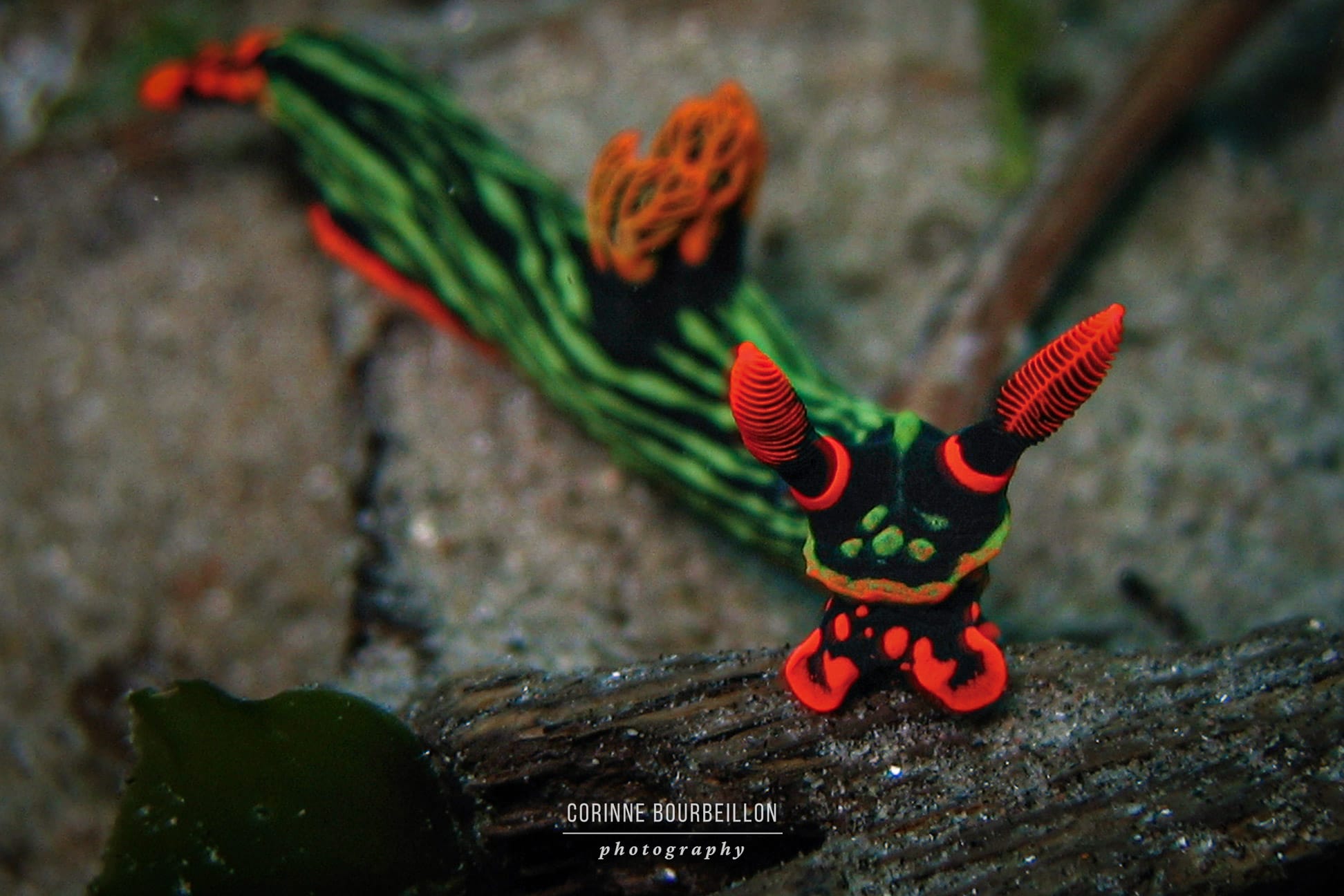
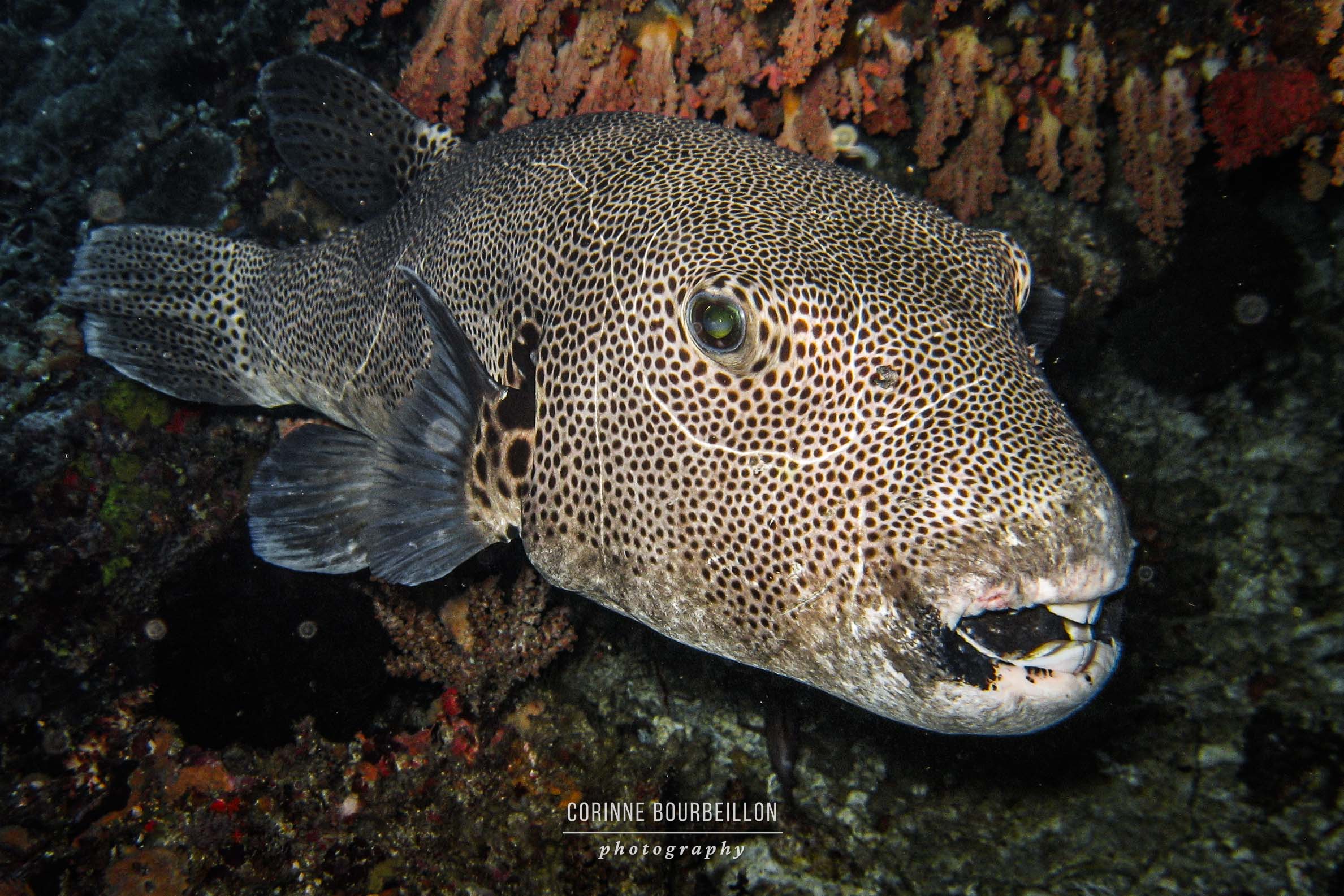
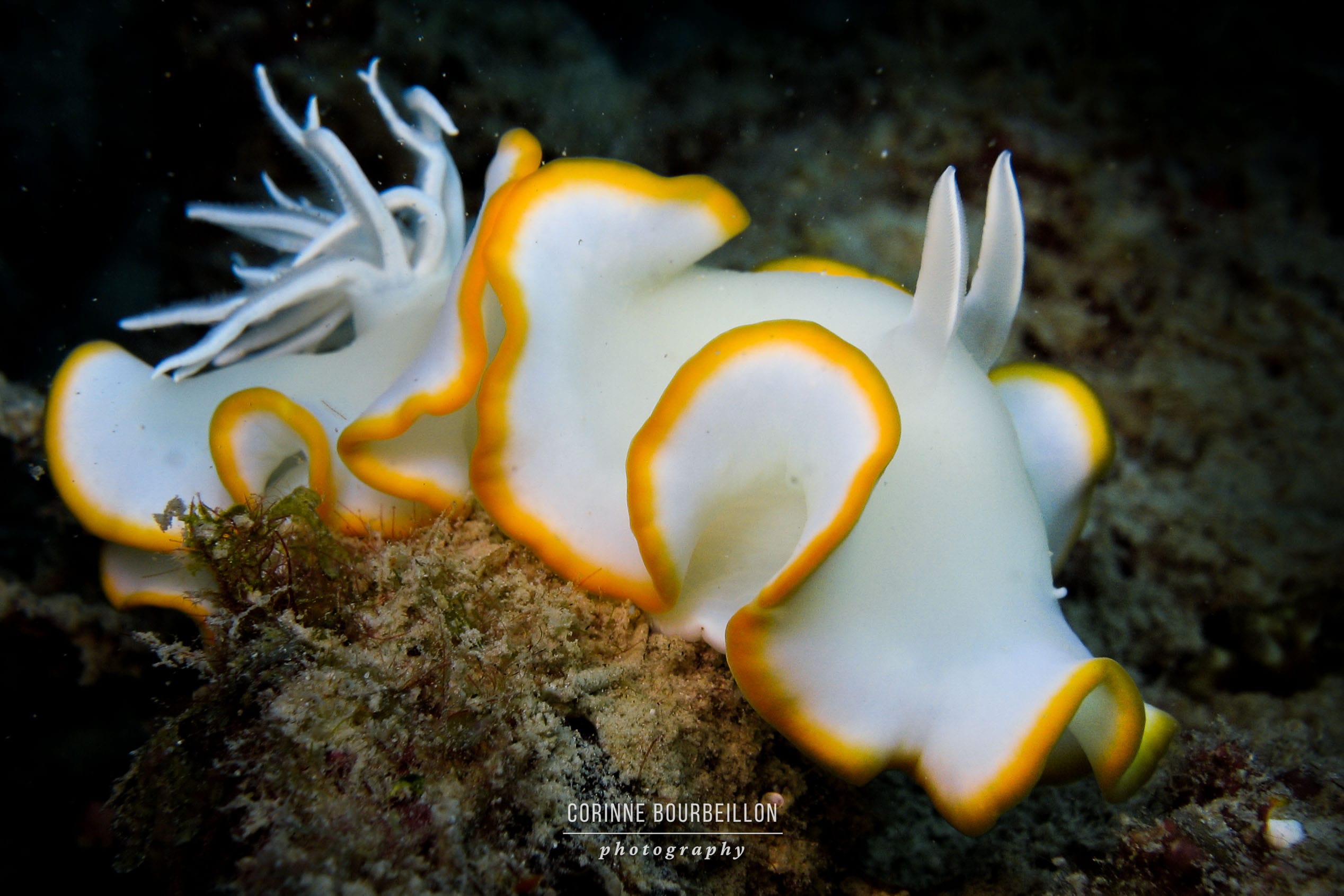
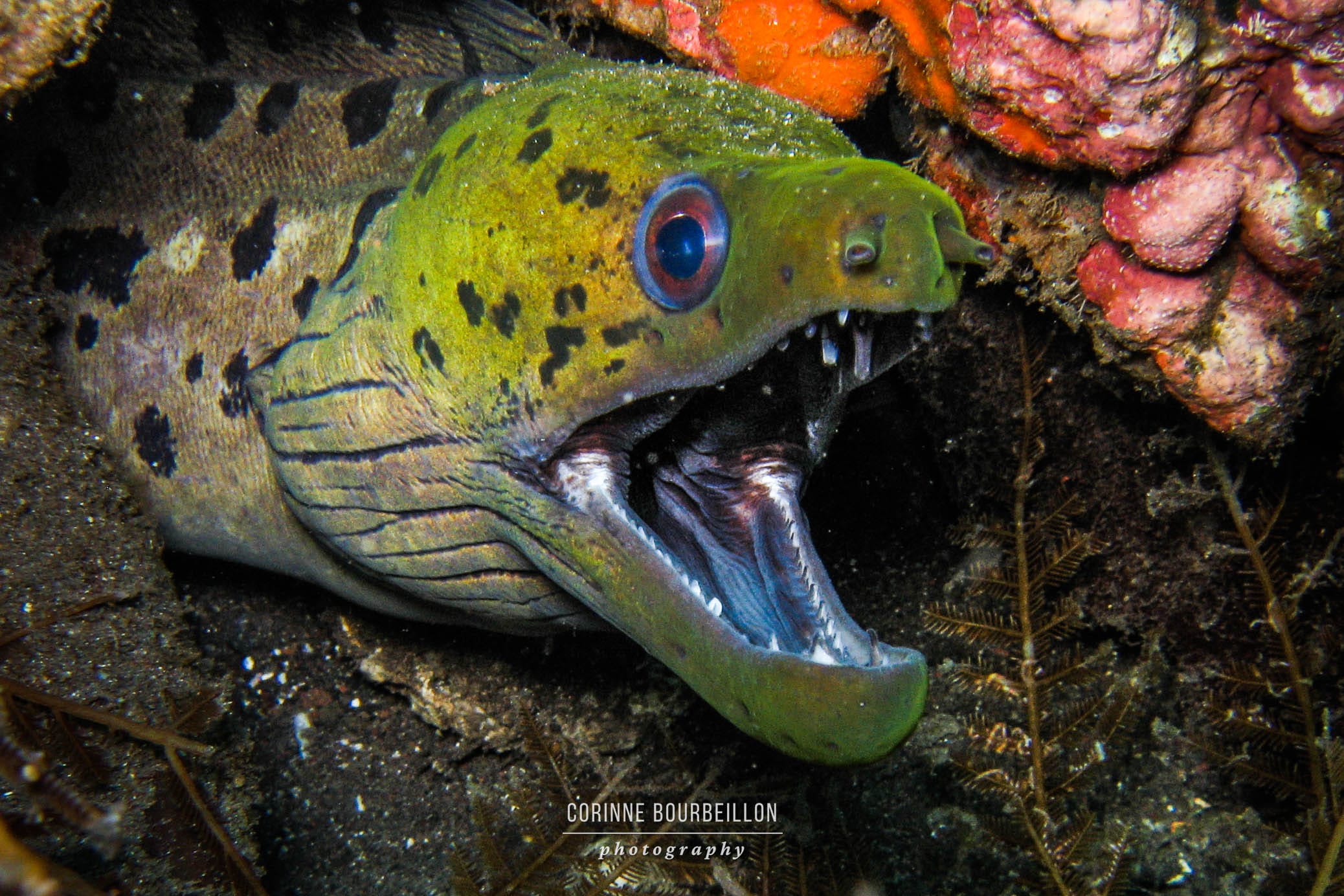
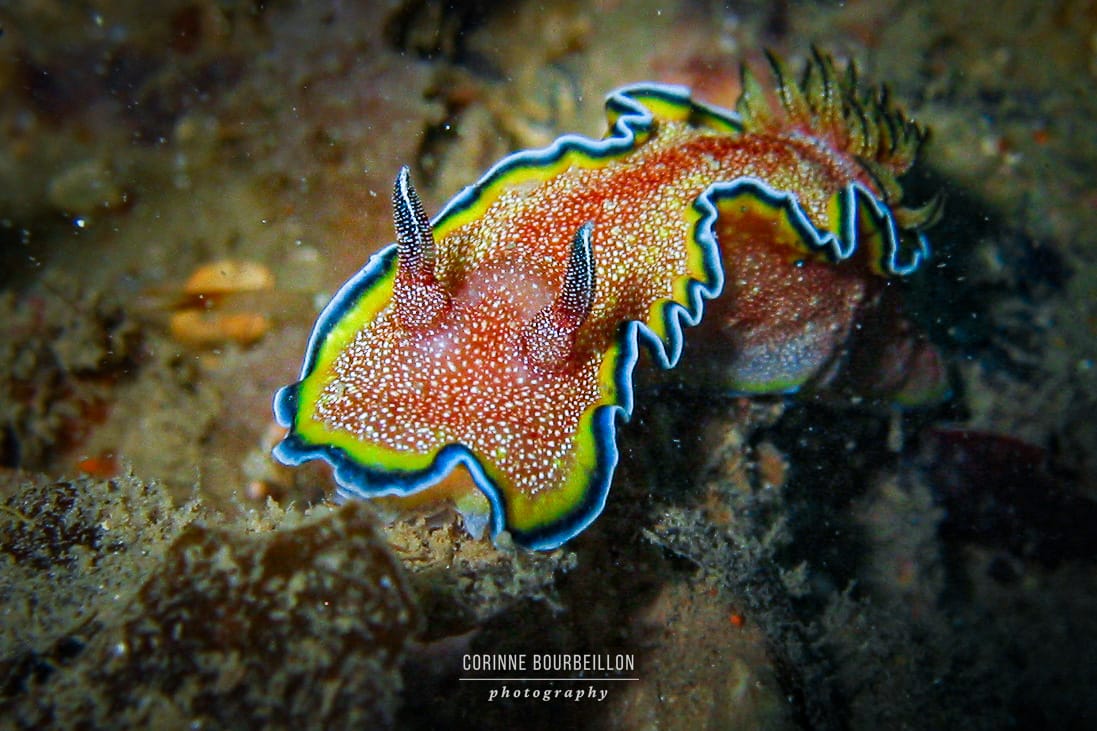
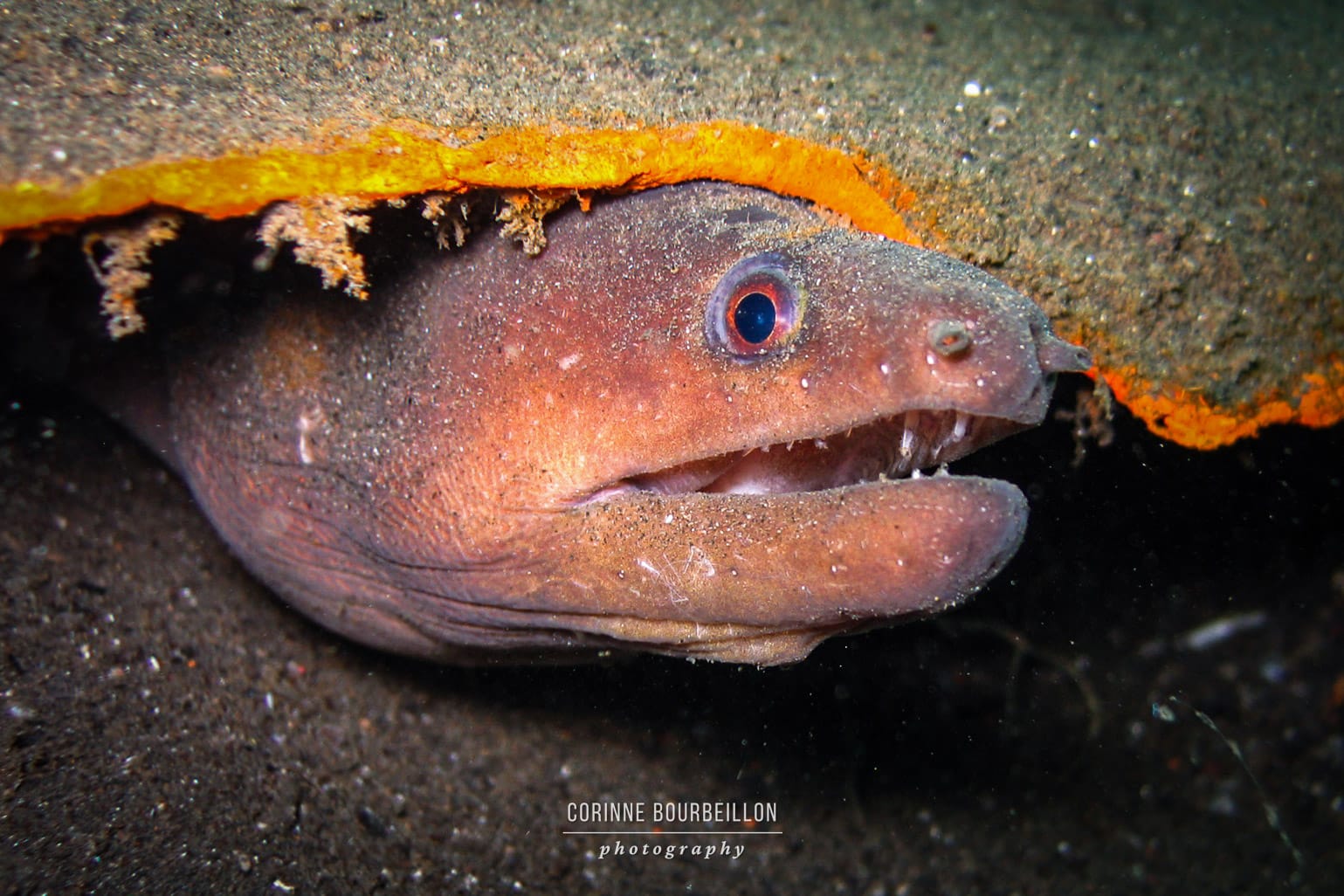
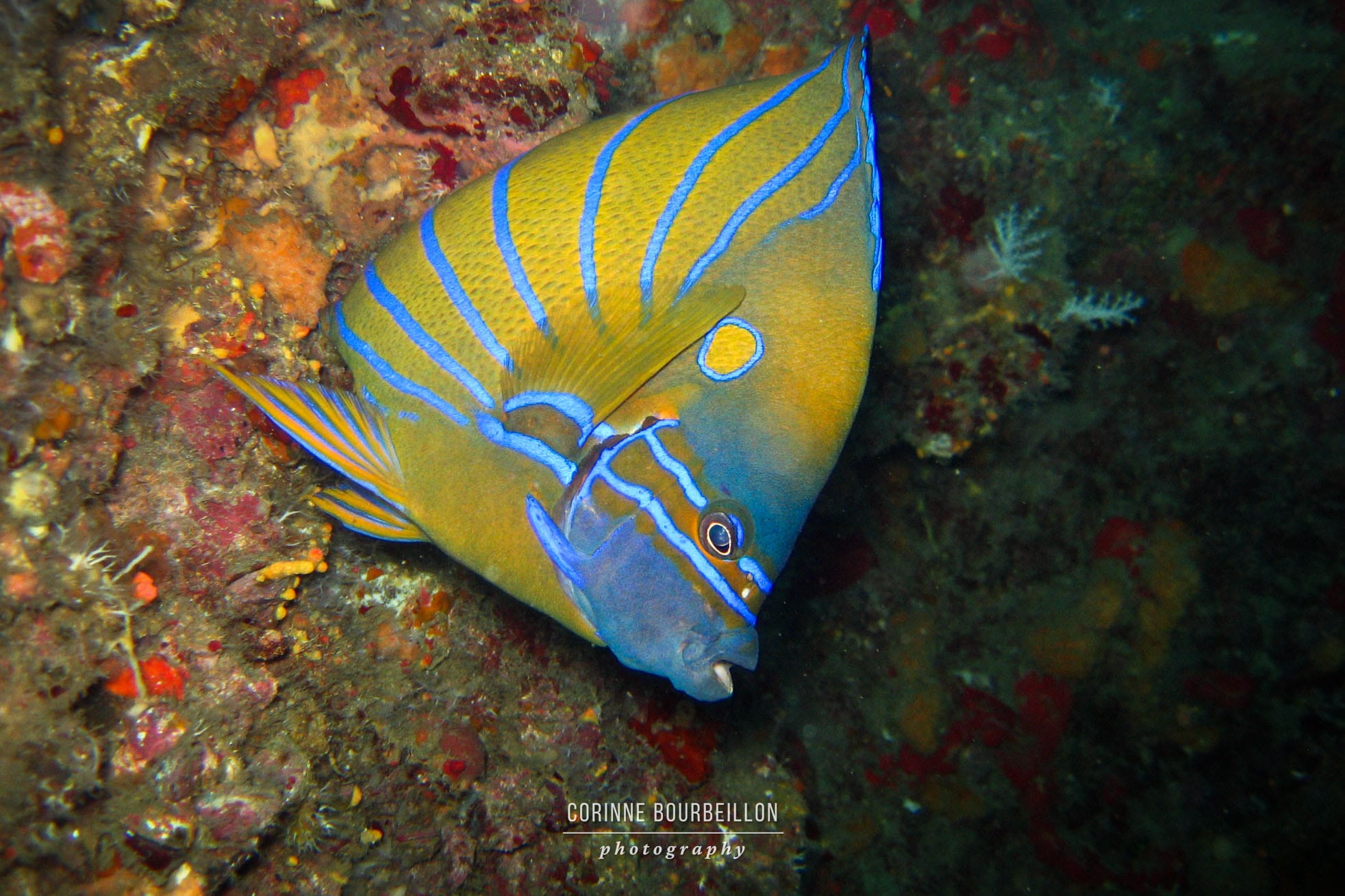
But I was pleasantly surprised, right from the start, by the quality of the underwater images obtained with this minimal equipment. I used it for four-five years and learned a lot with it. All the underwater photos below were taken with this little APN...
Photographing with a smartphone
The advantage of a smartphone for terrestrial photos: it's discreet and doesn't take up much space. These days, everyone has one in their pocket (which wasn't the case on my very first trips). You can pull it out at any time without attracting attention...
I invested in an iPhone X a few months after its release and was blown away at the time by the quality of the sensor, more than sufficient for the photos intended to illustrate this blog. Subsequent models have performed even better. I switched to an iPhone 12 Pro in 2023.
Diving equipment
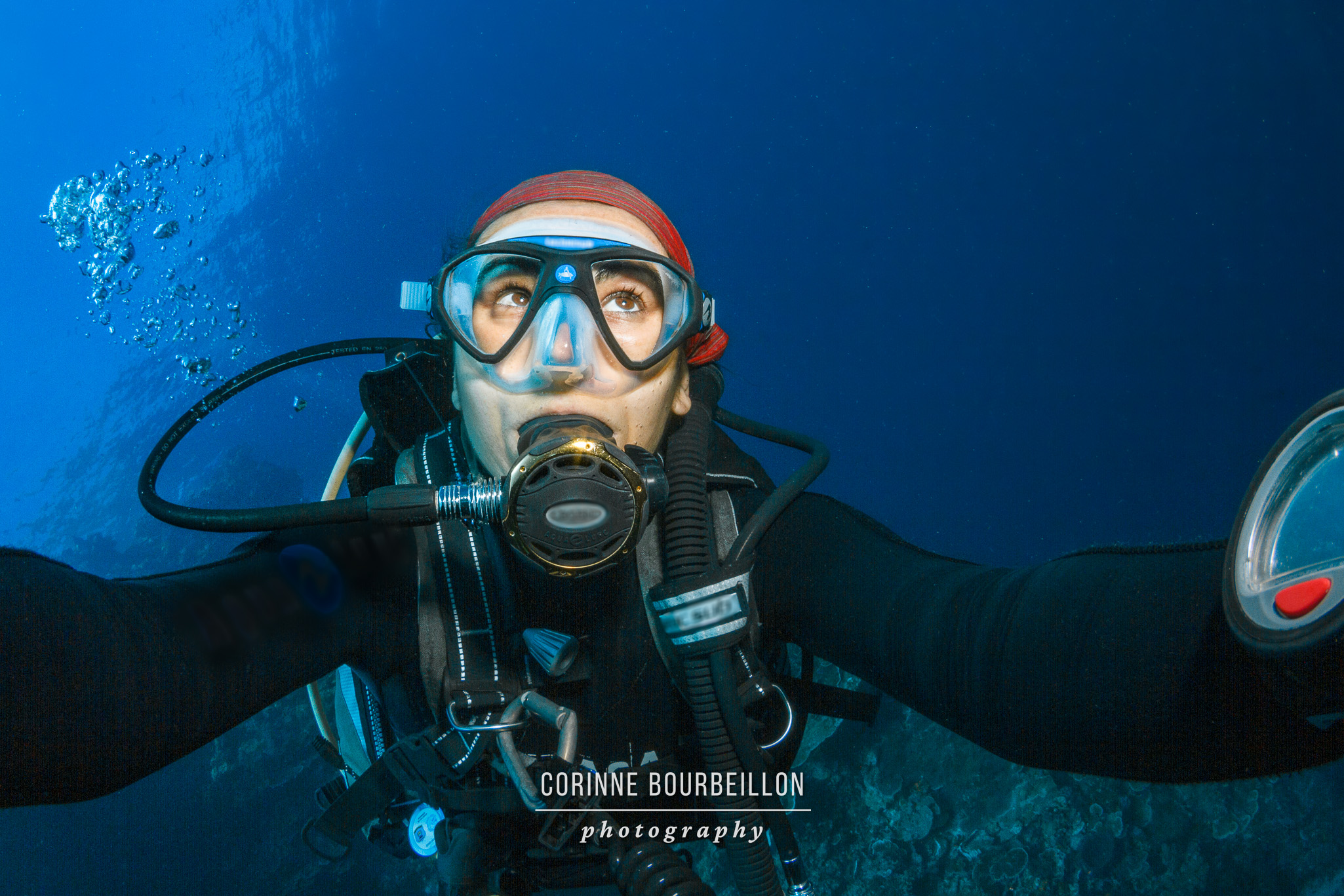
Regulator
I have a single regulator, acquired many years ago: the Aqualung Legend LX ACD in INT version, with Legend octopus and basic pressure gauge. Super-comfortable inhalation and exhalation, ACD system which prevents water from entering the second floor, I've never had any complaints. Its only drawback is that it's a bit heavy (2.1 kg).
The small, lightweight Mikron model hadn't yet been released when I invested at the time, and the stirrup mount was the most common in Asia, my main diving destination, hence my choice. Today, I'd opt for a DIN model, reputed to be safer. If necessary, adapters are readily available.
Diving computer
I now have two dive computers. In 2024, I spoiled myself with the Descent Mk3 from Garmin in 43 mm, taking advantage of a big promotion at the Salon de la plongée. The screen is easy to read, despite its "watch" size, and the connected functions are brilliant, allowing you to have your diving log directly on your iPhone (in addition to your other land-based activities).
This makes me redundant with my Quad of Mares (large, easy-to-read characters, nitrox mode available, you can change the battery yourself). The latter is still perfectly functional since it replaced my Puck, of the same brand, which I had quite unintentionally left somewhere at the bottom of the Red Sea in October 2016... I regretted it, I'd had it for quite a few years, it worked perfectly.
For the veterans: my very first dive computer was a good old Uwatec Aladdin, with its famous "fridge" look, which suddenly unlocked itself and went diving into a drawer on its own...
Buoyancy Control Device (nicknamed "BCD" by divers)
My BCD is a basic Seac Sub (it's not even listed anymore) on the BCD web page of the brand), found a long time ago, for very little money, in a large chain of sports stores (Décathlon).
Very sturdy, it's been working perfectly for years (it's my first, I've never changed it). It weighs only 2.8 kg, but I'm considering investing in a travel BCD or wing if I can get a lighter configuration.
Fins
To travel, in 2023 I tested the Scubapro Go Sport Boot-Fit, light and short (easy to carry), flexible just right, effective in the water. I approve!
I have long used a longer pair of Mares Volo Power, I really liked their great flexibility, but the fin part is starting to show signs of fatigue.
For drysuit diving, I ended up using adjustable fins RK3 HD from Apeks (in size M). They're short and a little heavy, ideal for weighting down your feet where you don't want air to accumulate in this configuration.
Booties
For a long time, I kept trying new booties... All of them hurt me, there was always a seam or a reinforcement that created a blister in the long run.
Except for Ellie Ergo from AqualungI've definitely adopted them since 2015. No seams or zippers. The neoprene is super-soft, so they slip on like socks! But they are fragile: after a few dives, the inner lining frays and the reinforcement on the top of the foot comes off. So I replace them regularly.
For drysuit diving, I have "rock boots" adapted to my Fusion drysuit.
Mask
I've had Aqualung's Micromask Technisub (small, easy to empty, well-suited to my face) for ages. With its yellowed silicone skirt, you can tell it's not brand new, but it's still functional.
It doesn't seem to be on the market any more, but you can find the equivalent in many other brands: look for small masks with little volume, designed for freedivers, such as the X-Free from Mares which I also have, in redundancy.
Wet suit
For waters that I consider "warm" (i.e. above 25-26° C), I always wear 5-6 mm wetsuit. I add a shorty above it or a neoprene undergarnment beneath, or both, when the temperature drops into the 20-24° C range. Since 2015, I've adopted the Focea Comfort by Beuchat, the cut fits me well (size M).
Dry suit
For my dives in "cold" waters (14-20° C). After testing Aqualung neoprene drysuits, on loan or rental, I bought an old, second-hand Whites Fusion.
Whites is a Canadian company that was taken over in the 2010s by Aqualung of France, which then marketed Fusion drysuits for several years. In financial difficulty, the Aqualung group was subsequently bought out by various investment funds (the British Montagu at the end of 2016, American Barings end 2023). As a result at the end of 2023, Whites reclaimed its brand, with plans to relaunch the manufacture and marketing of Fusion drysuits. The company is now called Whites Drywear.
I hope we'll soon find Fusion again in France, as I like the design. I'm thinking of buying a more modern version of mine one day soon. The ones now on the market in the US feature a high-quality bilaminate coating for the waterproof shell, as well asand Si-Tech sleeves that you can change yourself. To be continued.
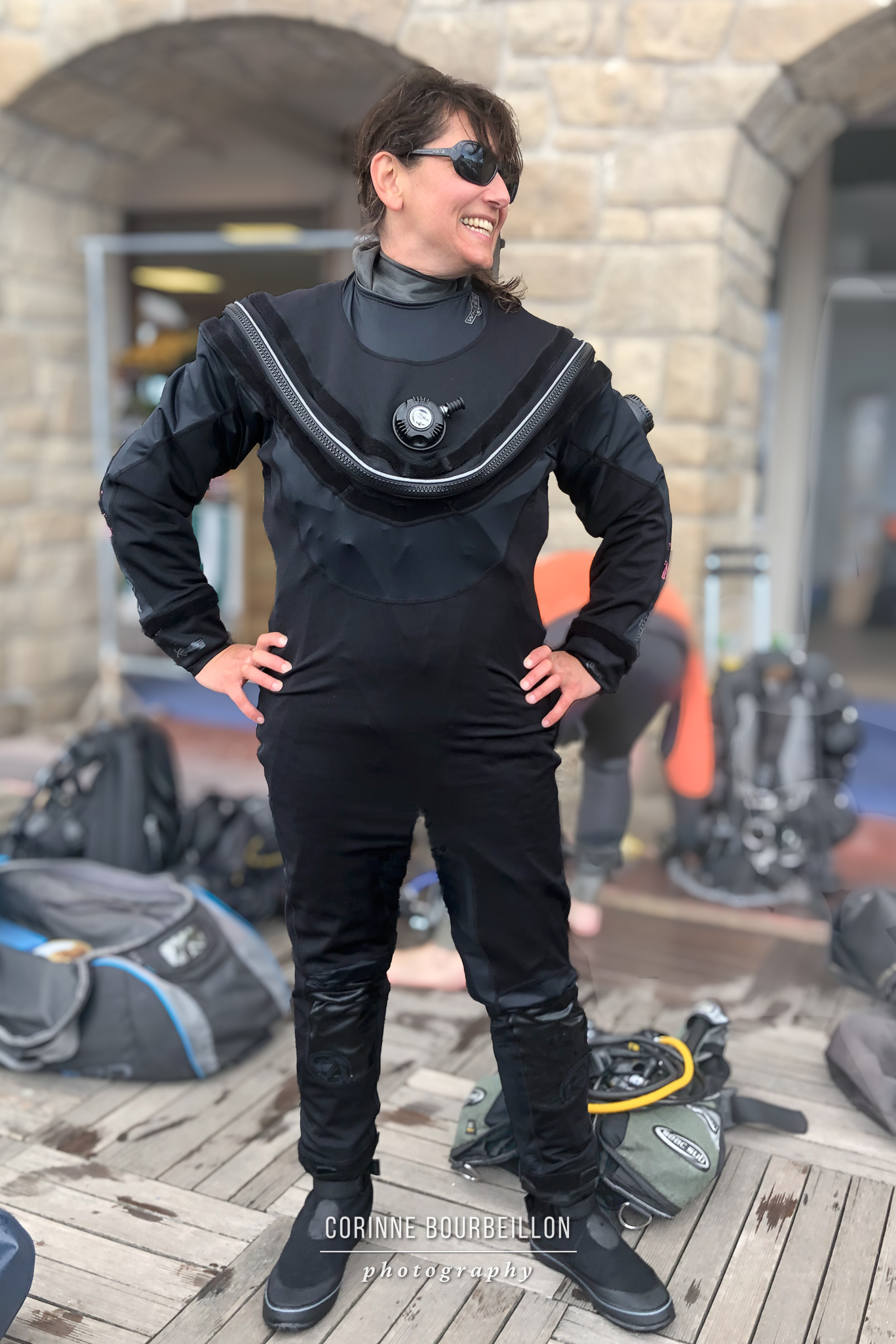
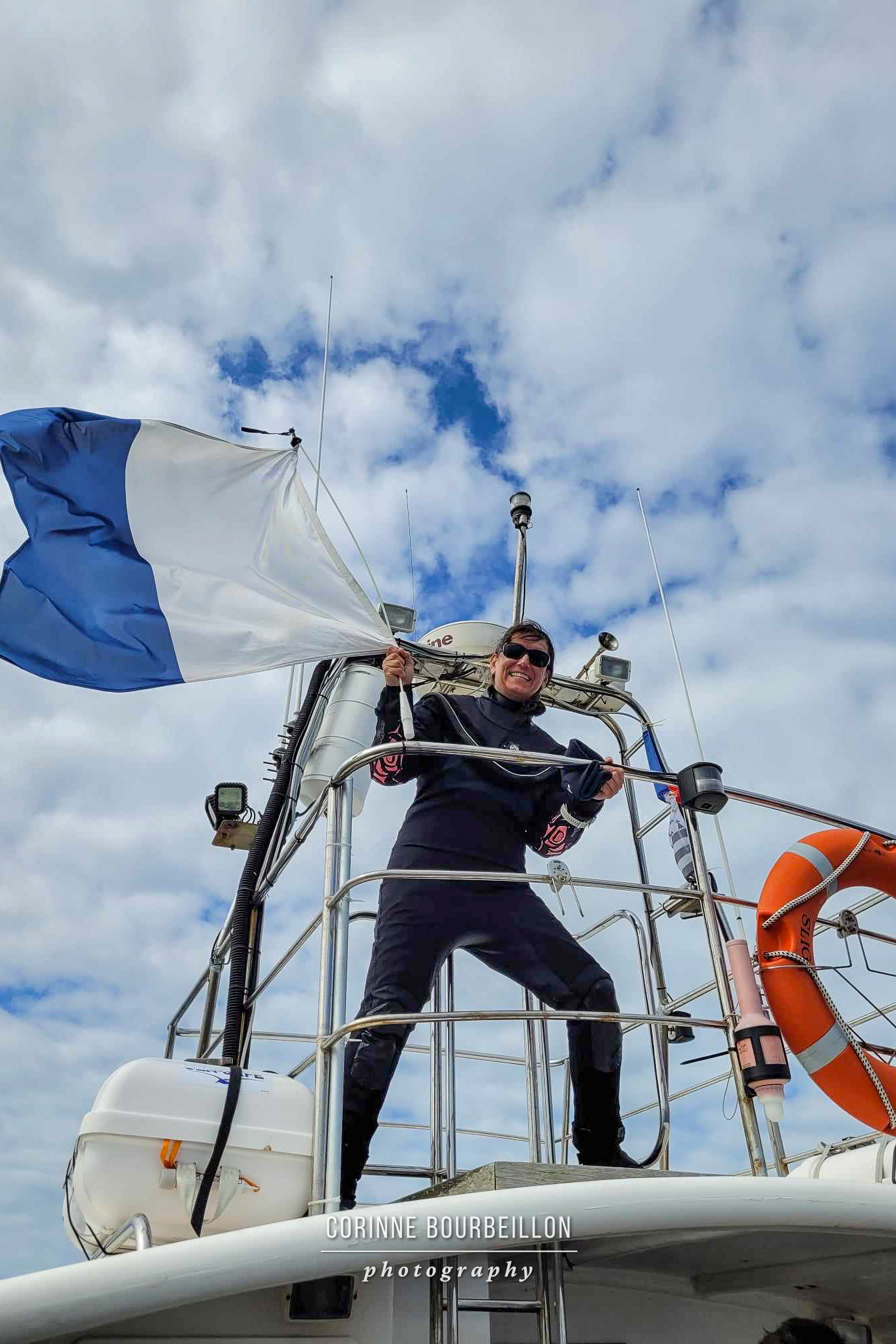
The special feature of this wetsuit is that it consists of a fairly large watertight suit, with a sort of elastic second "skin" over it, made of very thin neoprene. This makes for great ease underwater, as the elastic overlay holds the air bubble tightly around the body, without constricting or impeding movement. It's ideal for my underwater photography contortions, and feels as comfortable as a wet suit.
This design also has an advantage over tailor-made or tight-fitting drysuits: you don't have to change it if you get fatter or thinner. Of course, you need to dress warmly underneath, as the second "skin" is 1 mm thick and offers no thermal protection. After a lot of trial and error, I adopted thermal clothing Kwark (Polish brand)...
Accessories
In bulk: a stick or "pointer" (a metal rod used for a variety of purposes, very useful for a foothold on the sand when photographing underwater, to avoid touching anything), a 2.5mm neoprene and/or a Sharkskin top that I can put under the wet suit, hook, parachute, small flash-light, whistle, mirror, blade, octopus attachment, snap hooks diverse and varied, hoody and headbands-scarves for hair...
And to transport all this?
I equipped myself little by little, both for diving and for underwater photography. As a result, my luggage has gradually grown too. I'm not at all a backpacker anymore...
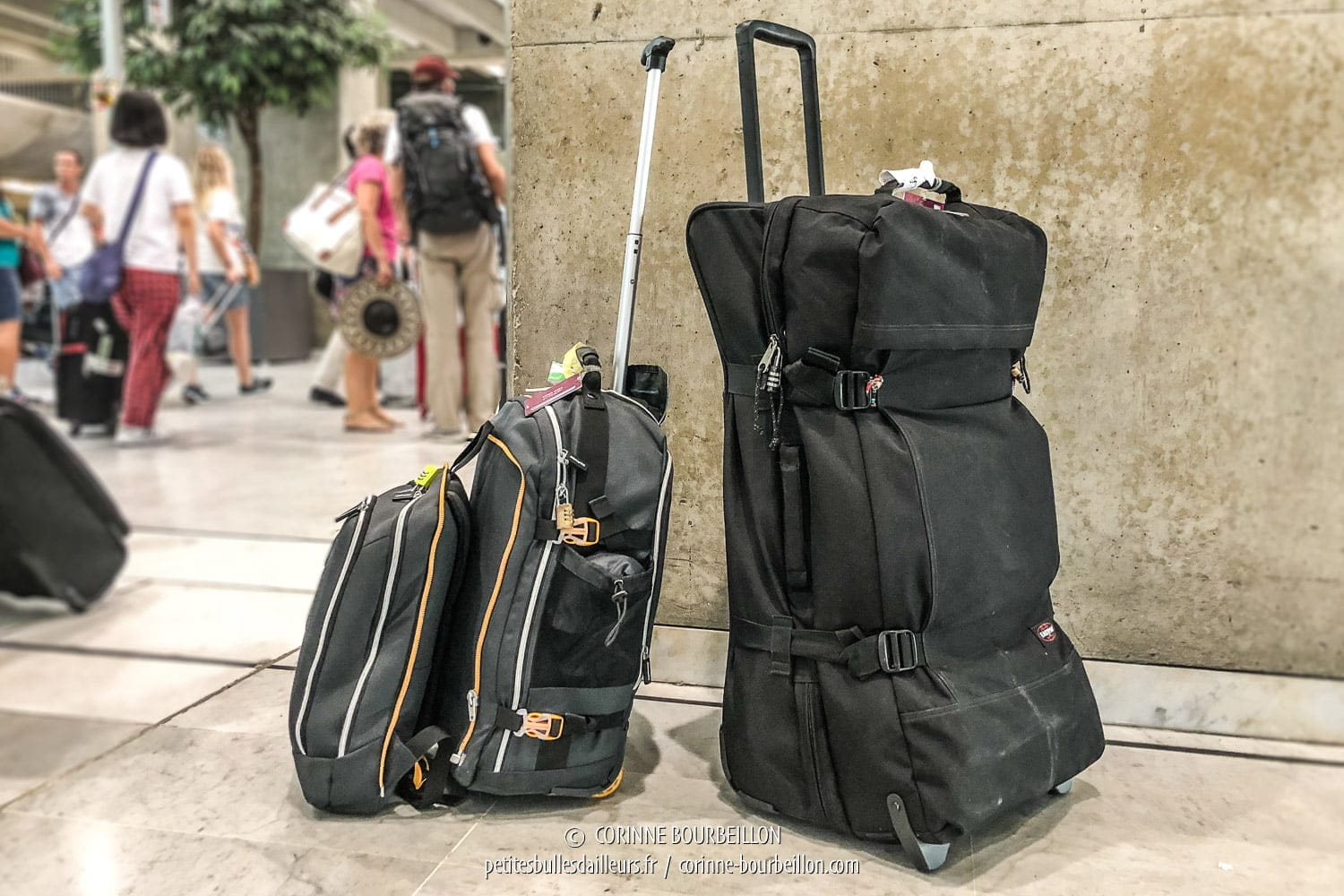
I've reviewed my logistics for transporting all my little junk and opted for wheels! I invite you to read the two articles below where I talk about it:
➜ Packing: Which Dive Bag Is Best for Travelling?
➜ Luggage for divers: out with the backpack, in with the roller bag!
😝

Hello,
I just visited your blog via "a world away", and as I saw your stories and photos about the Lembeh Strait, here is a link from a friend who has just returned from there: http://www.aquatilia.com section: themes
You will not be disappointed.
A + FREd
Hello Fred-Divemanche,
Sorry, your comment landed in "undesirable", I only just realized it! Here it is finally online...
🙄
We sometimes meet, as well as Aquatilia, on the forum Plongeur.com... I knew his site, but it's been a long time since I visited it. So thanks a lot for the link. It allowed me to see his latest pictures, superb, as always! I must say that Lembeh is an exceptional playground for diver-photographers.
It is with great pleasure that I found on Claude Ruff's gallery alias Aquatilia all these small animals that I love to flash... With a big crush on the pygmy seahorse and the couple of mandarins!
I'm thinking about creating a special "underwater photos" links section on my blog, to put the sites of divers-photographers that I like...
🙂
Good evening,
Yes, the pigmented seahorse had to be found. For your information, Claude is organizing a little like Marie-Ange (Maurice) a photo trip to British Columbia (Canada) in May 2009, with famous photographers... To my knowledge, there are still 2 places left, if you are as interested in cold seas as warm seas...
Regards 8)
Fred
Thank you Fred-Divemanche, for reporting this photo trip! The experience must be exciting, but indeed, cold seas are less in my range than warm seas...
😀
Hi, I just discovered your site by chance while looking for information on Sipadan and I want to congratulate you, it is very well done. You are a great traveler apparently. It would be nice if you could give me some information about Borneo, I'm a diver too and I'm planning to leave for Malaysia and Thailand for 4 weeks in January.
Voilou!
See you soon.
Hello Jean,
And thanks for leaving that nice note during your visit!
Borneo and Thailand, you will enjoy it! The best thing would be that you send me a message with the questions you have, with precise questions. If I can help you to prepare your trip, and bring you answers, it will be with pleasure!
You can use the contact form (click on "Contact" in the top horizontal menu), or write me directly by sending an e-mail to this address:
corinne@petitesbullesdailleurs.fr
🙂
Hello Corinne,
bravo for your site which is always pleasant to read. I just came back from sipadan and redang where I spent a very good vacation and I'm thinking about buying a housing for my 7D. I would like to know your opinion on the ikelite housing you have but also the + and - to switch from a compact system to an SLR system (under water of course). Are you disappointed with some things?
Thank you in advance.
Sincerely.
@Safe: I will soon have a more complete article on the Ikelite case for the 7D.
- The + : well, it's a bit the same thing as in terrestrial, the same reflection to have as when you switch from a compact to an SLR (it's only worth it if you are a bit of a photographer at heart, and if you can afford to invest in good lenses, because if not, you can find very good compacts to make nice pictures too).
• The -: the price and the weight.
I'm not disappointed with much so far. I take great care of the housing, which I guess is a bit fragile (I already had to patch up a few things on it). But overall, it's fine and I'm very happy to be able to take my 7D underwater.
🙄
Hello! I also use a 7D, but not underwater, I was discouraged by the price of the housings until now. At a much lower price, the Gopro is very nice for shallow diving (I went up to 20m but it lacks light to get a quality result). I am still curious to know what you have to say about the 7D housing!
A +
Julian
@Julian: The problem with a GoPro underwater is that it will struggle for colors and light. But it's for sure that it's a hell of a budget. I stayed 4-5 years "playing" with my little compact camera before breaking my piggy bank for the SLR and its housing. And I must say that I don't regret it. I'll really have to do a complete review of the housing and the 7D soon... (Ah, why are the days only 24 hours long ?)
🙄
Hello Corinne,
you were one of those who made me want - over time and reading + not decent chatter in front of your shots - to invest in some really good camera equipment... I have a new friend since a few hours: a Canon 7D 🙂
The box ... it will be the next big investment!
Thank you for that naughty influence, missy!
NowMadNow
Hi Aline,
I'm flattered to be such an influence...and funnily enough happy to hear you have a new travel companion!!!
You'll see, he's fantastic. Every day I keep learning more about him... I never get tired of it. And I continue to progress little by little.
Enjoy !!!
🙂
Hello!
Waiting for the article on the box: The question that is on my mind when I see your picture with all your material is obviously: how do you transport all this? You have a Japanese suitcase (2m x 1m)
I just read at the same time that you put it in your cabin trip ... and me who found that my luggage cabins were too crowded!
@Julian: 😆 In fact, in front of the check-in counters at the airport, I nonchalantly carry a backpack on my shoulder that contains all the fragile part of my little photo junk, pretending it doesn't weigh anything at all... Usually, I manage to fake it... 😀
Go see these two articles where I explain a little how I distribute this bulky equipment:
https://petitesbullesdailleurs.fr/dans-mon-sac/
https://petitesbullesdailleurs.fr/le-sac-20100307/
Hello !
I'm a little late, but I just bought the WP-DC50, a good opportunity, and it's also the way to give a second life to my A95 locked in the back of the cupboard.
On the other hand, I don't have the manual of the box. Do you have a site to recommend, or good advice, for its maintenance?
Thank you for this site that I always take pleasure to consult
@Vanessa: for maintenance, rinse carefully with fresh water, playing with the buttons. For advice, there are plenty on the excellent forum of the photo sub : http://forum-photosub.fr
🙄
Hello Corinne,
I just looked at your blog and would love some advice from a professional like you.
Here I am, I'm going to film a freediving champion and I've never filmed underwater before.
I am a professional cameraman but I have to buy all the necessary equipment for this shoot because usually I shoot with a Sony Z7.
Could you advise me on the right equipment to shoot underwater with a Canon 7D? Lens, housing etc...
I saw the material you were using but I don't know if it is suitable for video as well.
Unfortunately, I have a limited budget of between 1,200 and 2,000 euros for the whole thing.
Thank you in advance for your attention and the time given to my request!
Best regards,
Jean Baptiste
Wow I am really impressed with your marine photography equipment. As a photographer myself, I know it's a lot to lug around as a camera, but the result is really worth it, especially for the prints. I also travel with a compact camera and a small canon D30. I don't dive, but it's fun to snorkel 😀 The concept of your blog is great!
Hello Corinne, I am impressed by your blog!
Indeed I start underwater photography and I must say that it helps me a lot for my first experiences with my compact Nikon and my Canon eos 100D. I look forward to your next articles!
Congratulations for your site full of happiness and joie de vivre.
Everything is qualitative, thank you very much.
What about diving is South Africa? ( Protea banks) 🙂
Hi Corinne
Your blog is simply GREAT!
A wealth of information, attention to detail, everything I like
Besides we have the same gear, I started with a 7D + Ikelite in 2011
I changed for the 7D M2 in 2020 (I preferred the old housing for the flash adjustment bar at the back)
As I'm getting ready to leave for Lembeh, I came across your site thanks to the photos while looking for a sling
I was caught up in your article on the "thorny" subject of luggage...
That was my wink
Stef de Haute-Savoie