

Weda Bay between two dives

 EN
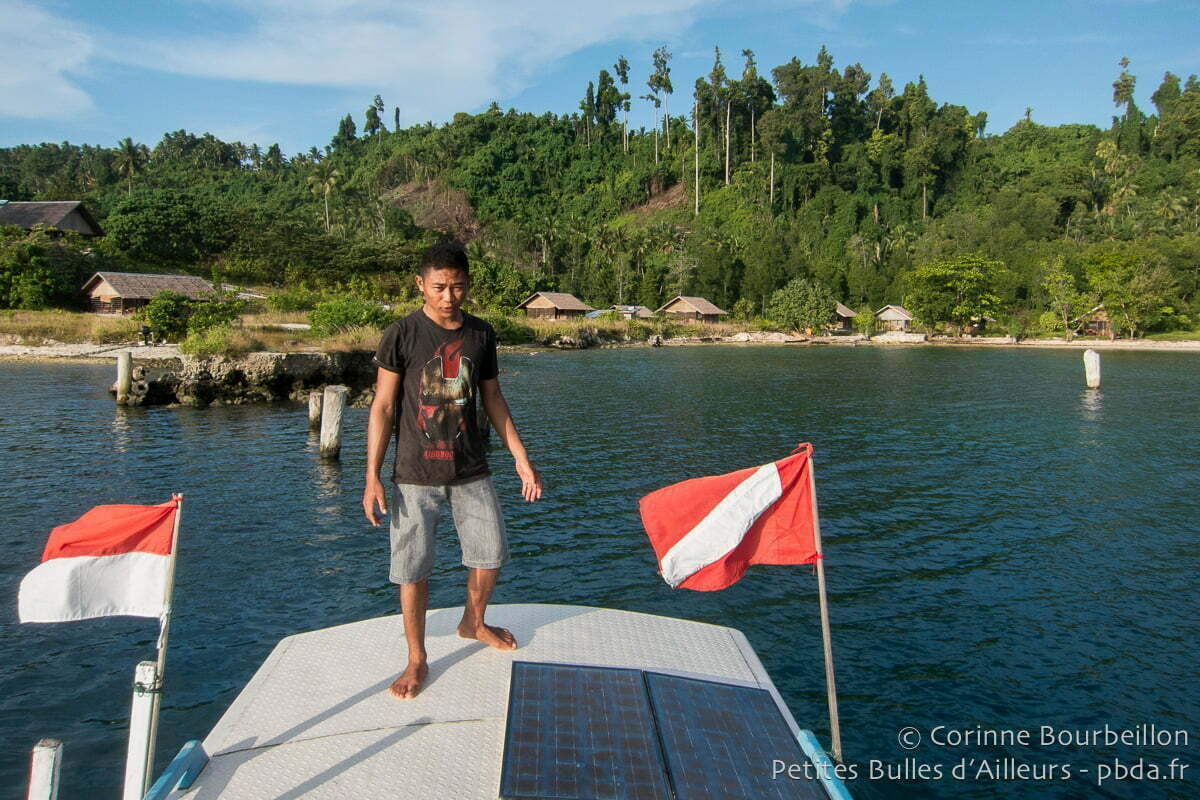
ENI like being underwater. But I also like to be ON the water. Between two dives, in Weda Bay, I enjoy sailing from one reef to another, from one cove to another, under the Indonesian sun.
Sailing on a dive boat
It was March 2013. I'm taking you back to Weda Bay in Halmahera, the large island in the northern Moluccan archipelago of Indonesia.
I'm staying there, at Weda Resortfrom where we go diving in the bay every day:
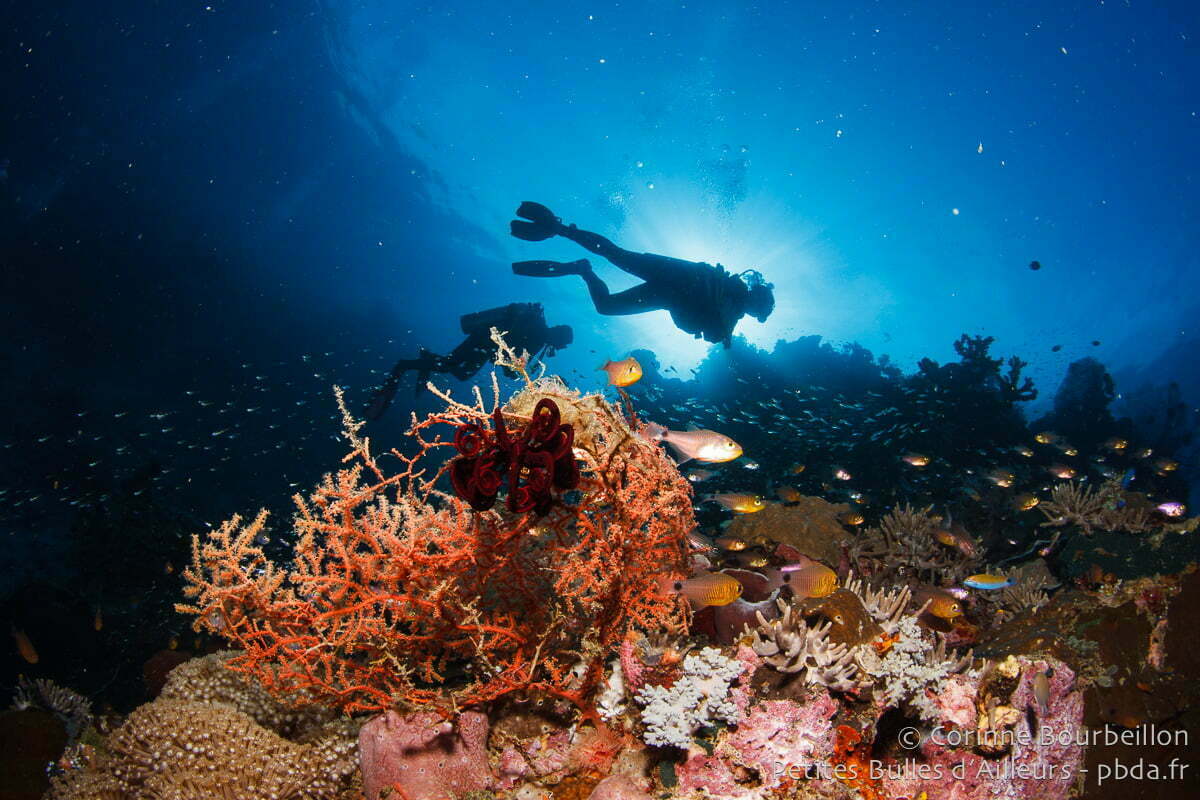
Underwater, I marvel at the beauty of the underwater world or tiny creatures like the seahorses-pygmies.
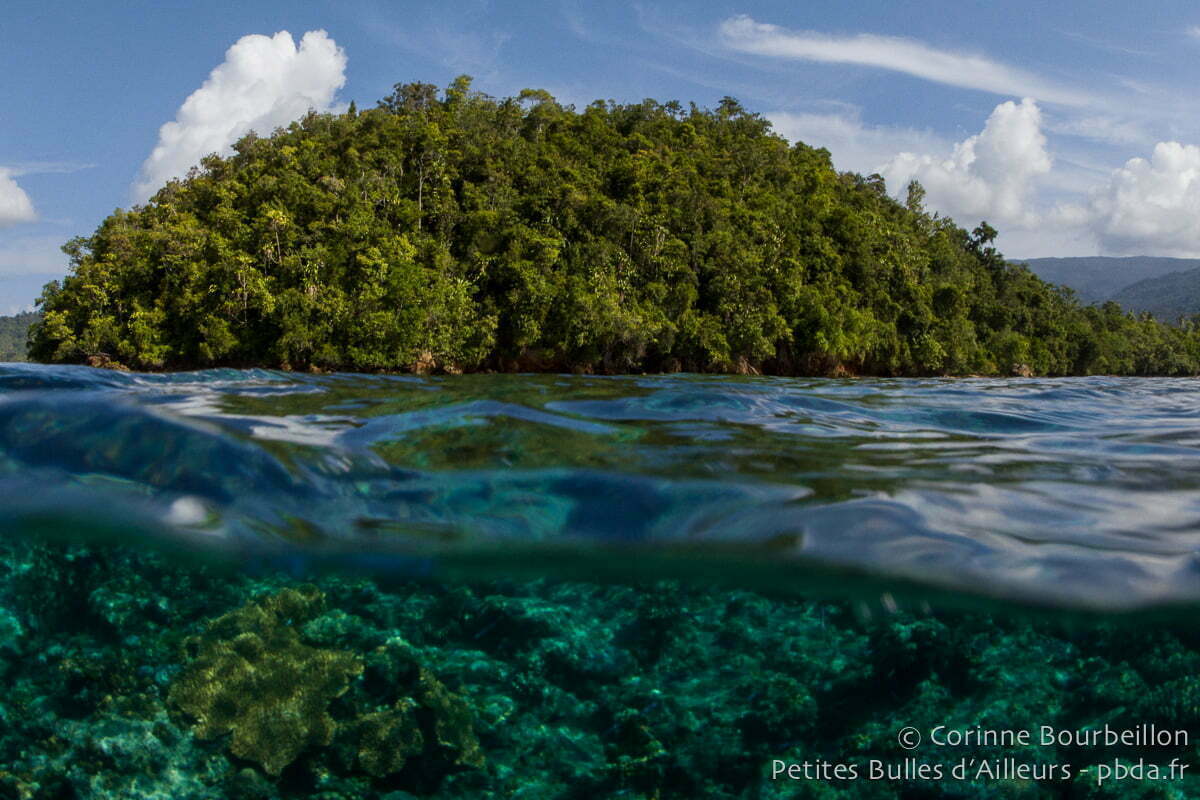
But on the water, I also marvel.
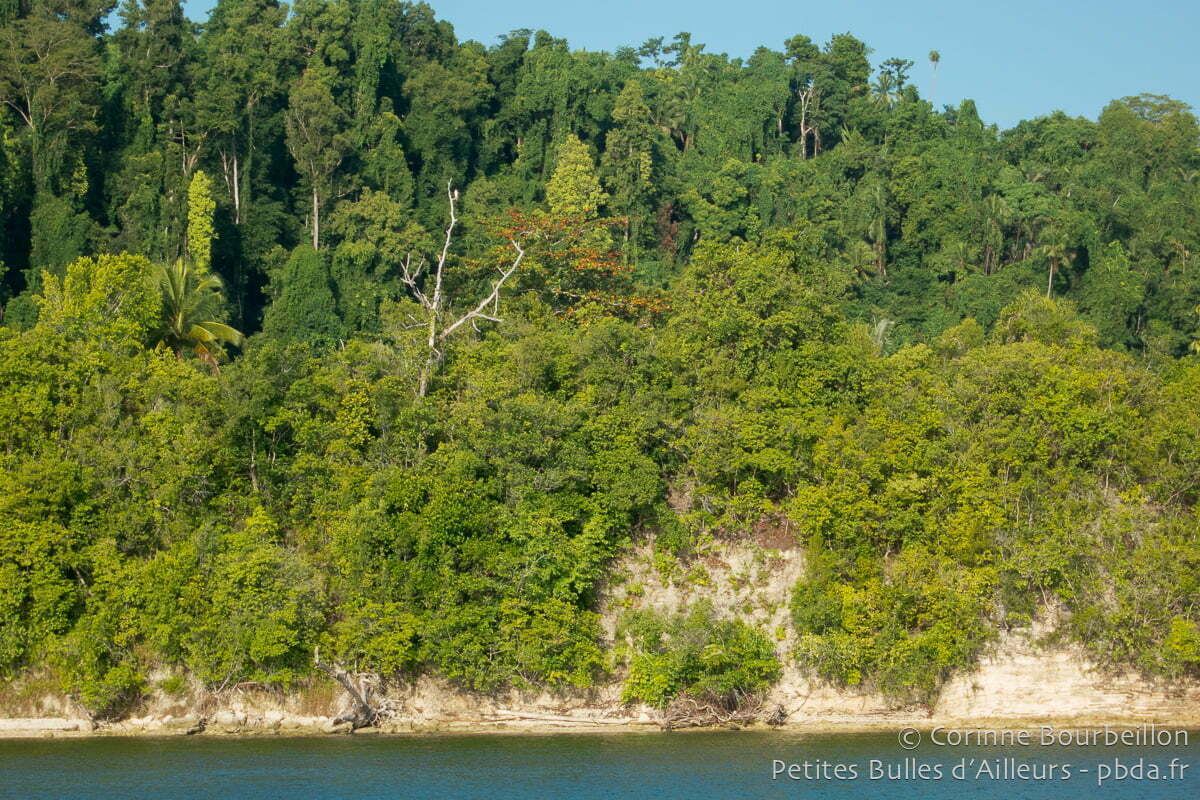
I love being at sea. I love being on a boat that sails to the end of the world. I love looking at the horizon and the wake as we cross the bay, I love watching the forest go by as we sail along the shore, not knowing yet what we will discover.
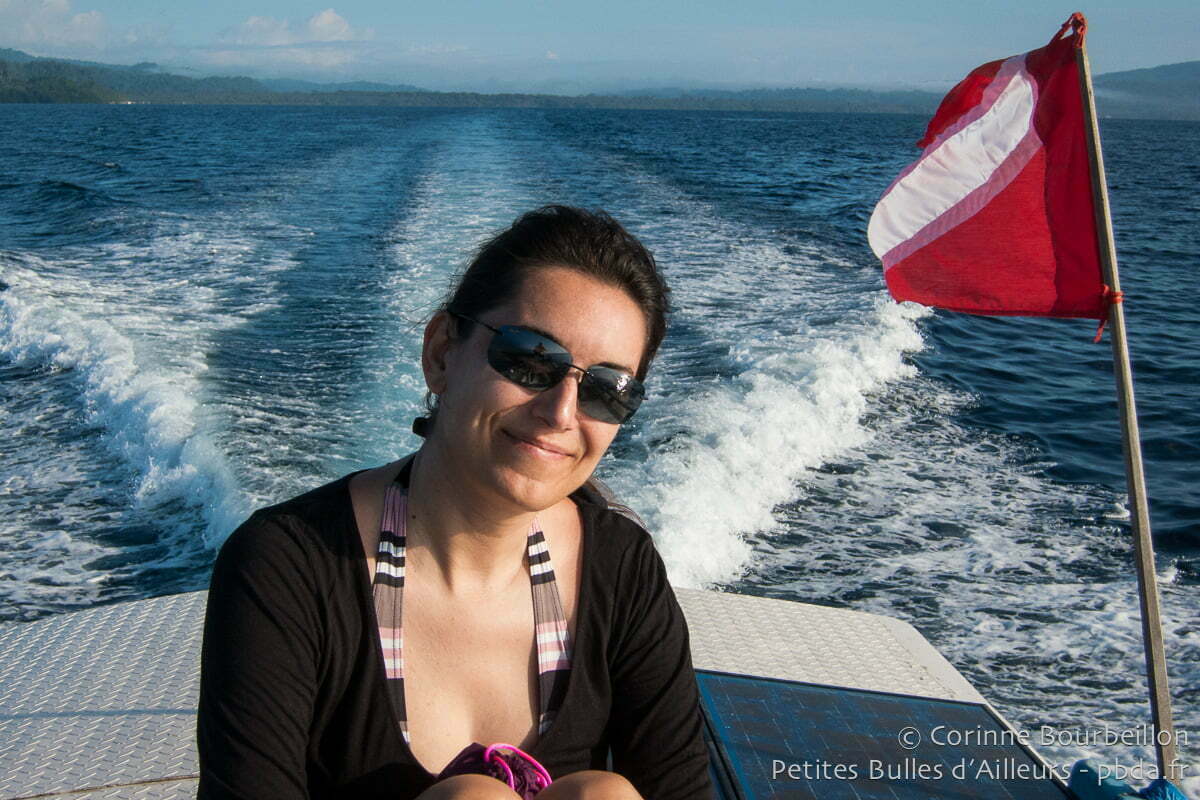
The atmosphere on the boat is nice.
We are a very small group. Four to six divers depending on the day, our two Indonesian guides Johnny and Radyal, two crew members, and sometimes Rob, the owner of the Wesa Resort, who joins us as a guide when needed.
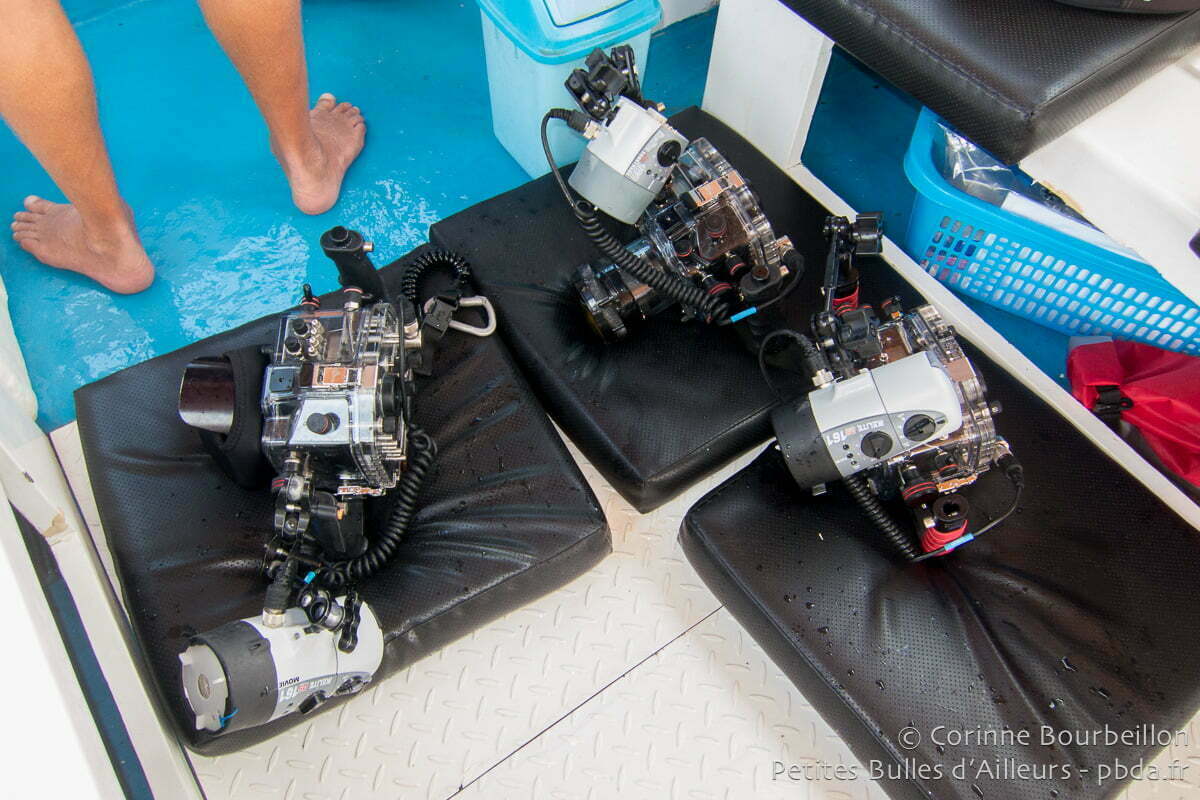
I note with amusement that I'm not the only crazy underwater photo lugging my Canon SLR in a bulky waterproof case in the depths of Indonesia. On the boat, a Dutch couple has the same Ikelite equipment as me for their Nikons. On the left, my camera, on the right, theirs:
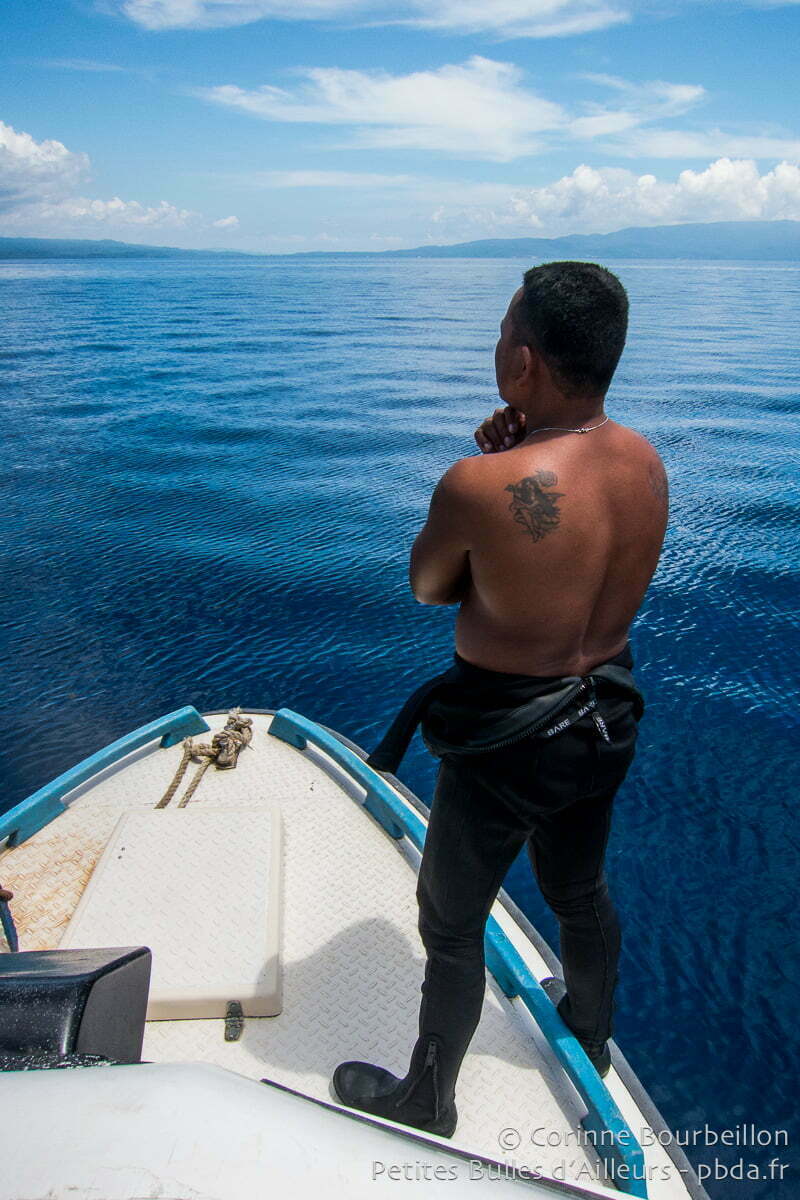
Between two dives, we make friends, we talk nonsense, we take pictures of each other... We enjoy the pleasure of being there, far from everything, with our noses in the wind, under the sun.
Happiness.
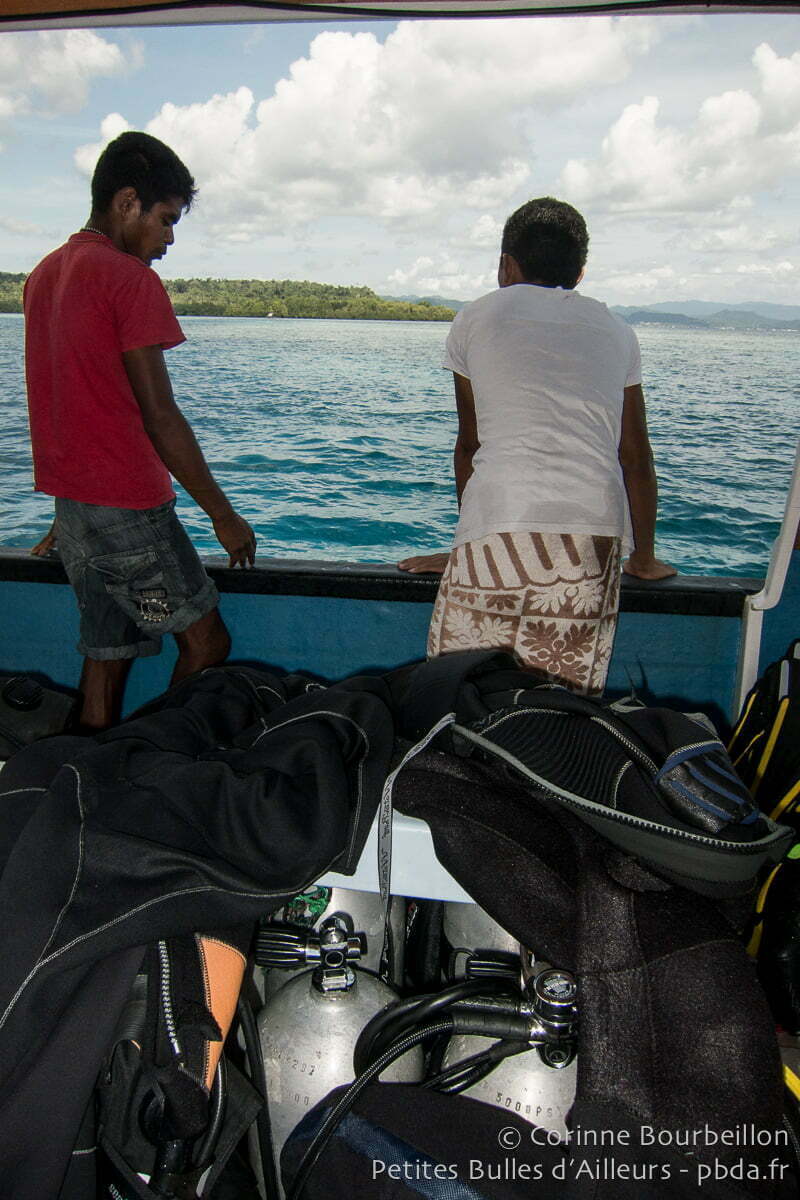
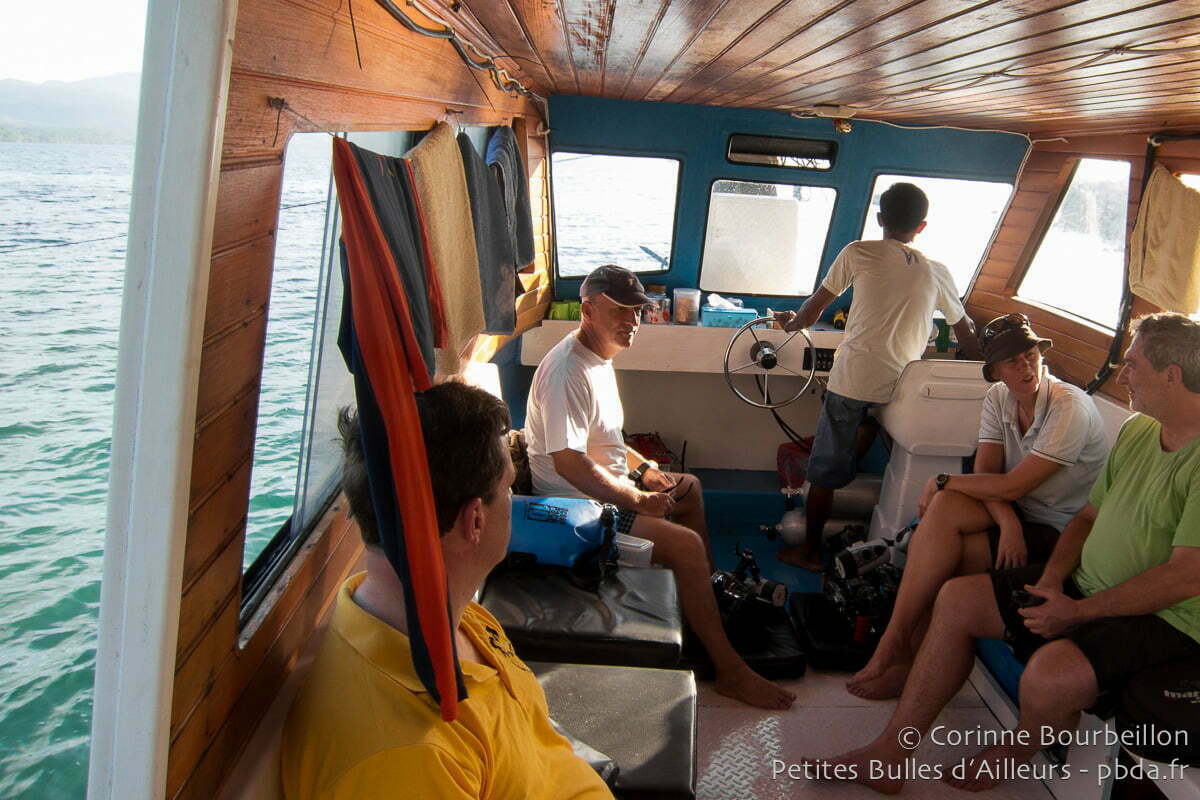
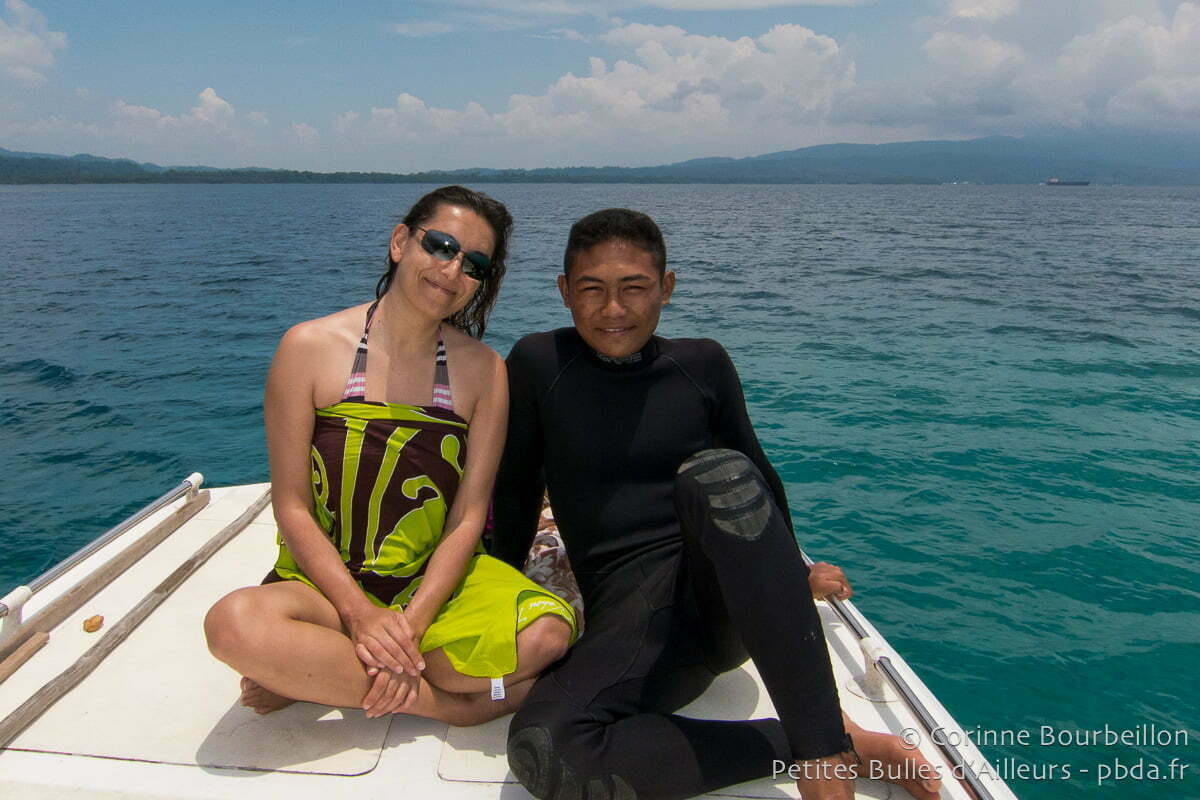
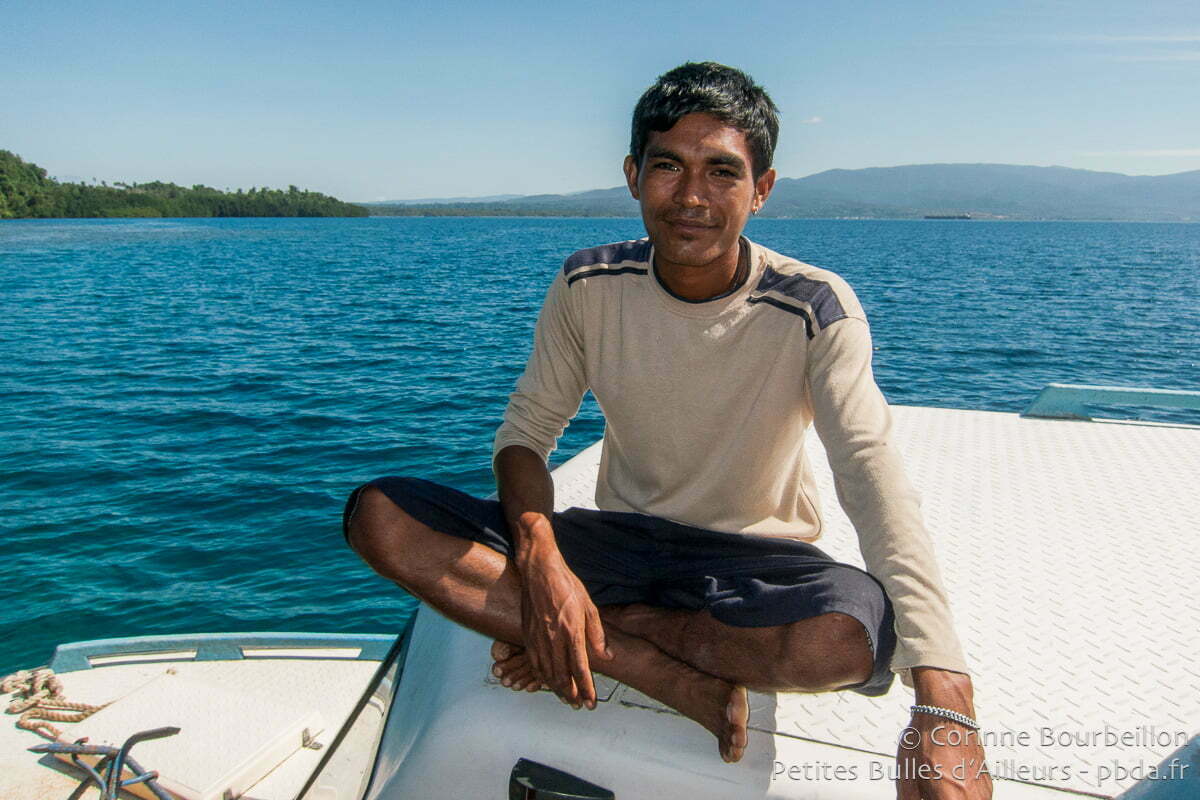
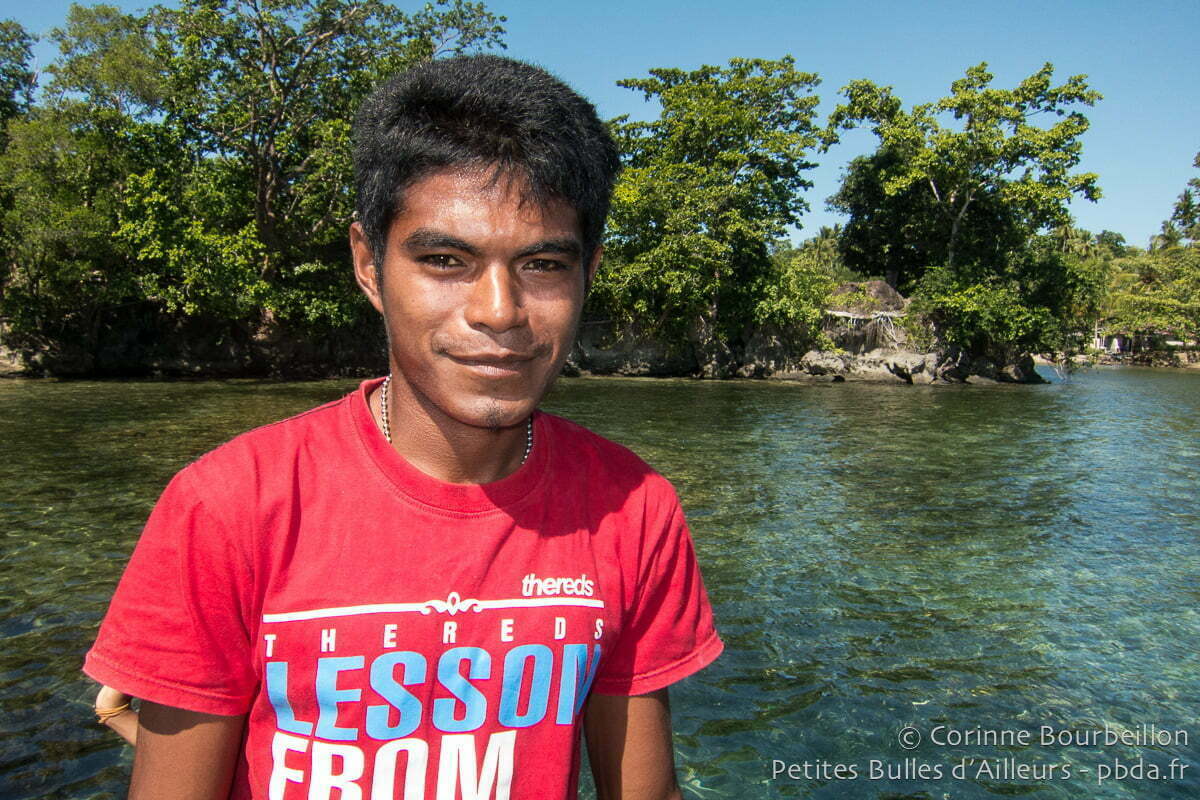
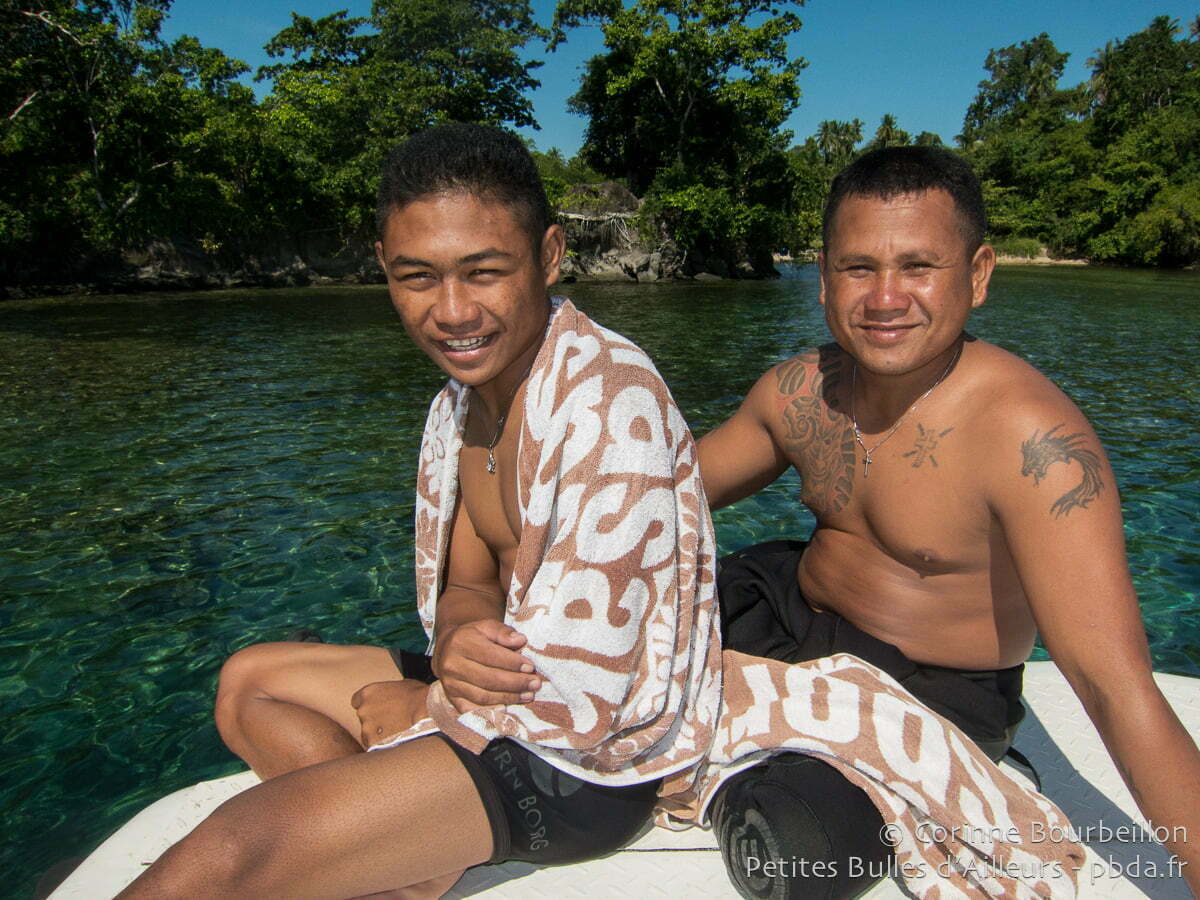
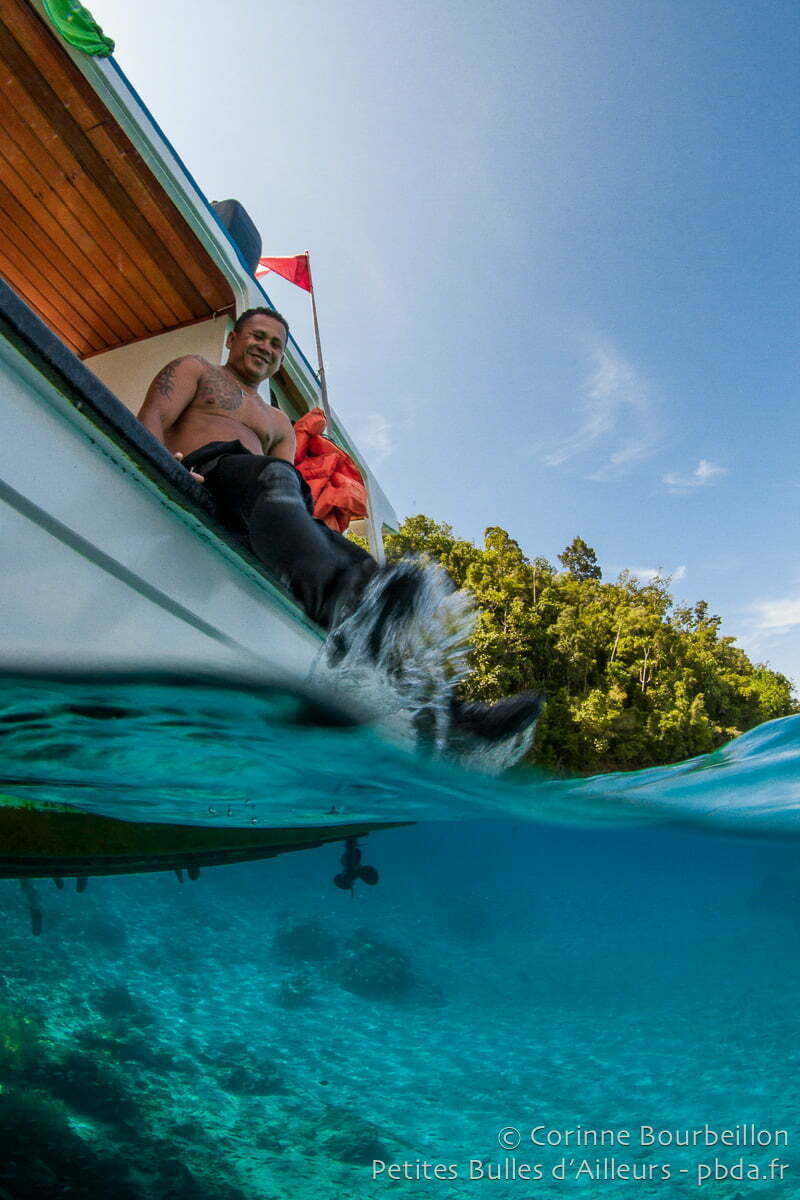
On two occasions, during our trips, we came across schools of playful dolphins. The Indonesian crew and our guides are never blasé by the show and are as enthusiastic as we, the diving tourists...
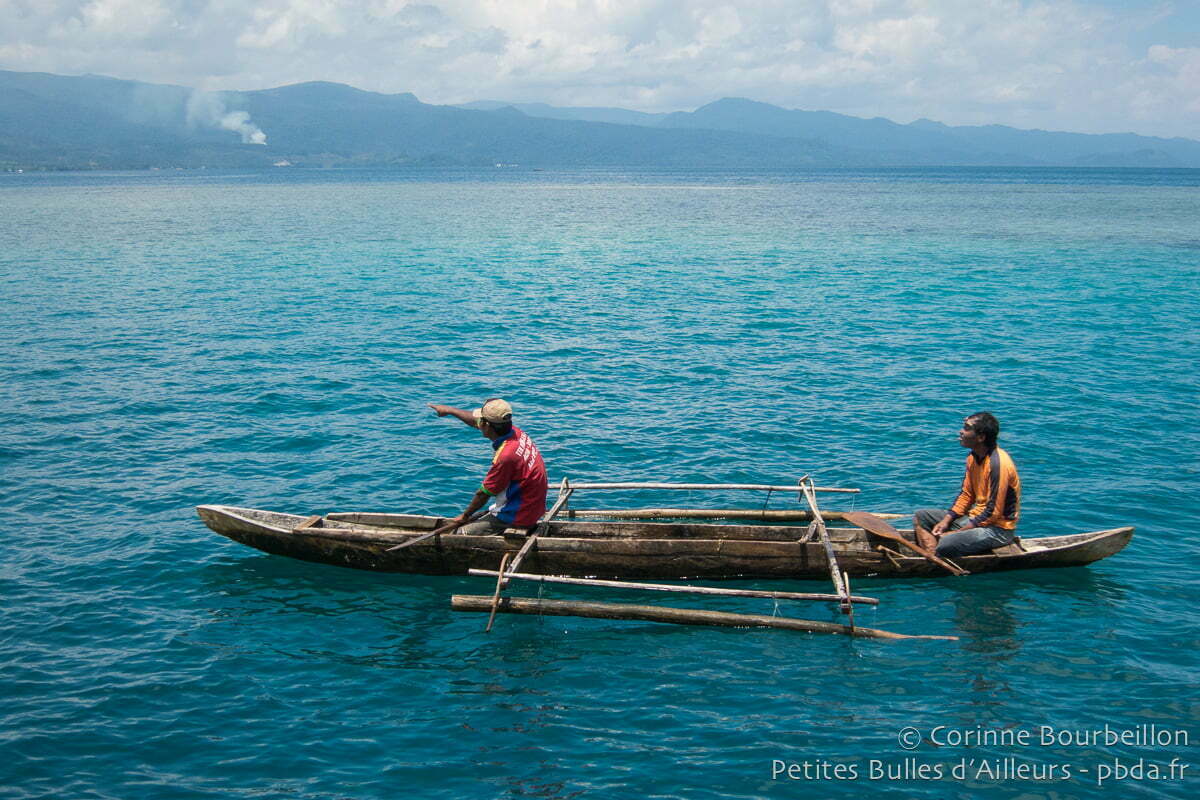
And then, there are the chance encounters, along our route, from one dive site to another: sometimes fishermen, or people sailing from one village to another, on a traditional pirogue.
To ask ecological questions
We also discover up close a sight less pleasing to the eye, but which has an important economic, social and environmental impact on the local population: the enormous cargo of a mining company.
It can be seen in the distance, from the resort. Barges permanently store ore there.
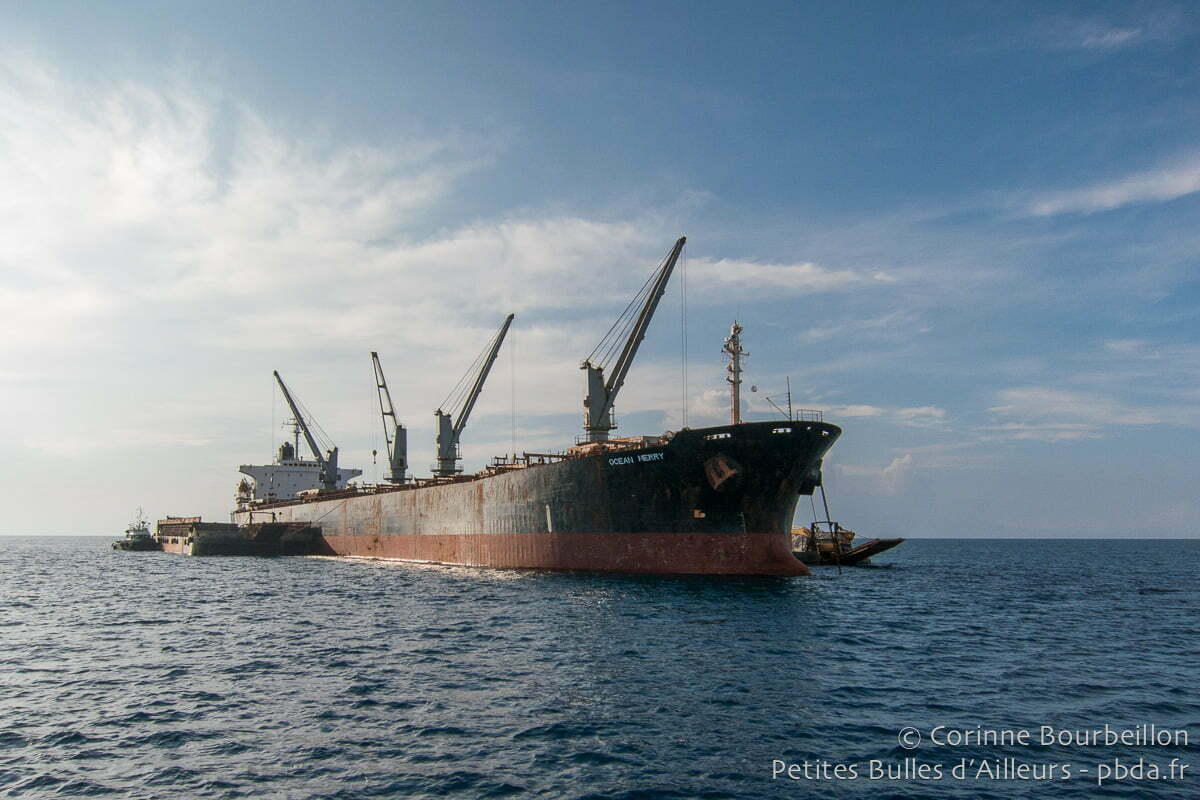
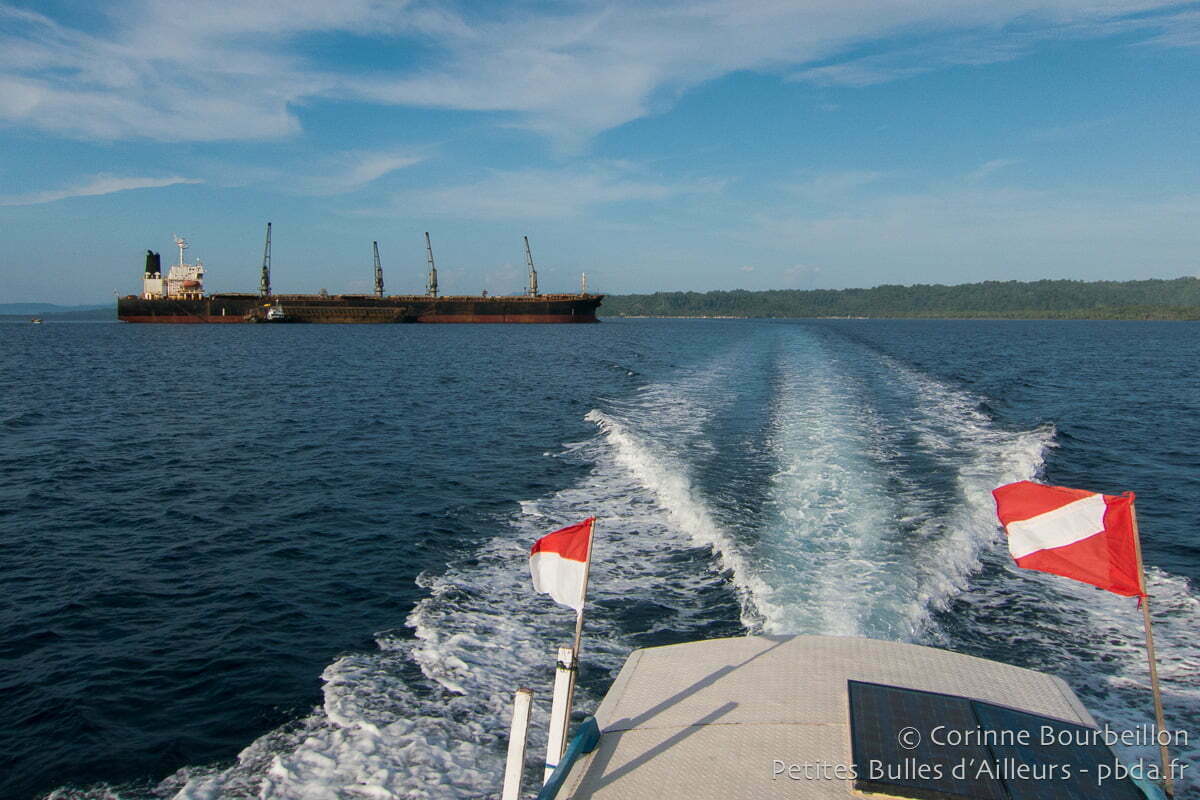
This is also Indonesia.
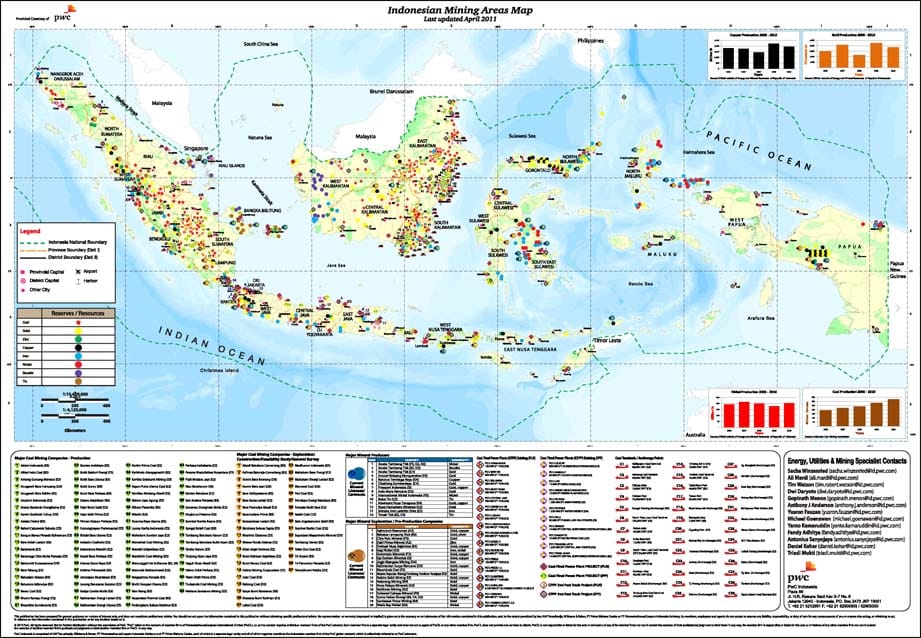
Mining operations are everywhere in the archipelago, and more and more. Here, in Halmahera, but also in North Sulawesi or in the Papua peninsula, to name a few regions where I recently traveled. The richness of the subsoil, in nickel, iron, gold, cobalt, etc., arouses the covetousness of Chinese companies in particular.
Below, a map of 2011 found on the PWC.com website. Even if it is not readable at this scale, each colored point representing a mining area, we can see the extent of the phenomenon...
The beautiful Bangka Island (North Sulawesi), where I also went on this trip in March 2013, after a first stay in July 2010 (and I'll get back to you in future posts), should escape a mining projectwhich was to be destructive.
Depending on the environmental policy of the mining operations, the ecological consequences are more or less catastrophic: deforestation, poisoning of the soil and river water, accumulation of sediments near the coasts that gradually suffocate the seabed...
When they first moved to Halmahera a few years ago, Rob and Linda, the owners of Weda Resort, had to completely rethink their plans and resign themselves to changing location because of the proximity of one of these mines.
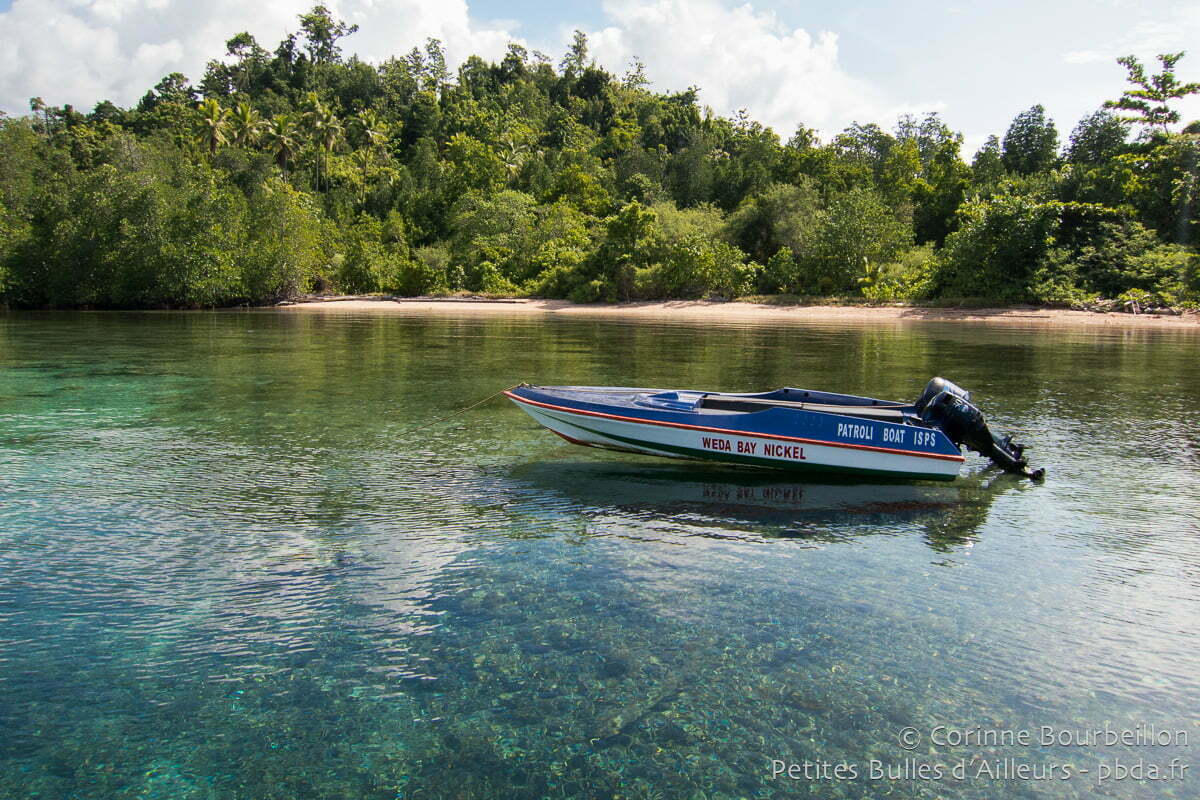
Their new Weda Resort, where I stayed, between jungle and mangrove, is located near the villages of Kobe and Sawai ItepoIt is not far from another mine, Weda Bay Nickel. But, for the time being, the owners of the Weda Resort seem to have a good relationship with this company. The latter claims to care more than others about the ecological, economic and social impact of its activities (which others dispute, see the links I added a little below, in November 2013).
Interesting detail: the mine Weda Bay Nickel is operated by the French, in cooperation with, among others, the Sandouville plant near Le Havre, in Haute-Normandie (sic). Visit these links, they provide a lot of information on the region and the operations of the French mining company.
For my part, I have not conducted the survey and I am not in a position to give an informed opinion on the matter. Moreover, Weda Bay is huge: from one area to another, I imagine that the situations must be very diverse. I came as a tourist, I just dived, and I could simply see that there were still in the Weda Bay splendid coral reefs.
Nevertheless, it is possible to worry: will Weda Bay remain as beautiful and relatively preserved as it seems to be today?
Updated: November 2013
I just came across some articles about Weda Bay Nickel, and they don't bode well, unfortunately:
→ Indonesia: Nickel for a Piece of Bread [International mail]
→ Eramet mine in Indonesia: a report denounces the appropriation of land [Alterasia.org]
→ An alarming report on violations of community rights [Amisdelaterre.org]
→ Selling their nickel for a dime [The Jakarta Post]
Introduction to spearfishing
Between two dives, we also stop in small creeks, the time of the "degassing" interval. We have to let a good hour pass, so that our bodies eliminate the excess of nitrogen accumulated during the first dive.
Most often, we take advantage of this rest forced to snorkel (swimming with mask and snorkel) on the surface.
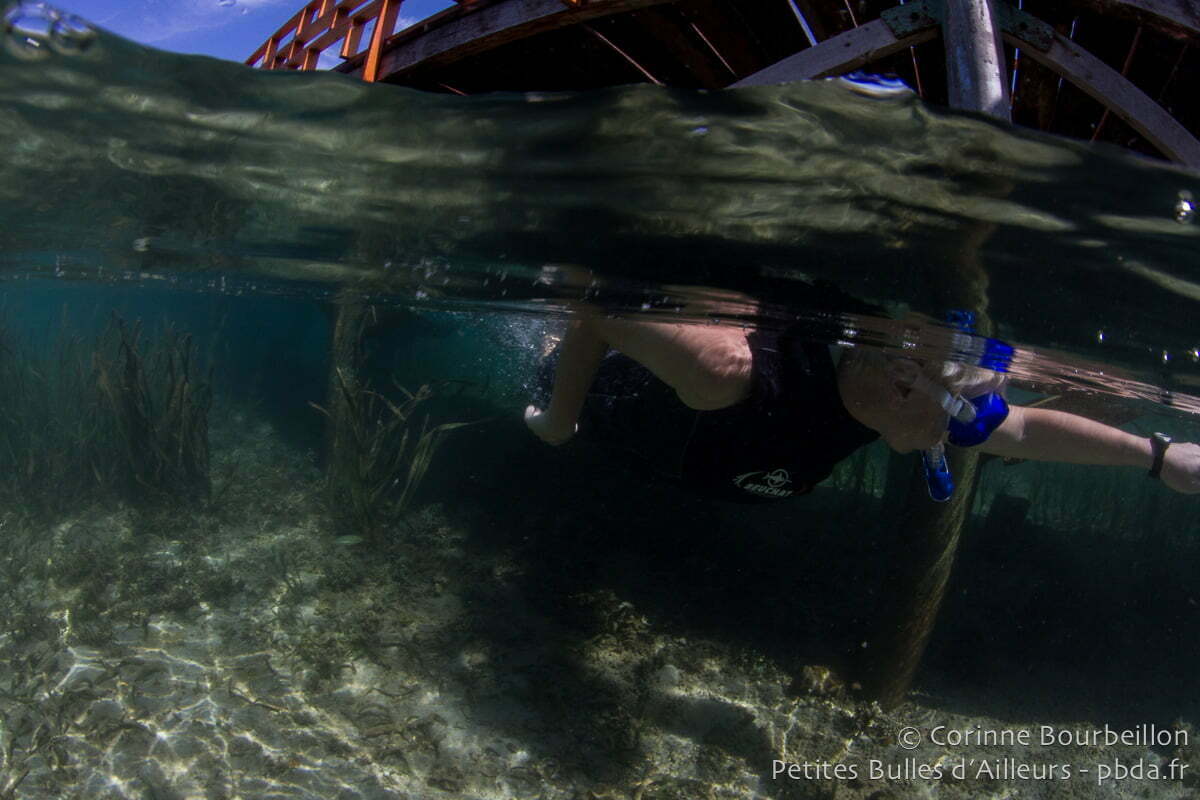
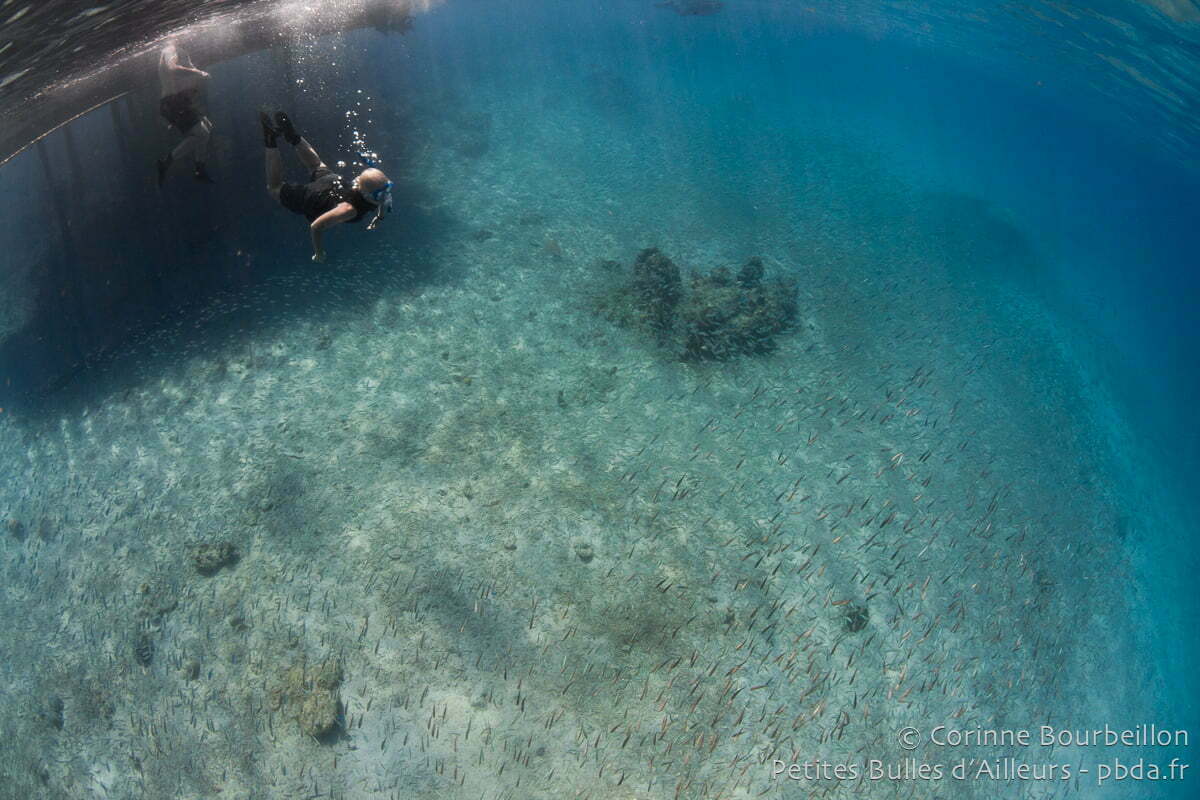
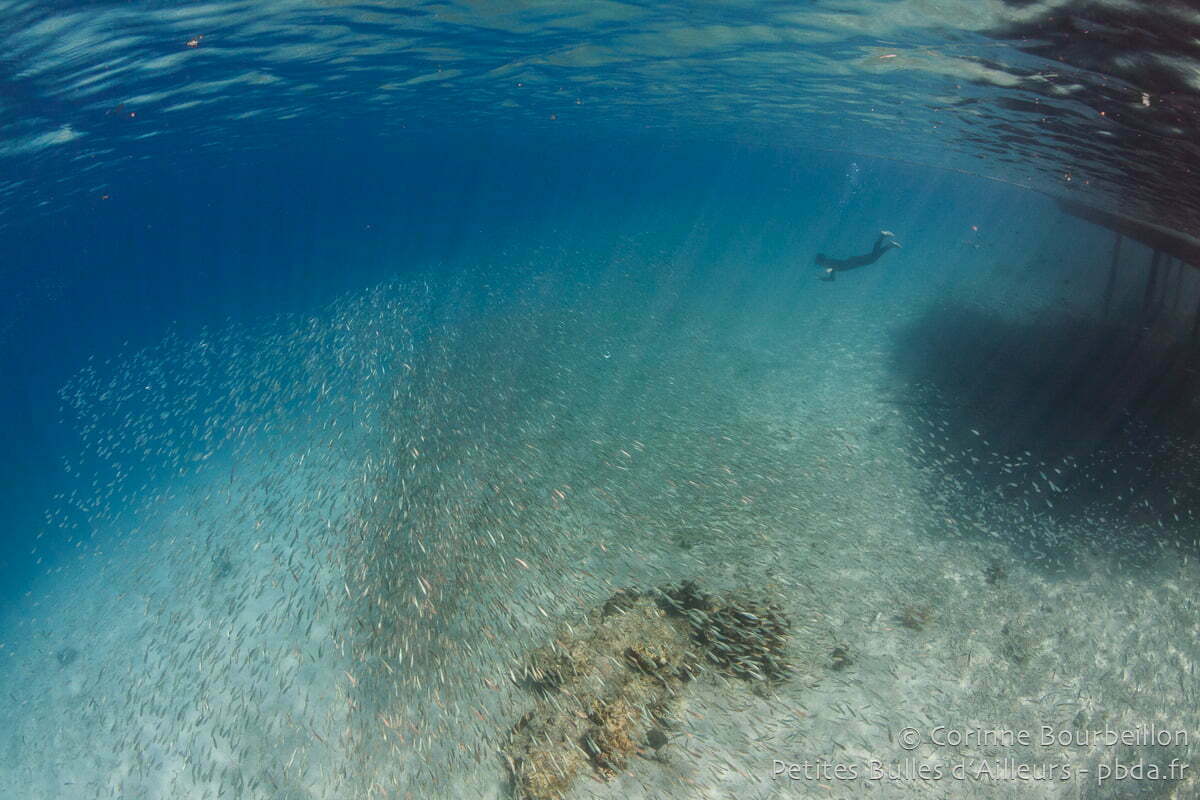
Otherwise, we learn the local fishing techniques.
That day, it's a harpoon course.
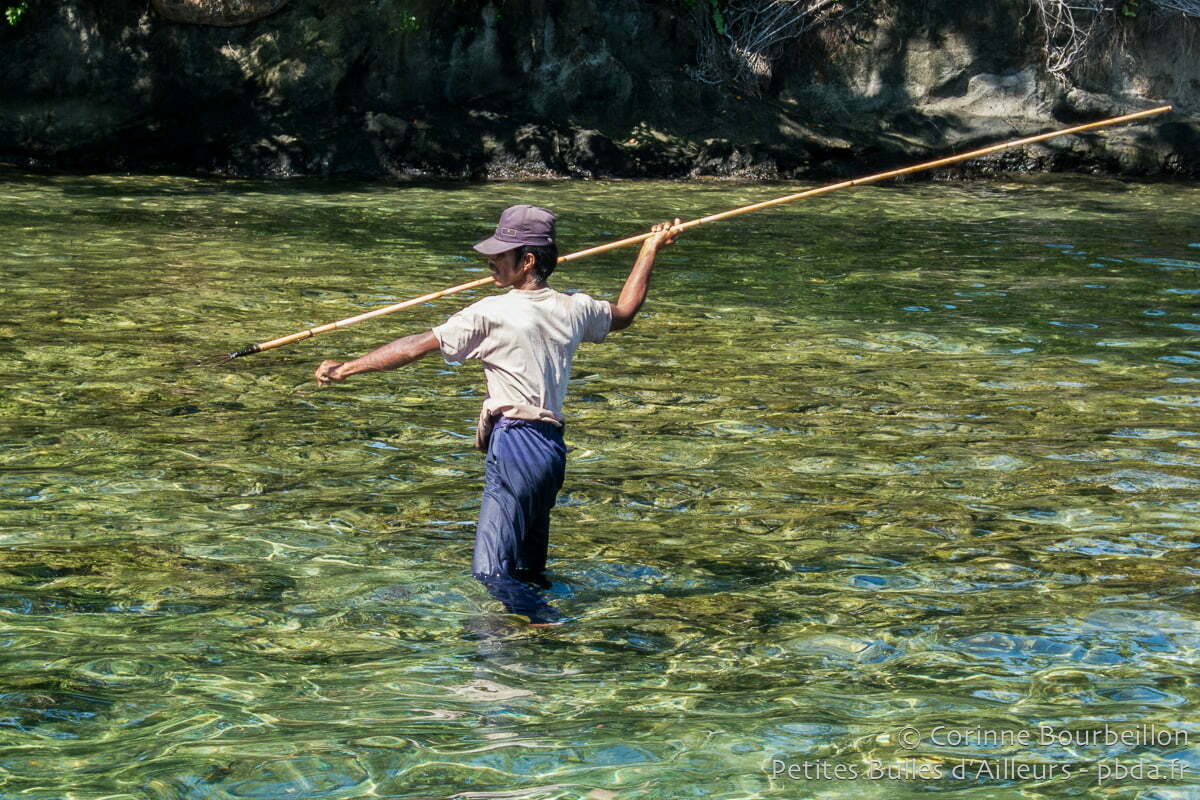
We docked a little further south in the bay, I think, at a place that I would be hard pressed to locate on a map. Apparently, it is near a village.
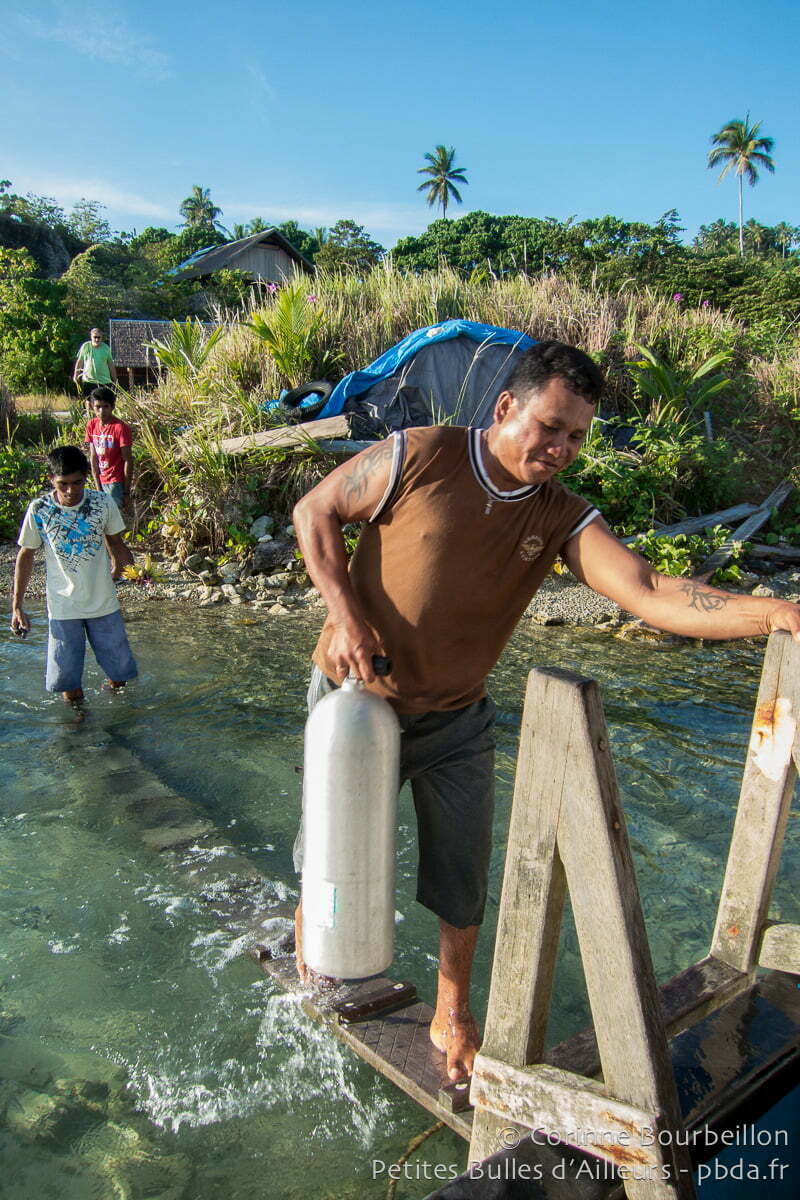
On the pontoon, there are two little boys and, not far away, a gentleman who I suppose is their father. The children are playing in the water. He is pacing the shallow waters of the creek with his harpoon.
The kids, all naked, hasten to put on their tee-shirts and shorts when they discover that there are ladies on the tourist boat that is docking.
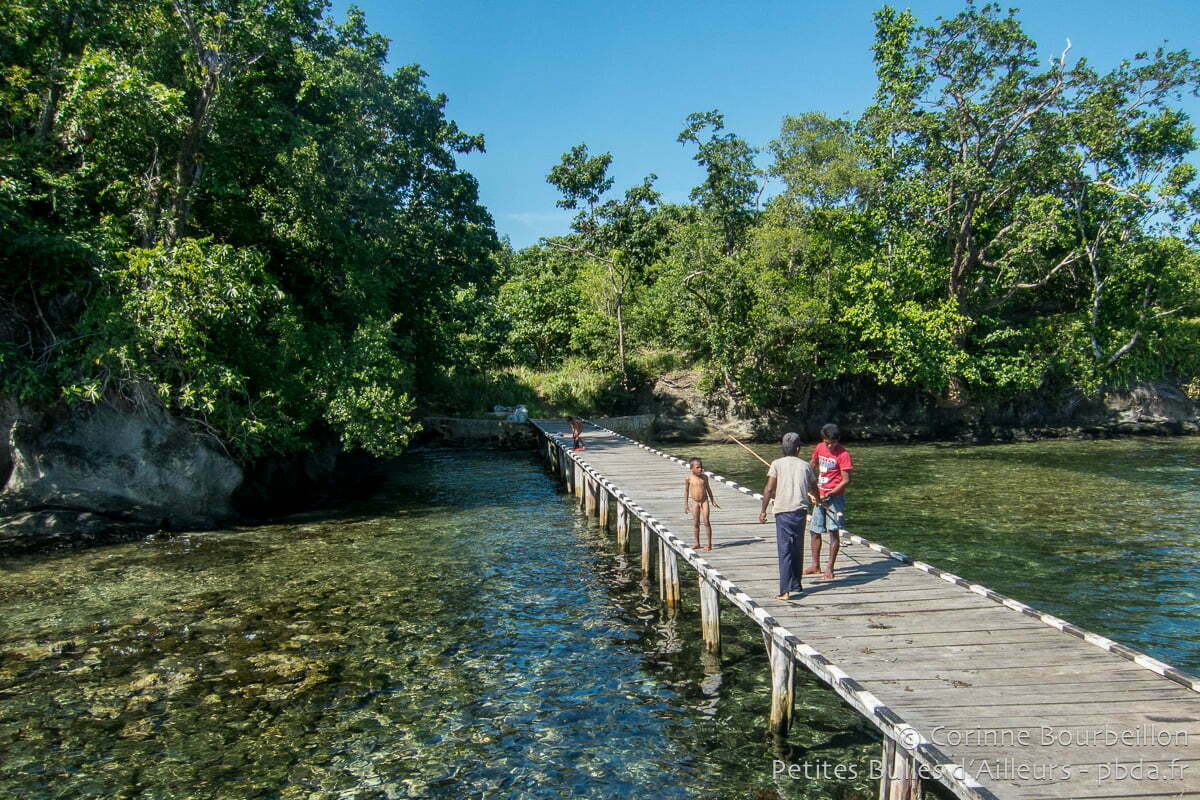
Around the pontoon, in an incredible turquoise blue water, there are schools of tiny fish.
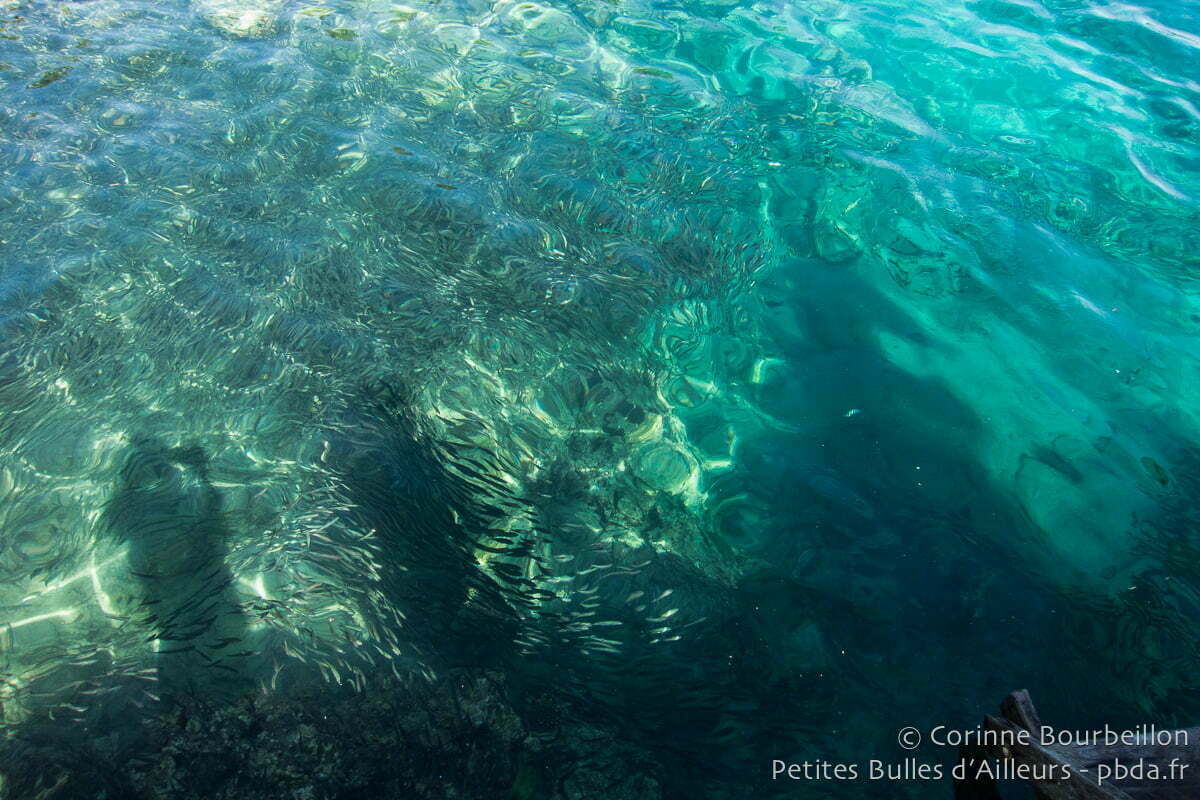
Our fisherman arrives to harpoon them with a staggering precision.
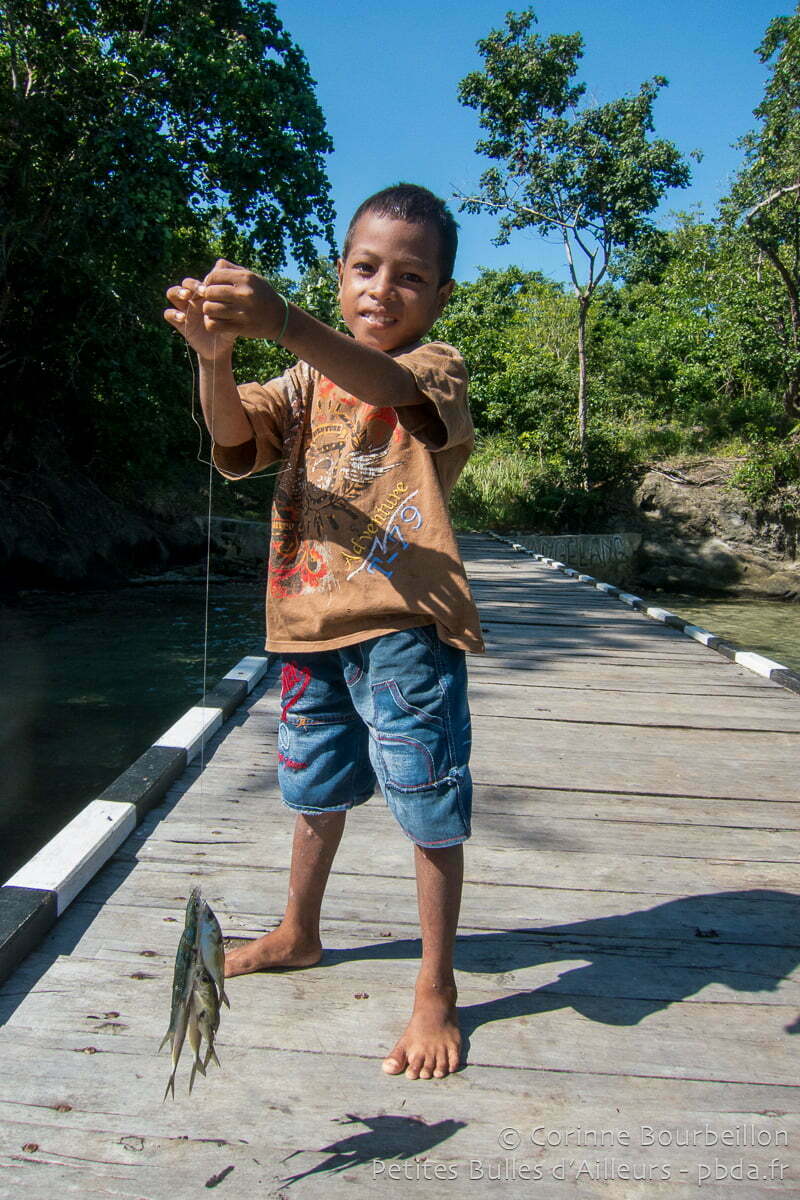 He brings back several of them, planted on the spears at the end of his harpoon, with each throwing.
One of the kids proudly poses with part of the day's catch.
While our guides are chatting with the fisherman, we, the tourists, are playing tourists: we are taking pictures and admiring the view.
Michael, my diving buddy, gets back into the water with his mask, snorkel and fins, for another snorkeling session. He can't get enough of it.
The fisherman, to impress us, goes back into the water to harpoon a moray eel, which he puts down at our feet. The poor thing twisted violently on the burning boards of the pontoon. But its ordeal lasted only a few minutes, as the man quickly threw it back into the water. Obviously, the moray eel must not be very good to eat...
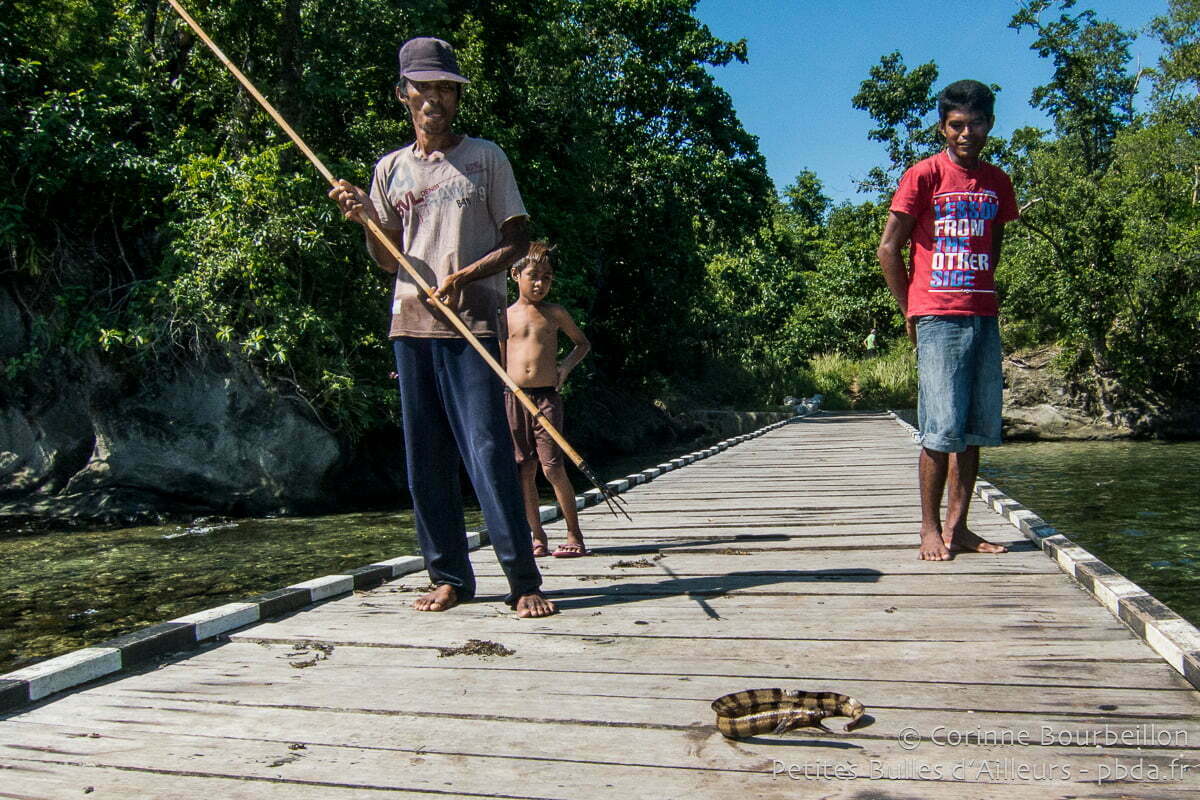
But our surface interval is over. It is necessary to go up on the boat. We leave again to dive, leaving the children to return to their games and the guy to his fishing.
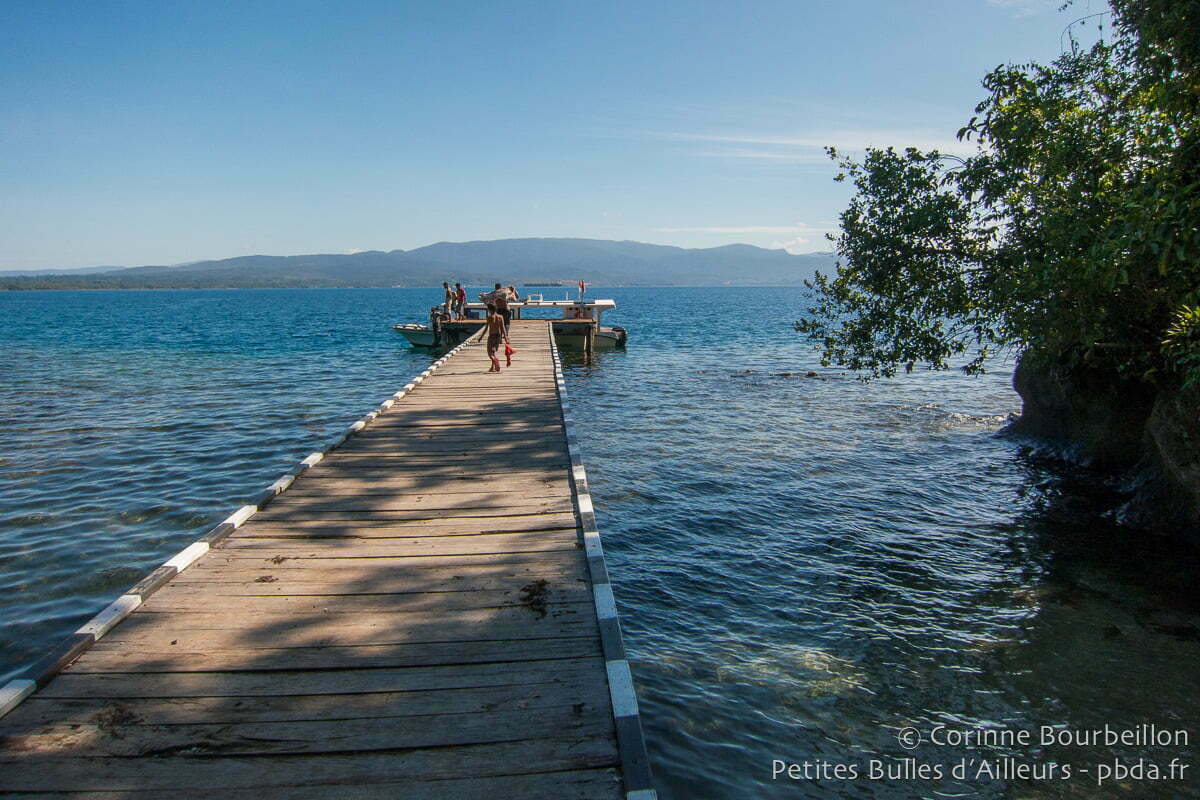
Now that I am back in France, far from Weda Bay, I enjoy remembering these nice little stops between two dives, and seeing these pictures again.
Unique moments, just as precious, in my eyes, as our underwater explorations!
????


magnificent as usual!
@Laurence: glad you like it, as usual... 😉 The place is gorgeous, for sure.
well yes what do you want, since the time I became a real fan 😛
The situation at Weda Bay is indeed worrying. Nevertheless, a small glimmer of hope for 2014, ERAMET (French leader in mining exploration) having broadcasted in a February 2014 press release that "conditions were not met to consider a final investment decision concerning the Weda Bay project in 2014" the link is here on page 2, 5th paragraph : http://www.eramet.com/sites/default/files/cp/resultats2013_eramet_21_02_2014_fr.pdf
Which, by the way, earned them a "palm" of 224 M€ (depreciation of assets corresponding to the shares of the company held by ERAMET which is developing the project), that'll do their feet in! 😛
But it is also up to us to question ourselves, since nickel is used among other things in the manufacture of smart phones whose developed countries are frenetic consumption ....