

Pygmy seahorses don't like pictures

 EN
ENNothing more annoying to photograph than a seahorse-pygmy. Too small. Too well camouflaged. Too shy. But its delicate plastic is well worth some efforts.
Half-naked asses!
After the background imagesNow it's time for macro photography! In the waters of Weda Bay HalmaheraIn Indonesia, where I was in March 2013, I'm lucky enough to have some choice models: pygmy seahorses.
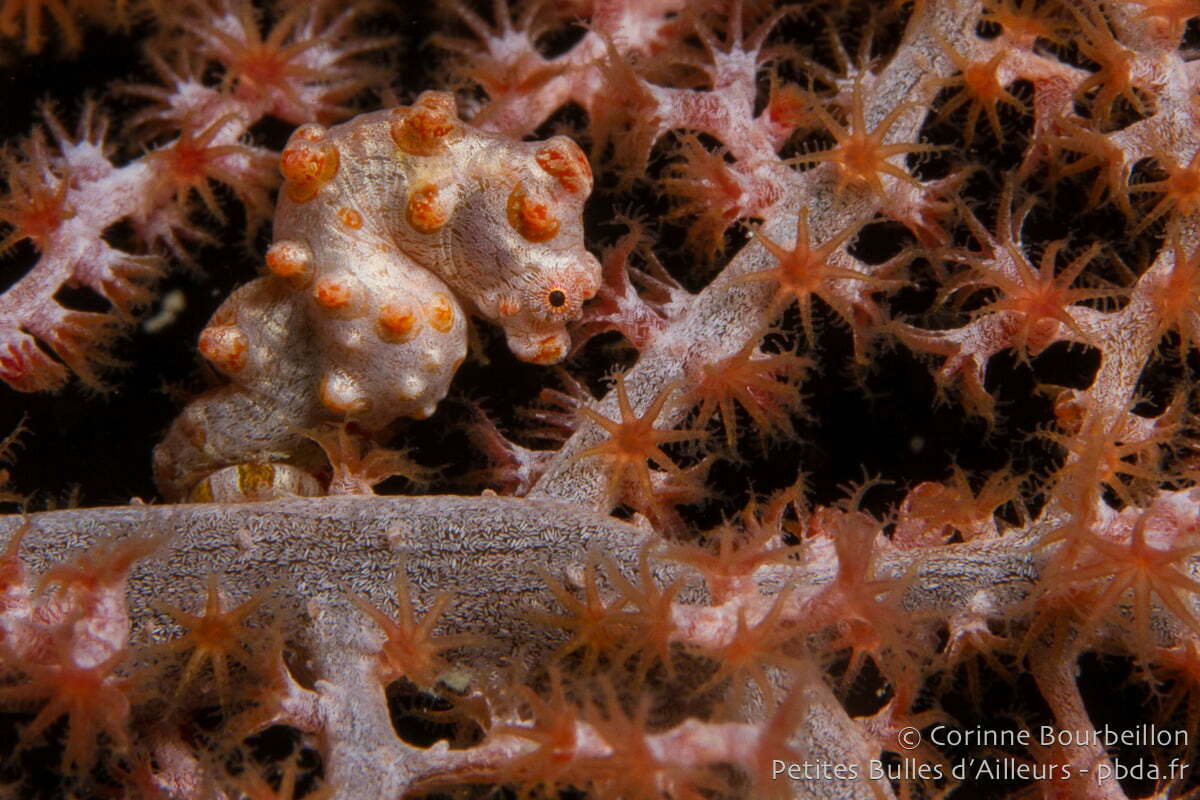
But photographing them is not easy. A real challenge, even...
The first thing to worry about with these miniature sea horses is that they're not just "pygmy", they're downright half-naked! To observe them, some divers even take a magnifying glass underwater with them. That's saying a lot...
With their size in the centimetre range (sometimes less), pygmy seahorses are really hard to spot. They can be found by patiently scanning the branches of the huge gorgonian sea fans in Weda Bay.

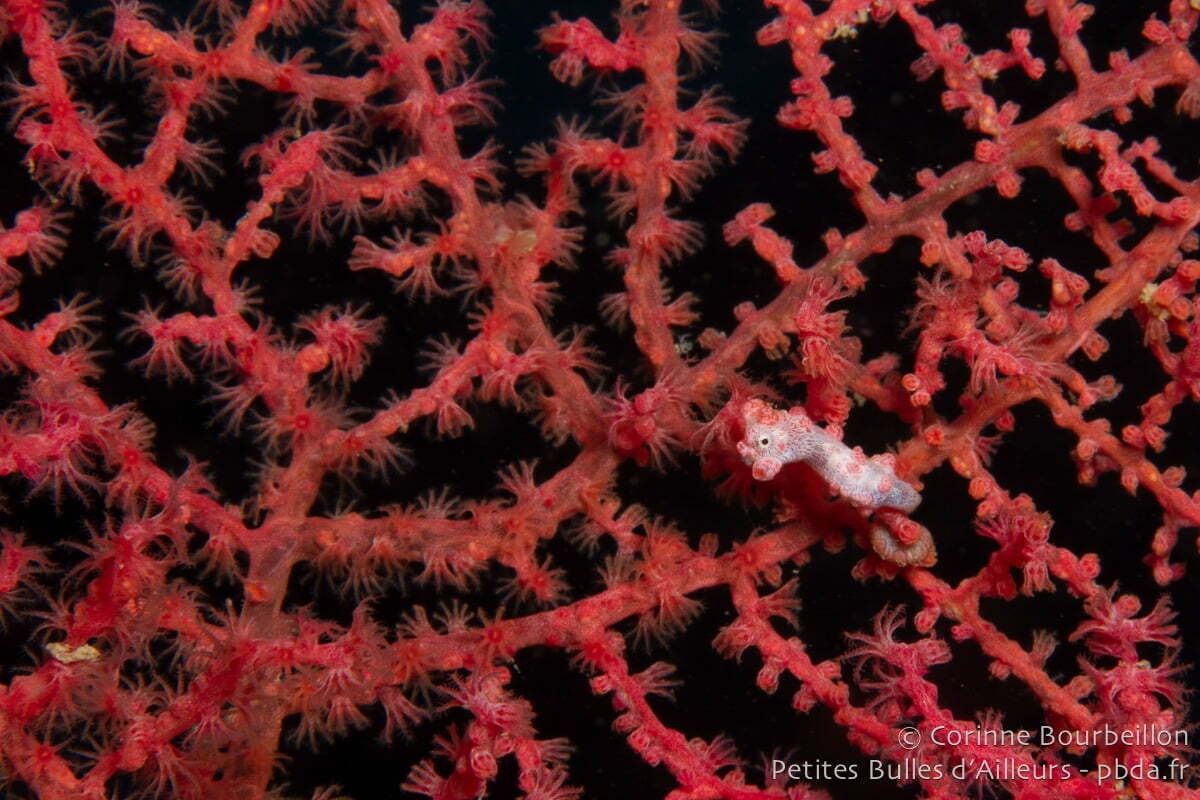
The quest is a bit like looking for a needle in a haystack, sometimes... But you get there. The proof.

Fortunately, I am helped by the eagle eye of my Indonesian guide, Radyal.
It helps me to see them, in the huge coral fans, and then, above all, to find them again, when, with my mask stuck to the viewfinder of my tank, I moved a few centimeters and lost sight of the branch where the little sea horse on which I had set my heart on is hiding. Patience and calm are needed to succeed in photographing pygmy seahorses.
We met two species during our dives at Weda.
The one that has pink or orange bumps, which serve as camouflage in the gorgonians of identical color, is a seahorse bargibanti. The little yellow boy with the bald head goes by the sweet name of Denise.
Shy people
Second concern: the little seahorses do not like to be photographed at all.
Every time I point my macro lens at them, I get the same acrobatic act around the gorgonian branch. Here they are, slowly swiveling on their coiled tail, until they pass on the other side, ostensibly turning their back to me...

I take a deep breath, walk around the gorgon, take up my position, readjust the angle of my flash and the opening of the camera. And zut! I missed again.
The development is very delicate to succeed, on such small creatures, it is played to the millimeter. But their shyness adds to the difficulty.
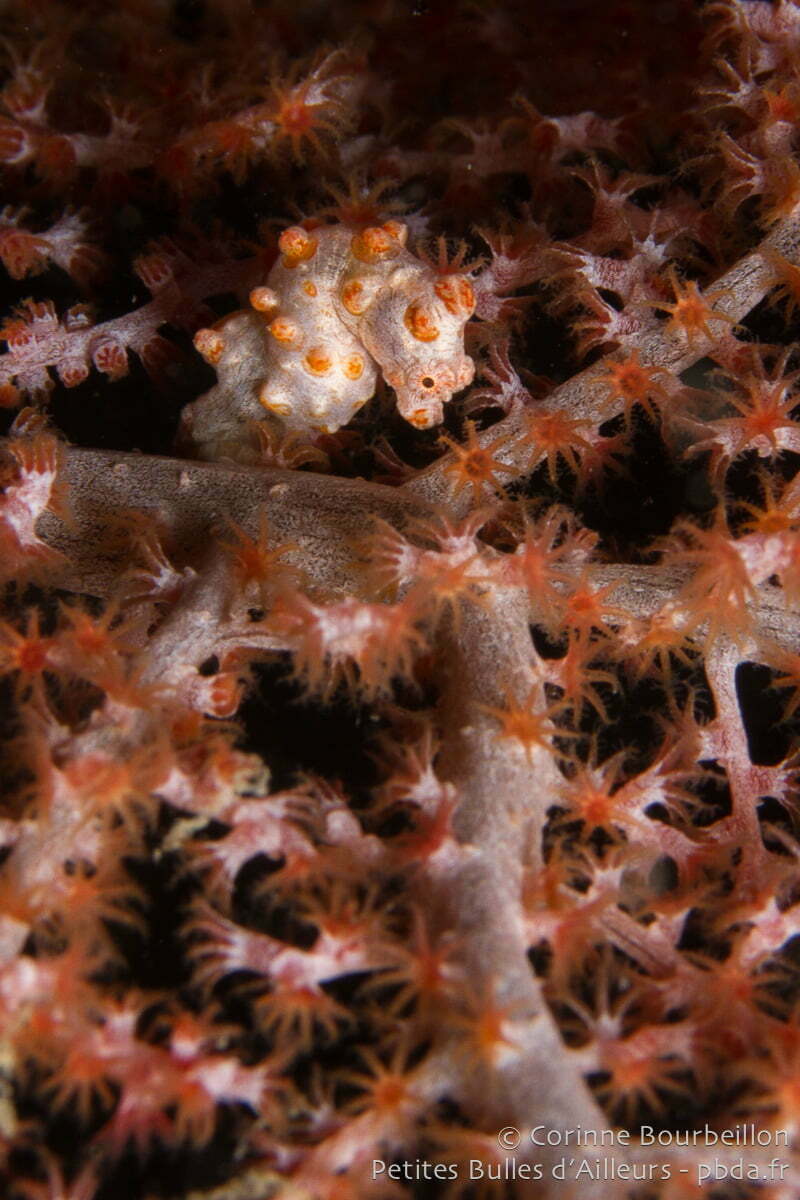
And I really feel like they're taunting me... " Hup! I'll turn my back on you again, I don't like photos."
😅
The repetition of this subtle camouflage manoeuvre - once, twice, three times - is getting very annoying!
But, by dint of perseverance, I still manage to draw the portrait.
My photo equipment : the Eos 7D and the lens Canon 60mm f / 2.8 EF-S Macro.
And I am the stubborn type, I must say... Able to stay stuck in front of a gorgon for long minutes, under the benevolent eye of my guide, who patiently spins out his string of bubbles.
He waits for me to finish, to lead me to another coral fan, a few meters away. He even made a small round trip, to check that the gorgonian is still inhabited, since his last visit, while I am complaining in my regulator about the lack of cooperation of my tiny model.

On one of the gorgonians we visited, we found a small family of sea horses. But here, I don't try anymore. Impossible to have everybody on the picture.
I just took a few shots, for memory, with two seahorses in the frame. It's not that common to capture more than one at a time!


When it's time to sort out the images, in the evening, on my MacBook Air, I eliminate a lot of them, without any qualms. But I have come a long way since my very first images of a seahorse-pygmy with a compact camera, in 2008 (see right here and the)...
I've been doing a lot less "macro" since I got my new toy, the fisheye lens. Tokina 10-17It's great for underwater photos. But at Weda, the tiny sea horses gave me a taste for the "small".
😍


@Corinne: I like these little beasts, but I've never seen one before!!! 🙁
I also have to say that my eyesight isn't great, and that despite my mask with corrective lenses (yes! essential for cross-eyed people like me! 8) I'm not about to see any! 😥
@Didier: do what so many other divers do, and go down with a magnifying glass in your stab! It's great for observing the little things that are really too small, and not just pygmy seahorses...
😉
Too cute! Like you, I adore them!
Superb photos, bravo for your patience 😉
@Manta: yes, really mimis, huh?... 🙂
Many thanks, but what a galley to get to get nice pictures !!!
too cute these pygmies!
I can confirm that it's quite annoying to photograph, especially when you'd like to take all the time you need but other photographers are also waiting for that rare moment....
Anyway well done !!
@Laurence: Weda, it was ideal for photography, I must say... In my group, just the guide and a Dutch diver who had drowned his camera a few days earlier, so I was the only photographer!!! 🙂
No need to wait your turn next to the Gorgon...
The other photographers were dispatched to the other palanquées. Long dives, very quiet, no-one around ... Ideal !!!
Superb photos, Corinne. Better than with your compact in 2008 (With my little Lumix APN, I did my best, when on 2 wild sites on the island of Samal -Philippines- we discovered several pairs of Bargibanti) 😉
You express so well - with humor - the difficulty of photographing them; yes, they have the art of pirouetting under the lens and passing over to the other side of the Gorgon!
A magnifying glass, yes, it can help to observe ...
Good bubbles
@Siratus: thank you 🙂 I became more skilful later on, with my little compact APN, but when you switch to an SLR with a good lens, the difference is incomparable... As for those damn seahorses, yes, it's enough to make you goat, trying to take their portrait!
🙄
I was so focused on your hippo that I hadn't noticed all the shrimp 😛 ......
@Laurence: you'll laugh, me too, when I was taking the underwater photos, I was so focused on the Denise, trying to capture it in the right position, applying myself to my focus, lighting, etc. etc. that I hadn't noticed the cute shrimps around, which actually add a lot of interest to the photo...
It was only afterwards, when I discovered my images on the computer screen, that I finally saw them!!!!
😀
MAGNIFICENT your pygmies, really!
And what do I learn? You don't have a magnifying glass when you dive 😉 Indispensable for an old-timer like me if I want to see these adorable creatures...
Bizzzzz
@Pit: a thousand thanks, from you, the compliment means a lot to me 🙂
Well no, not (yet) magnifying glass. But that's one of the little accessories that I'm thinking of taking with me for the next few times ...
😉
"a horse, a horse ... my kingdom for a horse !"
Little yellow Denise has his own pantry on his little flippers, and many shrimps have taken up residence in this gorgonian. Is it true that the pygmee feeds on shrimp larger than itself? If not, what?
@Lisemet: I have no idea what the diet of the seahorse-pygmy is... I'll look that up, here... 😉
Hello Corinne and congratulations for these images that make me wait! I will try to bring back some pictures of these pygmies !! Lilliputiens !!
8)