

Packing: Which Dive Bag Is Best for Travelling?

 EN
ENMy diving equipment and underwater photography gear now take up the lion's share of my luggage. I can't travel light like I used to! But the basic principle is still valid: I have to be able to carry all my stuff on my own.
Disclaimer : this is NOT a sponsored article, I am not affiliated with ANY of the brands I may list below.
My diving travel bag since July 2018
I invested in a new rolling bag in 2018 to replace the previous one (see below). I wanted it to be designed in the same way:
- a bag large enough to hold my diving gear, clothes and a few (non-fragile) accessories for underwater photography;
- and opens into two wallet-style compartments (handy for separating diving gear from the rest).
Again, I opted for a discreet bag, with no brand name written in big letters on it. In my opinion, there is nothing worse than displaying the name or logo of a diving equipment manufacturer on your luggage. It signals that there are valuable things inside, and that you are potentially a (very) rich tourist...
I chose a reliable model, made by a well-known luggage brand (Eastpack) that guarantees its products for thirty years. Its name: Transver L.
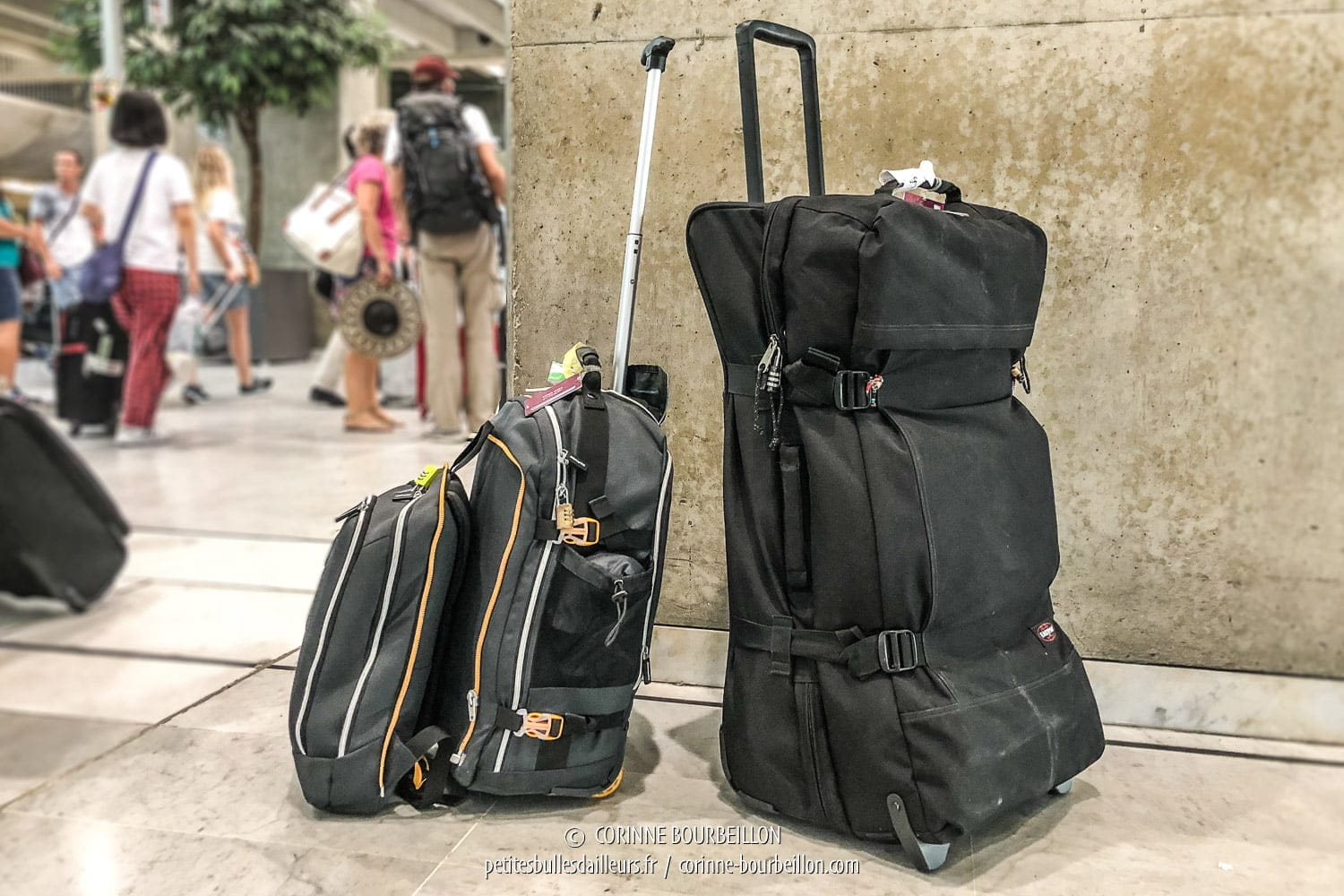
This big Eastpack wheeled bag is less "cheap" than my previous Decathlon bag, and a bit bulkier (121 liters). I hope it lasts as long, if not longer!
So far, I am very satisfied with it. It is sturdy, handy, practical and does not attract attention.
Underwater photo logistics
I don't carry my stuff around in a backpack like I did when I was 20... As I now carry a whole range of equipment for underwater photography, I've had to completely rethink the organization of my luggage!
That's why the solution of the big wheeled bag quickly became obvious. The photos below show why underwater photography requires special baggage logistics...
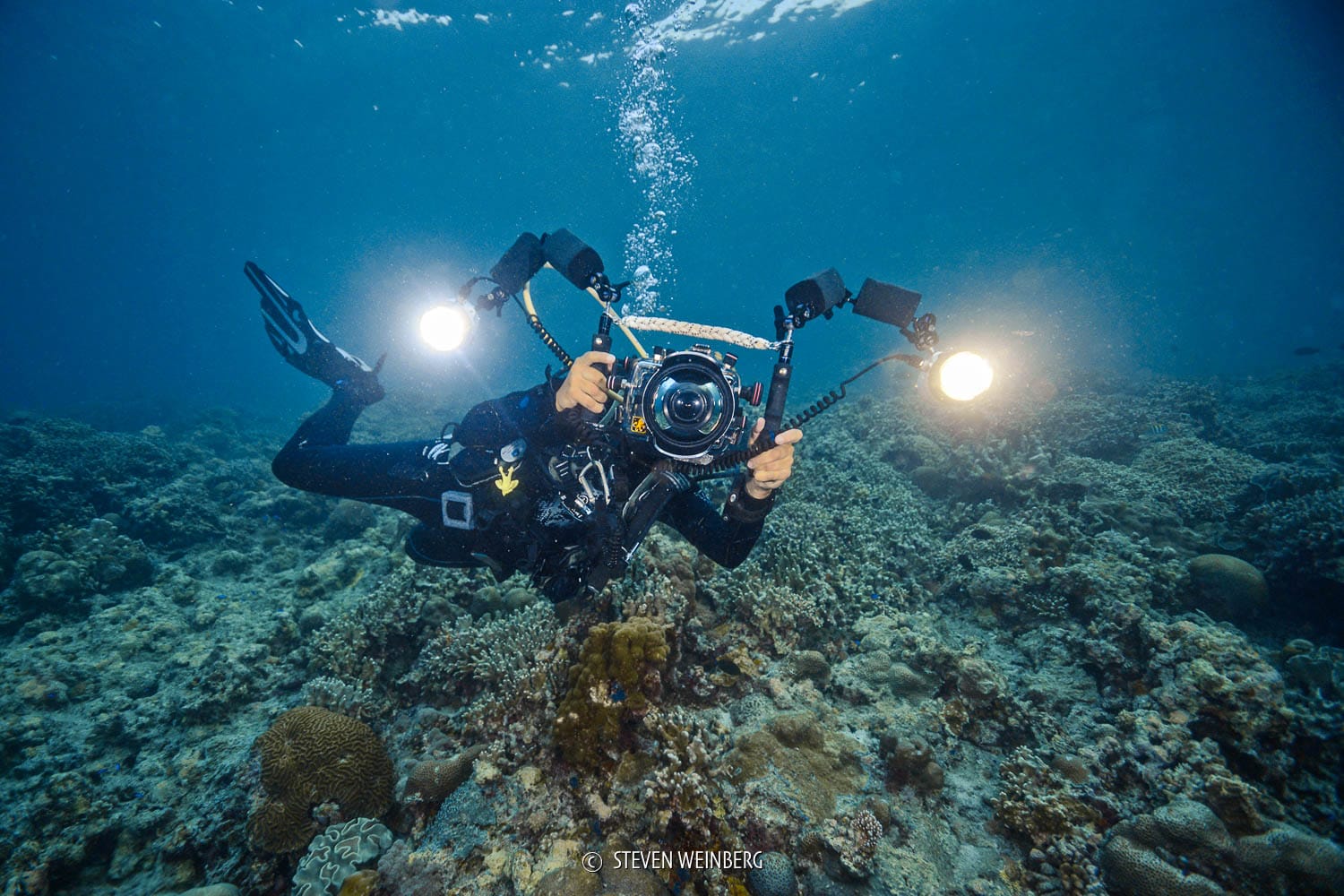
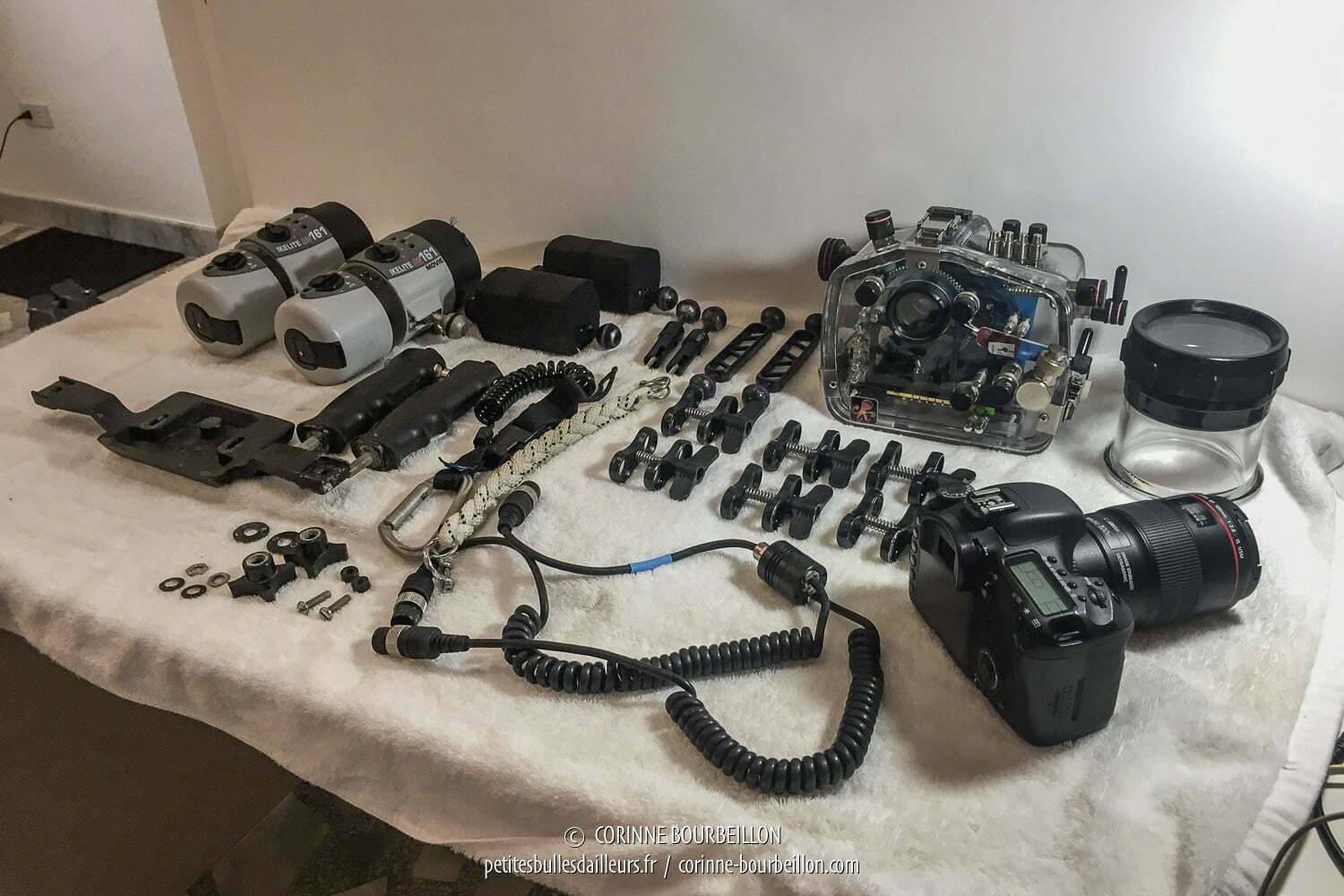
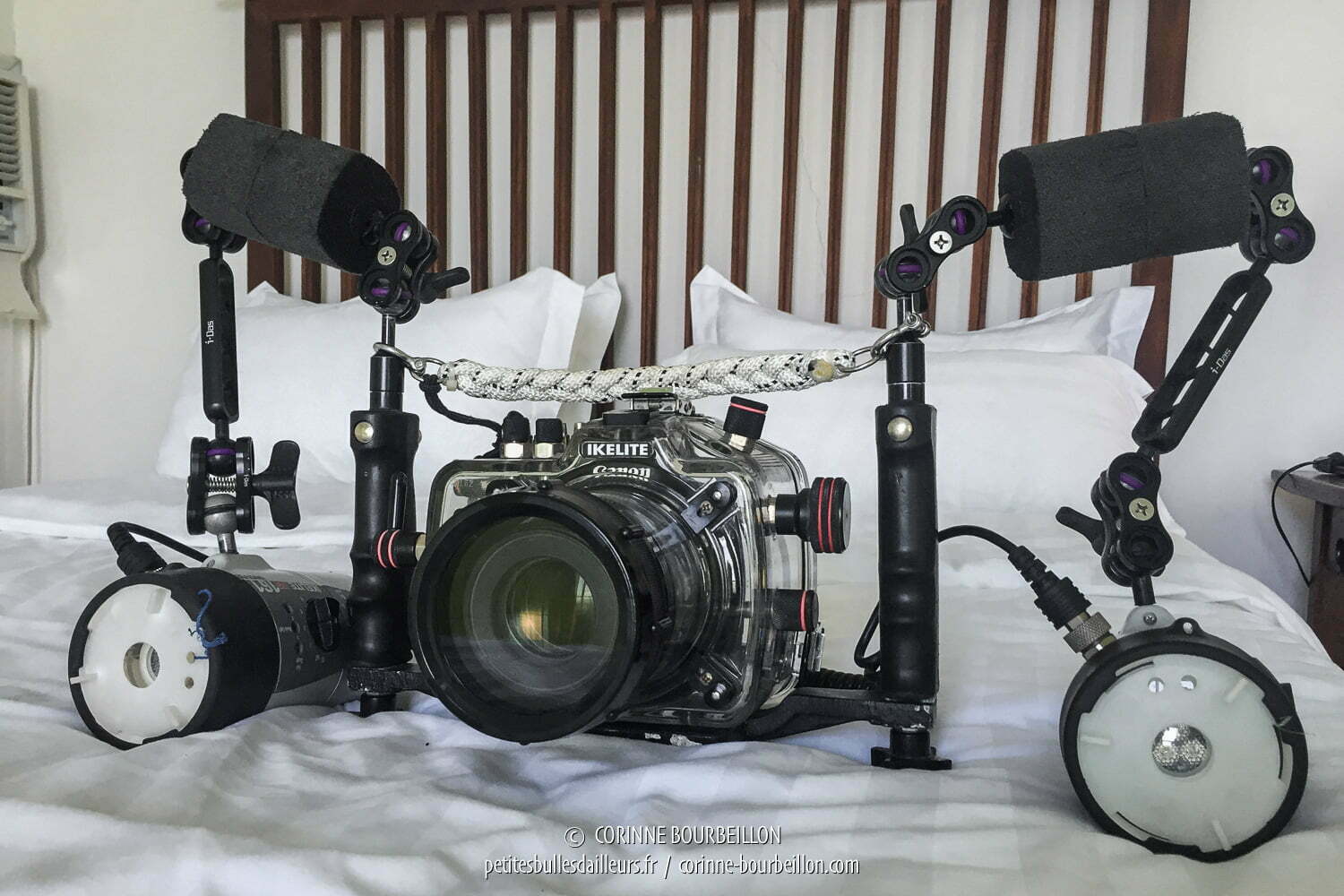

The thorny issue of "cabin" baggage
In addition to the big wheeled bag that goes in the hold when I travel by plane, I have with me :
- a "cabin" bag, also with wheels;
- a "hand" bag accepted by airlines, which is in fact a kind of shopping bag that can hold my 15-inch MacBook Air and precious things (papers, money), convertible into a backpack, found at Uniqlo. Inexpensive, discreet and very well done.
In the wheeled cabin bag, I put: my underwater photography equipment that is too valuable or fragile to go in the hold, i.e. the watertight housing Nauticam and its portholes (wide-angle dome + macro porthole), the Canon EOS R7 and lenses, underwater flash batteries (which are not allowed in the hold). Add to this your electronic equipment (dive computer and back-up hard drives), a fleece jacket for transport (especially in Asia, where the air-conditioning is often cranked up to the max), and an emergency mini-change (in case the hold bag containing your clothes doesn't keep up, a precaution I've been taking since it happened to me in 2015). → Go to an island far from everything). I also put a multi-pocket jacket in it, to transfer my lenses on me, if I need to lighten this bag at a baggage check at the airport.
In the handbag: my MacBook Air 15" and my iPhone (and their chargers), money and papers, my airplane survival kit (mask, earphones and earplugs, compression socks, mini toiletry kit). I usually keep this bag with me on the plane, tucked under the seat in front of me, and place the other in the overhead luggage compartment.
The question of overweight luggage
As I said above, I only put one big rolling bag in the hold. This rolling luggage, divided in two compartments like a "wallet", contains :
- on one side, my complete diving equipment ;
- on the other side, a few items of clothing and accessories related to the underwater photography I mentioned above (flash units without batteries, battery charger, flash arms and floats, flash cables).
It's a good thing this bag rolls! The whole thing easily reaches 28-29 kg... 😱
Because of the extra kilos of my underwater photography accessories and diving equipment, I can't keep within the 20-23 kg limit usually allowed in economy class on international flights. I therefore prefer to travel on airlines that allow 30 kg in the hold at no extra cost. Fare policies change regularly, so I take the time to check carefully before booking, even if it means paying an overweight supplement if there's no other option.
Overweight charges are rarely a problem on the local airlines I often fly (Indonesian, Malaysian, Philippine): they are very low compared to Europe. You can either pre-pay them when you book online, or pay them at check-in, in which case they are sometimes charged at a "discount" to the customer (and especially to the customer, when she gives a big smile at the counter and says hello in the local language)... 😉
For flights between Asian countries, I've often used the low-cost airline AirAsia, which allows you to purchase additional kilos up to a total of 30 kg at the time of booking, over and above the basic 15 kg in the hold...
Watch out for Emirates: During the stopover in Dubai, this company has the habit of checking again the weight of the hand luggage of the travelers. Employees are waiting for you with a scale, just before the access to the boarding room... Better not to exceed the 7 kg allowedFor photographers, they are very strict, the extra kilo is charged at full price (and impossible to board the plane without paying). For photographers: I advise you to take everything heavy out of your cabin bag. The easiest way is to wear your camera around your neck and to put your lenses in a multi-pocket jacket...
2010-2018: my first wheeled bag
This is the bag that faithfully accompanied me on all my diving trips from 2010 to 2018: a lightweight, inexpensive 90-liter wheeled bag found in a major sports chain (Decathlon) in early 2010 (this Newfeel bag is no longer sold).


Its two compartment design was very practical. My complete diving equipment was stored on one side. The clothes and part of my underwater photography bardas on the other.
I completely revised my luggage logistics starting in 2010, when I started to carry more substantial photo equipment to make underwater images. I talk about it in these articles:
→ No more backpacks, long live the wheelie bag!
→ Photo Equipment and Dive Gear
I've relinquished my "backpacker" status, carrying all my belongings on my back/shoulder, without regret. It's much less exhausting to be a "rollpackeuse"... 😂
This compact, unobtrusive wheeled bag attracted much less attention than the bulky diver's travel bags, all of which have a clearly identifiable brand name written across the top. It lasted eight years, three to four trips a year, and was often abused!
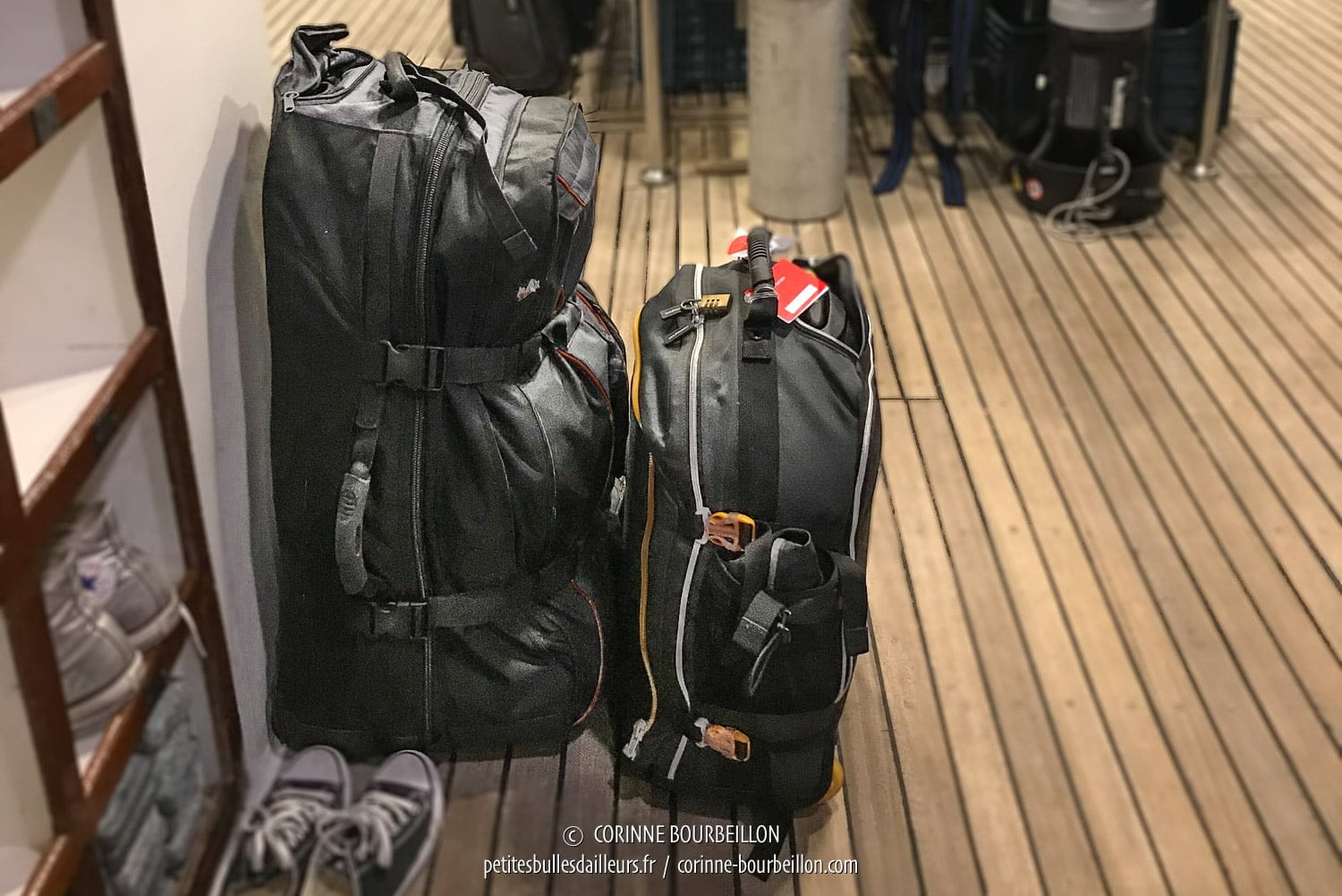
I was very happy with it, until it let go of me in May 2018 when I returned from a trip to the Philippines.
The handle ended up coming off its rail and the two corners at the bottom front were all frayed. On the other hand, the zippers still held and the whole canvas was still in good condition. Quite sturdy, so despite its very small price, a very good investment.
Until 2009: my backpacker's luggage
The photo below was my backpacking and diving gear, before 2010. Back then, I was a backpacker. I didn't yet have a big watertight housing for underwater photography, which today represents a whole lot of extra gear to carry.
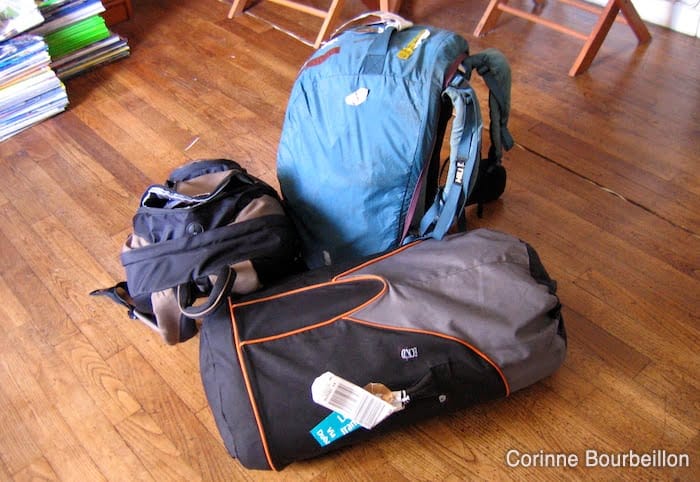
I would then travel with the following three pieces of luggage:
- a large backpack (the green thing) for clothes and the rest (10-12 kg);
- a pudding bag with shoulder strap for diving equipment (10-11 kg) ;
- a small backpackmy "carry-on" luggage, where I kept my compact camera of the time and its little case, the laptop and small fragile and/or precious things (iPhone, papers, money)...
All of this was within the usual limits of economy class luggage at the time: about 20 kilos in the hold (my two big bags) + a few kilos in the cabin.
Clothes: the tropical minimum
As for the rest, what do you pack for a diving holiday in Southeast Asia or the tropical islands? As little as possible! 😎 🌴 In the course of my travels, I've learned to pack only the essentials. I've compiled a short checklist below.
Long live summer clothes! My usual destinations have the same climate: hot and humid. I don't have to worry about buying anything: if I need something, I buy it on the spot (and it's much cheaper than in France). No problem to get flip-flops, tee-shirts or sarongs in Asia!
Clothes: tops
- some strapless tops for the "beach" places
- two T-shirts covering the shoulders and several thin long-sleeved tunics. Both to respect certain places and situations (cities, Muslim countries, temples) and as protection against mosquitoes at night. Preferably things that are easy to wash and match with any stocking.
- a small fleece jacket for all those air-conditioned places that are often in "fridge" mode (planes, buses, boats, shopping malls, etc.).
Clothing: stockings
- shorts (below the knee)
- long pants (for air travel, and for places and circumstances where it's not a good idea for a woman to go bare-legged)
- a skirt and/or a summer dress with straps
- one or two shorts
Undergarments
- panties and bras: simple and comfortable
- in sufficient quantity for a week
At the feet
- a pair of canvas sneakers that I wear on the plane, which I use only when I have to walk a little
- a pair of flip-flops that don't weigh anything in the bag and that I have almost permanently on my feet
I'm not a trekker, so I don't bother with heavy hiking boots or socks...
My indispensable accessories
- 3 or 4 bathing suits (I'm in the water all the time, I like to change)
- 2 to 3 pareos or sarongs (one "clean", one or two others for the beach and sea outings - I often buy new ones on the spot)
- a hammock (one of these light models as found everywhere in Asia)
- Sun glasses
I do not take bath towel for a long time, it is now everywhere.
Toilet stuff
- Shampoo, conditioner, shower gel or soap, toothpaste, moisturizer, sunscreen, etc. I used to take shower products in minimal quantities in small bottles for my arrival, as I often bought them on the spot to save weight in my luggage. Now, I use solid products (soaps Unbottled or Umaï) and biodegradable, both to save weight and reduce pollution. As they're not easy to find when I travel, I take as much as I need with me.
- Toothbrush, hairbrush, hair elastics, tweezers, etc.
Girls' special: Whether you use tampons, pads, cups or menstrual panties, it's best to remember to take your sanitary protection with you, because we're not sure we'll find the solution we prefer everywhere, especially with tampons...
Drugs: small medical kit for sores
My first-aid kit has been getting smaller and smaller during my travels, mostly to Asia and the Indo-Pacific archipelagos... Keep in mind that in tourist areas and big cities, there are usually medical facilities in case of a real problem.
Overall, the risk of contracting a serious illness is minimal for a Western traveller who is in good health, well nourished and up to date with his or her vaccinations. And if it does happen, you won't treat yourself: you'll consult a local doctor or use the services of a travel assistance/insurance company.
So I'm happy here to give common sense advice, for small problems on the trip, not for serious situations. These tips obviously can not replace a medical opinion. But given the exorbitant price of some drugs (which often will not be used), the best is to take with you only enough to treat small disorders and small sores.
Covid-19. This article dates from before the pandemic... In addition to the basic health recommendations recalled here, remember to take precautions to protect yourself and others in the event of Covid: mask, distancing, hand washing (soap and hydroalcoholic gel).
The really useful stuff
Problems most likely to be faced: the famous tourista (traveler's diarrhea) and small wounds (bites, scratches, cuts, blisters, which heal poorly in a humid climate and can become infected).
So, what is really useful in a travel first-aid kit: it is at least an anti-diarrhea, as well as bandages sterile and a disinfectant type Betadine (be careful with any small sores on the feet, as we're always walking around barefoot, in flip-flops, and they can easily become infected). I also carry waterproof bandages to protect a wound when I dive, as salt water only makes the situation worse...
Possibly antibioticsIf you know that you will spend time far from any city (where you can find a doctor and/or a pharmacy). For example, I once had to find a pharmacy in a hurry between two planes in Indonesia, in order to get antibiotics for three days, in order to stop the infection of a palm blister (sic!) which had degenerated.
For small ordinary ailments, I also take a few pills ofanti-pain with paracetamolDoliprane or equivalent.
Finally, very useful for the diver that I am: some drops to treat otitis externa (caused by poorly rinsed ears after immersions). The most effective for this type of infection, among those I tested: those named Ottopain in Indonesia or Panotile in France.
Mosquitoes and malaria
The malaria (also called malaria) is an infectious disease potentially deadly, caused by parasites of the genus Plasmodium, transmitted by mosquitoes when they bite us.
Malaria does not occur everywhere in equatorial or tropical regions of the world, nor in the same country considered a malaria-endemic zone. By this I mean: there is no need to take preventive treatment when you go to Phuket, for example... For malaria-infested areas, it is obviously advisable to consult a doctor before leaving. He alone can properly inform you about the risks of contamination where you are going and how best to prevent them.
This is not a matter to be taken lightly. As many travelers on the internet rightly remind us, it only takes one bite from a mosquito carrying the parasite to be infected for life...
For me, it is rare that I take an anti-malarial treatment. I am often asked the question and I am always a little embarrassed to answer, knowing that it can influence the decision of other people. But it is a personal choice, and I assume the risk for myself, knowingly.
My decision is not a substitute for medical advice and is not a recommendation. Everyone to take responsibility with their health.
I usually stick to the simplest basic precautions, which have proven their worth: mosquito repellent, long sleeves and pants at dusk if needed, careful closure of the net around the bed if there is one and the room is not closed.
I invite you to read this excellent article published by François du blog Tourdumondiste, which explains everything very well, with serious information (sourced) and advice → Should I take malaria medication when travelling?
Malaria is not the only thing to worry about: mosquitoes can also transmit the dengue...in particular. Protecting yourself with repellent and long clothing is therefore a basic precaution in all cases.
Techno: an indispensable superfluous
I have to admit, I'm getting a bit overloaded. I'm addicted to my toys! I used to travel for a long time without a computer, back when I was a real backpacker, but no more. Back then, to connect to the web and keep this blog up to date during my travels, I'd spend hours in local Internet cafés...
1. Laptop
With the amount of underwater pictures I make now, I can't imagine traveling without a computer. I can write my texts whenever I want, from my room or my terrace, sort my pictures as I go along on LightroomI was able to connect to the internet, either by using a wifi connection when there is one, or by using the shared connection of my iPhone in which I put a local SIM card (it's not expensive at all in Asia, very convenient to connect via the mobile network).
The first time I decided to take a laptop with me, I opted for a lightweight, inexpensive netbook (a mini-PC laptop), the Medion Akoya (read here → My technomade mini-computer). But from 2010, when I acquired my Canon 7D SLR camera who is doing HD videoI gave it up: this little computer was not powerful enough...
Instead, I took my old 15-inch MacBook Pro. Only, it gave me a fright when it broke down, with a beautiful black screen: it didn't like the humidity and heat at all. It came back to life afterwards, but the machine was already beginning to look obsolete by then. Technological toys evolve at breakneck speed!
So, in January 2011, I fell for a 13 inch MacBook AirIt was one of the first generation, very light, very good. I loved it and traveled with it for many years. But in the same way, it ended up not being enough for me, with the stock of Raw photos and videos I was accumulating... Its slowness, facing new software and ever larger files, became exasperating.
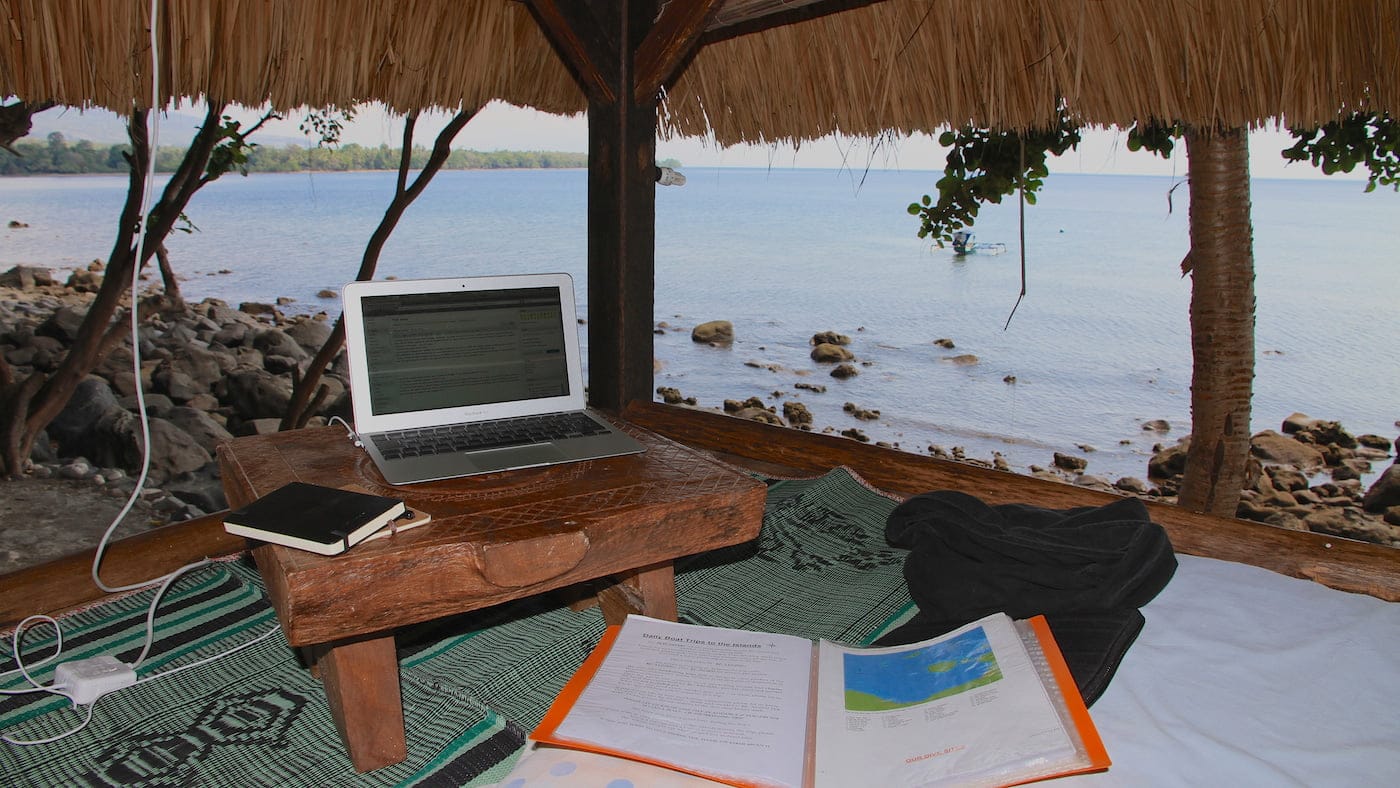
In June 2016, I invested in a new machine, capable of processing a large number of files without dragging, and which has lasted several years: a MacBook Pro 15-inch Retina Display from mid-2015 (photo below), refurbished, with 2.5 GHz Intel Core i7 processor, 16 GB Ram memory and 1 TB SSD storage.
As the years went by, this computer in turn became obsolete for ever more demanding image, photo and video processing software... In 2023, I switched to a similar but more powerful and lighter computer: a MacBook Air 15 inchwith M2 chip, 24 GB of Ram and 2 TB of storage.
2. Photo and video equipment
Since 2023, I've had a hybrid camera, Canon Eos R7lighter and more modern than my old one Canon Eos 7D acquired in 2010, which has never let me go. I only use the R7 underwater. For terrestrial photos and videos, I now use the iPhone.
For the R7, I take several 64 GB memory cards, a spare battery and its charger. For the lenses, I take a wide-angle (actually a fisheye) and a macro. See details here:
→ Photo and diving: my equipment
I also have a portable SSD hard drive for backing up photos and videos (I unload and store the originals on my MacBook Air).
Finally, for underwater shots, I also carry an underwater housing. Nauticam and various accessories: flash units and chargers, flash arms, power cords, dome and porthole.
3. iPhone and local SIM
I also mentioned this above. The iPhone has become my second camera. It allows me to make images without attracting attentionAnd that's not all, since almost everyone now carries a smartphone.
For all communications (phone, SMS, internet), my French SIM is an e-SIM, so I keep my main number associated with the smartphone without needing to physically occupy the SIM card slot. I slip into the iPhone a local SIM for the duration of the trip, which I buy on the spot on arrival. It's the cheapest solution. It gives you access to the Internet via the 3/4/5G mobile network (when available) and avoids roaming charges. The phone acts as a "modem" for the computer via connection sharing, when there's no wifi available.
4. Power adapter and power strip
In modest accommodations, it is rare to have more than one electrical outlet. And it is sometimes installed in strange places, in height, or near the door, or in an inaccessible corner behind the bed... So I take a strip to plug in all my accessories and chargers more easily. Before I leave, I check the type of plug in the country I'm going to use. the adapter (but if you forget, you can find it on site).

it's a baggage that weighs how many pounds all that?
It's not a joke, I would really like to know how much you travel with, because your list seems very good, and I always have too many kilos, it's really a handicap that "weighs" me down when traveling.
And still there is no multi-climate as when you travel in a country, half tropical-beach and half mountains at 4000 m. Between the shoes of small hike, and the "polar, windbreaker, anorak" ...
The iPod, a good idea. Do you travel with an iPod of how much?
thank you for your information.
@Joce: The backpack weighs about 12kg, sometimes it even went up to 14kg... All the cables, batteries, electrical equipment are heavy. I can't afford to go beyond that, as I also have the diving bag which weighs about 10kg [EDIT: rather 11-12kg, now that I put the regulator with the rest]. Most companies tolerate a total of 20-22kg in the hold, but not much more.
As for my iPod, it is an old model, which is "only" 60GB.
😉
Hello Corinne, I take note of your backpack which seems to be well organized, I would have for my part the hiking shoes in addition but well, I can have them on my feet in the plane. It's the diving bag that worries me more. Mine alone weighs 20 kg, problem... I have a stab a little too heavy, halcyon, great but not easy to carry. Maybe I could buy a lighter one for the trip. I'm going to travel from South India to New Zealand between September 2009 and May 2010, I'll go through Thailand, Malaysia, Indonesia, Australia and finally NZ. What material do you bring? Thanks for your answer
@debullenbulle: Hello, and welcome to Petites Bulles d'Ailleurs! With a name like that, you're in the right place 😉
My dive bag, which is in 8-9kg, contains:
- mask
- Mares AdvantiX-3 fins
- boots
- stab Seac Sub Pro Lady XS (I will invest in a lighter one one day)
- combi 5mm (before I took a 3mm, much lighter)
- accessories: soft snorkel, small parachute, knife, lamp (without batteries for transport)
Tip #1: the bag itself is very light, I think that's where I save weight compared to others: a simple mesh bag with a zipper, slipped into a duffel bag that closes at the top (all found in a large chain of sports stores that encourages us to be "All in shape"). It's the black and grey bag with orange piping you see on the picture.
Tip #2: I keep my regulator (Legend ACD) in my "carry-on" bag when I fly, to lighten the weight in the hold.
I'm envious of your trip... Just the kind of itinerary I would do if I had a few months of freedom and some money to spare.
Good preparations!
8)
Hello Corinne, yes I will look for a light stab because mine has a stainless plate of 6 lbs and a support also in stainless. I had mourned my equipment but thanks to you I made the decision to bring it. It's great to share your experience. Thank you for sharing your experience. Whatever you think I am not very rich but it seems to me that a longer trip is cheaper, maybe I will find some work, who knows... And then life leads you sometimes to a crossroads that smells of adventure. I trust the return trip. I know that I will be amply energized by Asia.
Your blog motivates and reassures me. I'm going alone too, to celebrate my 50th birthday. I really like the idea of downloading chapters from Lonely Planet, really clever.
@debullenbulle: The main thing is that you are able to carry everything (duffel bag + clothes bag) by yourself. That's really the determining factor. Beyond 20 kilos, it's a pain anyway. At worst, you leave without a stab and you rent one on the spot. During my first trips, when I didn't have all my gear yet, this is what I did. And then, on such a long trip, when it comes to clothes and so on, you can buy stuff along the way, as you go along, and unload other stuff, according to your needs at the time.
I didn't think you were "rich", on the contrary, what you say is very true: the longer the trip, the more it's worth it. Besides, your trip looks like a project that is secretly maturing in me and that I will probably realize one day... During my trips, I met a lot of people, neither more nor less wealthy than you or me, who were traveling on a long term basis, working a little bit, here and there, from one dive center to another, according to the encounters, the desires, the opportunities. And lugging their gear around! Really, Asia is a fabulous destination for small budgets and "solo travelers".
For my part, I am not yet at a "crossroads" I am satisfied for the moment with my vacation periods to travel, but I come back each time more frustrated (always too short!), with the desire to leave again...
🙄
Hello Corinne,
In fact, I put my nice big stab for sale on diver.com. Too much tech for me anyway. Thanks for your prompt and thoughtful reply. See you Cô
Hello
I am very impressed by your blog and post very practical and super clear for who wants to get started on long distance trips!
I just wanted to react to two pieces of information: the traveler's "first aid kit" and malaria.
Pharmacy kit : I personally travel a little bit heavier than you because, even if you can find a lot of products in the capital cities (although for Biafine, for example, it's not easy !), the more remote areas don't often offer much (I think for example in Cambodia, Laos, Burma, some parts of Thailand or the Philippines, etc.). Moreover, a significant proportion of pharmaceutical products available in Asia are counterfeit and to pass the door of a place marked "Pharmacy" is seldom a pledge of quality, thus prudence.
Another thing about aspirin: this product, although very common in France, is far from being harmless. It inhibits - in particular - platelet aggregation and, as such, is unusable in dengue areas (South East Asia, South America, Africa) because there is an increased risk of bleeding. It is therefore recommended to use paracetamol instead.
Malaria : one could understand from your sentence that malaria transmitting mosquitoes "flee" from tourists. Unfortunately this is not the case! Many tourist areas are also impaludent. So, once again, be careful, the best thing is to get information about your destination and to consult a doctor specialized in tropical medicine if necessary. And since the goal is not to be bitten, sleeping under a mosquito net is an excellent thing!
The tropics are great, don't bring back bad memories!
@+
Ben
@Ben: Hello and welcome to Petites Bulles d'Ailleurs! Thank you for your comments, which I can only agree with, of course. Very right about the paracetamol and the mosquito net.
My point here on the little travel pharmacy was to "play it down". It goes without saying that if tourists were scaring away malaria-carrying mosquitoes, it would be known... 😆 I dare to hope that I was not misunderstood on this point! Of course, I recommend consulting before leaving to get professional advice and a suitable prescription. Once informed, each person opts for prevention and the solutions they feel are best suited to their case: it's a matter of personal responsibility.
It's just that I've sometimes seen people pack a mind-boggling (and very expensive) pharmaceutical arsenal just to spend a week in Phuket... 😯
Can you give me the tip to go to Phuket as cheaply as possible, by Malaysia or other? Your site is remarkable, thank you.
@Marie-Christine: Thanks for the compliment... 😉
There is no real "tip" to go to Phuket as cheap as possible. The best way is to check the prices of flights to big hubs in the area, such as Bangkok, Kuala Lumpur, Singapore... As well as the promotions of companies like Thai Airways or Malaysia Airlines. Once in Bangkok, KL or Singapore, you can take a cheap flight with Air Asia to the final destination, Phuket in your case.
For my part, to find the cheapest fares, I use a very good search engine, which allows me to indicate several departure and return dates: Partirou.com. Then I will see directly on the websites of the indicated airlines.
Good preparations!
🙂
Hello,
Great site!!!! 😉
Full of advice, beautiful design, etc.
No, really! Deserves to be known!
We are leaving Bali early and I also plan to create a blog on our different trips. I intend to promote your blog.
Good continuation
😀
Lili
from Yaya & Lili
@ Yaya & Lili: Welcome to my Little Bubbles of Elsewhere! I'm so glad you like the walk... And thank you for this nice comment. Let me know when you launch your blog, I'll go for a walk. Good preparations!
8)
Written by Ben (see above):
"Pharmacy kit : I personally travel a little bit heavier than you because, even if you can find a lot of products in the capital cities (although for Biafine, for example, it's not easy !), the more remote areas don't offer much (I think for example in Cambodia, Laos, Burma, some parts of Thailand or the Philippines, etc.). Moreover, a significant proportion of pharmaceutical products available in Asia are counterfeit and to pass the door of a place marked "Pharmacy" is seldom a pledge of quality, thus prudence.
Another thing about aspirin: this product, although very common in France, is far from being harmless. It inhibits platelet aggregation and, as such, cannot be used in dengue areas (South East Asia, South America, Africa) because there is an increased risk of bleeding. It is therefore recommended to use paracetamol instead.
+1
@John: Are you the virtual clone of Ben, who left the same comment (very relevant, this said), word for word, a little higher?
EDIT: I just figured it out... you're quoting Ben, actually, and "plussoying" with the +1... 😆
I rectify the presentation of your comment, so that it is clearer.
Hello Corinne,
Thank you for this blog which makes me travel a bit at work while waiting to leave for Borneo and Sipadan in 1 month... By the way, speaking of luggage, I was wondering if you had a torch and if you put it in the hold or in your hand luggage?
I seem to remember that there were some concerns with the dive torches and airlift and when I search the internet and forums, I find as many versions as the internet can give... Do you have an opinion on this subject?
Thank you in advance & long life to this blog.
Aurélie
@ Aurélie: Welcome to my Little Bubbles of Elsewhere !!!
For the sub-lighting, I put everything in the hold. I only have a very small flashlight from which I simply remove the batteries, and an Ikelite flash for my camera, which I also travel separately from the "battery" part. That way, there is no danger of either of them lighting up by accident in the checked bag.
You will enjoy Sipadan ... Good preparations!
8)
The French power strip was often unusable in Thailand. The problem is when you have to plug the fan on one of these inputs of the multi-socket, because the fans in Thailand, they have flat plugs as you know. And as often me too I found myself with only one plug in the room!!!
I managed to travel this time with 10,5 kgs (I'm proud it's the 1st time) + the day bag, 20 l, containing the notebook and its cables. I came back with 15 kgs. no diving equipment like you, but also a lot of electronics, between computer, HD ext, USB keys, card reader, photo app. (small) and phone + chargers.
Do you know Marie-Ange from http://www.unmondeailleurs.net/ a super diver too (and photographer).
@Joce: I also have a flat plug adapter, to plug the power strip into... 😉
Congratulations for the 10,5kg, it's true that it weighs, all these little things!!!
Yes, I know Marie-Ange, we even met two years ago at the diving show!
I also have a flat adapter, (and even full, bought in Bangkok,) on which to connect the power strip ... French.
But there, already that only one plug (the adapter with flat plug it leans down to death on their plugs of ...
well, you see, the adapter couldn't support the weight of the French power strip, which couldn't accept the flat plug of the fan either. it was leaning down to death...
So, flat plug adapter + French multi-socket + flat plug adapter to plug in the fan, and the others (since multi-socket is made to plug in three devices in my case, chargers, computer ...
I never got out of it, and I forced myself to use the electrically powered computer while staying on my terrace. Otherwise, on battery.
When I talk about 10 kgs, it was the suitcase on wheels, because I also had the computer on my back and its stuff (1kg5)
I would like to take this opportunity to thank you for the story of your stay in Koh Yao Noi, it really helped me a lot to read you.
Very beautiful site 🙂 Design, content, photos, I will take my marks there.
As far as equipment is concerned, I try every day to get rid of useless things. I left with 10kg of luggage and I must have lost two kilos along the way. I realize that I don't need much anymore.
Hardware: Mac Book Pro, adapter, Sony 550 camera, some cables. A good book, two outfits, a notebook, and that's it. I had opted for a tent and a sleeping bag, which I finally gave up.
Good continuation,
NowMadNow
@Joce: I'm familiar with the trick of having the plug on the wall and everything leaning down. I have a trick: I have a mini-adapter with a flat plug I found in Thailand, which fits well and stays in place, on which I plug the power strip (which power strip is with a wire, so I can put it down, and it doesn't get stuck on the wall with the weight of all the little things to plug in...).
😉
NowMadNow: Welcome to my Little Bubbles! I'm glad you like it. I should update this section, because, since then, I have seriously equipped myself for underwater photography and it changes the game: with the housing for the SLR, the porthole, the support plate, the arm for the flash, the flash, the charger for the flash, the cable for the flash, I find myself with a lot (too much) of extra kilos to manage... Last time, with the clothes + the diving stuff (complete equipment of 10-11kg) + the photo equipment, I was around 26-27 kilos!!! 😯 But it's true that for the "clothes and personal stuff" part, it's easy to do very light.
8)
Hi !
A quick question: how long did it take for your Macbook Pro to give up? I'm a bit worried about it...
I plan to bring mine back brand new, practically 17p, on my trip to Asia. You had a suitable bag to protect it, I imagine. If you have any tips, that would be cool 🙂
Anyway, great site, I feel like it's going to help me prepare well ^^ thanks to you. 🙄
@Jasmineloo: After a few days. At first, the screen made me several times caprices before turning off for good. But when I came back to France, everything was fine. But it was a very old MacBook Pro... If yours is new, I don't think you have to worry too much. No particular advice to give you, except to have a cover, to protect it, to avoid shocks, during the transport. One thing is for sure, computers don't appreciate the heat and humidity of the air in tropical areas.
8)
Hello,
oki good j hesitates to spend the dark side only for these few months to know take a pc ...
otherwise I will inquire for the macbook air to know if it supports well, the CS5 (photoshop, flash, dreamweaver ...) but it seems to me that yes with the new processor ... ah ah, in any case thank you very much for your answer. ^^
Have a nice trip, beautiful !!
A girl who travels with so little is very rare! I remember a friend of mine who accompanied me during a trip to Spain last year and she took with her a lot of useless clothes for a week trip. Knowing also that she is a shopping enthusiast, she couldn't help but raid many stores on site. On the way back, her suitcase was way over the maximum weight allowed, but fortunately for her, the company did not weigh her hand luggage!
@Elyes: It doesn't matter if I'm a girl or not... You're comparing me with trips that have nothing to do with mine, in fact. As I fly to destinations where I intend to go scuba diving (and not shopping), and as I'm now also equipped with a waterproof housing for underwater photography, I don't really have anything else to bring. And then, in the tropics, a swimsuit and a sarong are often enough. I think, on the contrary, that I am much more loaded than your shopping friend, with all my diving bardas...
🙄
Hello,
Starting for the first time in BDE cruises in Egypt next year, I am in search of solutions to fit all my gear (like you Ikelite and 7D box with big Hublot).
I want to take my 13″ macbook pro with me as well.
Could you give me stp the references of your cabin bag where you put all that stp?
A big thank you in advance!
Thank you for all your advice !
Olala, that's quite a load for diving but I don't think we can do otherwise! I take note of the drops against ear infections, I had not thought of it. Every time I get my ears back because I know that it's quickly caught. Which ones do you take?
The Macbook Air 11″ is really the computer made for travel. And I'm not talking about the new series with the return of the backlit keyboard and a powerful proc...
Side clothing we go pretty light with my girlfriend, walking shoes (low) included, we arrive in the 9-10kg each!
@Bruno: For ear infections: Otipax that I buy in France, works very well. In Malaysia, I found a bottle of Ottopain that was also very efficient. But all these things must be pretty much the same...
The 11-inch MacBook Air was exactly the computer I dreamed of before it existed, when I bought a netbook and dreamed of seeing it display an apple at startup:
https://petitesbullesdailleurs.fr/mon-petit-ordi-de-technomade-20090128/
And now I'm green with envy to discover the power of the new MacBook Air that just came out. If only I had waited a few more months... But that's how it is, when it comes to technology, new things are quickly outdated as soon as they are acquired.
As for my diving gear and my underwater photo equipment, I don't plan to do without them, so yes: it's impossible to go light anymore.
Hello Corinne,
Congratulations on your site. It is pleasant to read and very inspiring. I'm going to Bali with my 5 years old boy and I want to introduce him to snorkeling. Do you have places around Bali that you recommend to practice snorkeling with a young child.
Thank you for all your good advice.
Brigitte
Yes, really top the Macbook Air and I drool over the new 🙂.
Thank you for the drops for the ears, I note, I take advantage of our passage in France to recharge our pharmacy!
A +
@Brigitte: Thank you and welcome to my Little Bubbles of Elsewhere. In Bali, for some nice snorkeling, you can go toAmed-Jemeluk-Bunutan or to Pemuteran.
Good preparations! 8)
@Bruno: Yes, there's plenty to drool over, indeed... 😉
Hello,
First of all, congratulations for this beautiful blog and the quality of the photos.
For my next trips (a 5-day dive cruise in the Similans in early November), I hesitate to bring my own diving gear.
For the wetsuit (I use a 3/5 mm kitesurfing wetsuit) OK; it's better for the hygiene and I don't like the rental shorties...
But for the rest: stab, fins, mask, regulator. Is there really an interest given the weight constraints?
Jean-Luc from Lorient
@ Jean-Luc56: Thanks for the congratulations, it's always nice... 😀 As for the interest in carrying your diving gear, it's really a personal choice. I'd be you, I'd still take a mask and regulator.
🙄
Hello,
I came across your site a bit by chance. I find the pictures beautiful. We are planning to go to South East Asia for 4 to 5 weeks this summer, but we are hesitant about where to go. We like to practice snorkelling, we avoid too touristic places.
The country must not have too many health risks (child of 5 years). Do you have any leads to give me?
@Ma': Hello Marion, and thank you for the compliment!!! 🙂
I'm telling you nicely: you want one thing and its opposite, don't you?... 😉
Let me explain: the advantage of the so-called "tourist" places, when you travel with a small child, is that you can find there all the infrastructures you may need in case of concern (medical equipment, transportation, communication, accommodation, etc.). If you want to avoid the tourist places, you choose a trip that will be less comfortable (longer, more complicated, farther) and that will involve more health "risks"...
Personally, I would recommend "easy" destinations to travel to, such as Thailand (snorkeling: in the southern islands, on both sides), Malaysia (snorkeling: Perhentian Besar Island, Tioman Island), and Bali in Indonesia (snorkeling: Amed, Pemuteran).
These are certainly tourist destinations, but you can find lots of peaceful corners anyway. Look a little in travel guides (Routard, Lonely Planet) on these destinations, it can already identify corners and islands that would suit your desires ...
Good preparations !!!
8)
Hello and thank you for your answer,
Yes, you're right what I'm looking for is contradictory ...
Thailand and Bali: these are the 2 destinations I thought of. The choice will be difficult.
We've been to Malaysia before, including Tioman and the Perhentians, but back then it was childless - backpacking and adventuring.
And since then, I really want to discover other countries in Asia...
Marion
@Ma': Thailand or Bali... what a dilemma!!! 😀 Both have their attractions and are quite doable with a little one. Since you're going in the summer, maybe aim for Bali, rather, you'll be almost certain to have good weather wherever you go in the island. In Thailand, in this season, the southwest coast is very wet... Good preparation!!!
8)
I was inspired by this post to go to Israel. I don't dive but I had decided to go with only a carry-on bag for my 12 day trip... well, I won't do it again 🙂
Bravo for this very useful blog with a person who works formidably well in his head ............. It is rare!
For my next trips to Indonesia from where I return it will be of good help.
do you have tips for snorkeling in Flores, Komodo, borneo?
Michel
@Michel: Thanks for the compliments on the blog! 🙂
It is always difficult for me to advise people about snorkeling in particular, as I do not practice it. But in general, where there are good diving spots, there are also good places for snorkelers...
So no, I don't really have a "snorkeling place" to recommend in Flores, Komodo, Borneo. You will find some everywhere, I guess... Otherwise, check the places where divers go, there are bound to be nice places to swim with fins, mask and snorkel nearby !
8)
Hello and thank you very much for making me dream about Raja Ampat. We are 4 from, a little trek in the jungle and to us the bubbles .......
It is good the departure approaches D-12, the things are ready, it remains just a small detail about the exchange.
I have a stopover in Jakarta, where I will do my visa. Is it better to change, compared to the exchange rate at the airport or when arriving in Sorong, so that it is more advantageous. Often it is not so good in the airports.
In Sorong or go change: in a bank, in a hotel like Novotel or other.
Are euros accepted without problem or should we also provide dollars?
Thank you, see you soon and make us travel again, it's only good.
cordially .
Sylvie
Hello!
Your blog is great!
I have a question, did you ever take your flippers on the plane with Airasia?
Thank you!
@Jean: when you say "on the plane", I guess you mean with me in the cabin??? As I explain in the article, my fins and all my diving gear go in the hold in my bag, whether on AirAsia or other airlines. I have no reason to take the fins out of said bag to take them in the cabin... 😉
Hello Corinne
First of all, congratulations for your super well documented site, we travel just by consulting it! Your journey is a little (a lot!) identical to mine. I travel almost exclusively to dive, since my first bubbles in 1990, day of my baptism, a revelation! I am also a photographer and videographer, but I stay with "light" equipment with a gun that still makes good pictures. I'm currently making my checklist to go on a cruise to Rajat Ampat (with Wallacea), and I would like to know if you have ever had problems with excess luggage on this destination? I have the same bag as you, but it's going to be quite compact, I also plan to put my camera gear and my clothes in it. And how does it work on domestic flights? Finally, I read that the water temperature was constant at 28° all year long, is it the case ? So a 3mm should be enough. Thanks again for this nice site and the beautiful pictures !
@Marianne: no problem for the luggage until Raja Ampat. Usually, you are asked to pay for the extra kilos at check-in, but not always (it depends on the airline, the mood of the person at the counter and the customer's face). As it is at the Indonesian rate, this extra charge is quite affordable.
Yes, the water is hot, we didn't lie to you 🙂 I am very cold, I can handle a 5mm at these temperatures, especially when we dive every day, several times a day. But a 3mm is basically enough, indeed. Good preparations!
Hello,
I appreciate any details you can provide. Is it possible to know the name of the new model of roller bag to put in hold that you acquired? I'm in the red sea soon and I'm looking for ^^
Thank you and good bubbles 🙂
@ Solène: it is an East Pack Tranverz L (large size) https://www.eastpak.com/oc-en/luggage-c140/tranverz-l-current-khaki-pEK63L73T+00+999.html Like my previous bag, it is in two compartments, and I put on one side the diving gear, on the other the clothes and a lot of other stuff (cables, non-fragile elements for underwater photography, etc.). It is a bit bulkier than the other one, but it seems more robust. I just tested it in Indonesia... I'm getting used to its size, a bit bigger than the previous one...
great item for luggage
I add: concerning the labels, I put 2 on the handles of the luggage, and a paper with my addresses inside the luggage.
I take a picture of all my luggage on my iPhone, and I backup all my documents (plane tickets, hotel, passport) on my iPhone and on the cloud.
As for my camera bag, I found a special photo backpack for my compaq and its flashes, I'm still too afraid to put my reflex in the water and ... it's heavy.
I add to my waterproof case a set of O-rings backup, silicone grease of course ... etc
And I make an exel file with all the things I have to put in my luggage so that at each trip I take back my list without forgetting anything ... hehe once my spouse had forgotten his bathing suits, things easy to buy in tropical countries ...
Hello, thank you for this very informative article. Could you advise me on the purchase of photo and video equipment for diving. Thanks again
Cortiana: hello, there are so many new cameras and housings available, in so many different price ranges, for photographers of various levels, that it is impossible for me to advise you on a particular type of equipment... Set a budget to start with and see what is accessible according to that. If you want to do underwater photography/video occasionally, don't spend too much... It might be worth looking at second-hand equipment. If you're already an image buff and have a good grasp of the principles of land photography, then you should see what type of camera is right for you... You can join the sub photo forum, where you'll find lots of advice and be able to ask questions to other enthusiasts: https://www.forum-photosub.fr/forum/
And I add: if you read English, there is this site, which is a mine of information: https://www.uwphotographyguide.com/
Thank you for the very appropriate and useful advice. They helped me to reassure myself and adapt my luggage and my diving bag.
Nice summary, I'm going to bed more reassured
Germain
Good evening Corinne,
A small practical question from a diver without much experience.
Can the Eastpack be a good choice for a traveler with a big semi waterproof and a big stab?
Thanks to you.
@Hervé: good evening, it's difficult to evaluate... It depends on the amount of clothes you carry with you. The Eastpack I'm talking about is 121 liters. I have a hard time evaluating if it's enough for a big stab and a big semi-waterproof one, plus all the stuff you plan to carry with it or not. Maybe look at the volume of the big wheeled diving bags sold by well-known brands. In general, these bags are designed to hold only the diving gear. This will give you an idea of the size of the bag. Maybe this Eastpack bag will be too small for you, maybe you should consider a bigger one, I don't know.
I manage to fit all my diving equipment on one side (so about half the volume, for a 5 mm wet suit and stab that is not too bulky, Legend regulator, fins, masks, booties, and parachute type accessories that go in the pockets of the stab). On the other side, I put very few clothes, two pareos, a toilet bag, a small pharmacy, a large bag containing cables, chargers and electrical connections, a slightly bulky case containing accessories for my camera housing: two large flashes with their batteries disconnected, the arms of the flashes and their floats, etc. So, roughly speaking, 60 liters on one side, 60 liters on the other...
There you go, if that helps you better estimate how much volume you need... Happy prepping! 🙂
Excellent, thank you for this, very educational.
Makes you want to travel...