

In search of nudibranchs ...

 EN
ENNudibranchs are the marine cousins of land slugs. Their gills are exposed, naked, hence their name...
Fresh water and poor visibility
On Tuesday, I start diving in Tioman. First surprise: the water is COLD !!!! I know, everything is relative, but here, in this season, we lose almost 4 degrees compared to the very warm waters of Perhentian.
That's a lot. Spending an hour in water at 30°C is fine. But at 25-26°C, it's systematic shivering and teeth chattering for the very cold diver that I am. From now on, I will wear a tank top + T-shirt under my too thin wetsuit.
Another surprise, which is not really a surprise, because I had been warned about it: in July-August, visibility is even poorer here, in Tioman, than in the Perhentian Islands and in Redang. I realized this as soon as I started exploring small wrecks of fishing boats close to the coast.
The fascinating sea slugs
As a result, we are less interested in the "big" animals that may pass in the distance and that we cannot see anyway, because of the "fog" that reigns in the water, to focus on the small ones.
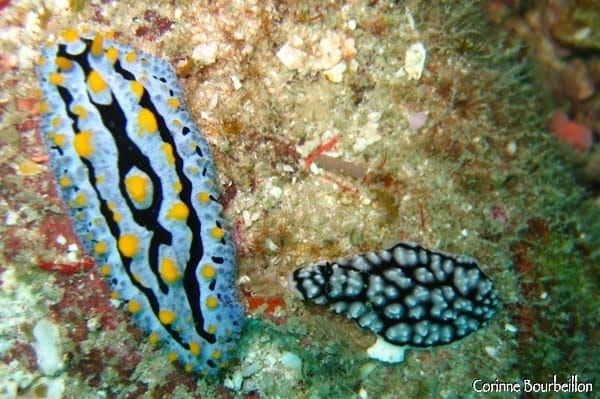
Among these very interesting little things, which are an inexhaustible subject for those who, like me, do underwater photography (I carry my little compact in its waterproof case with me on every dive): the nudibranchs.
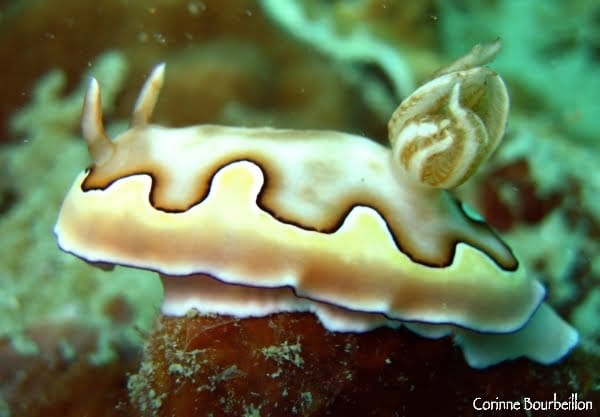
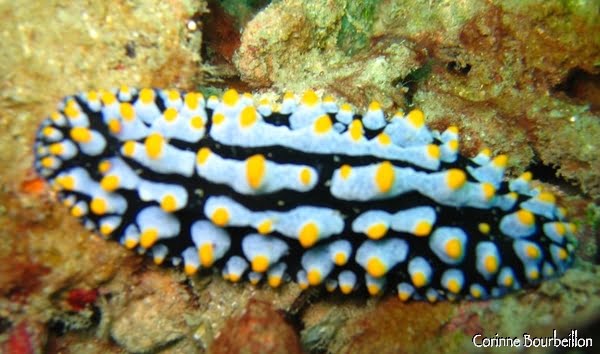
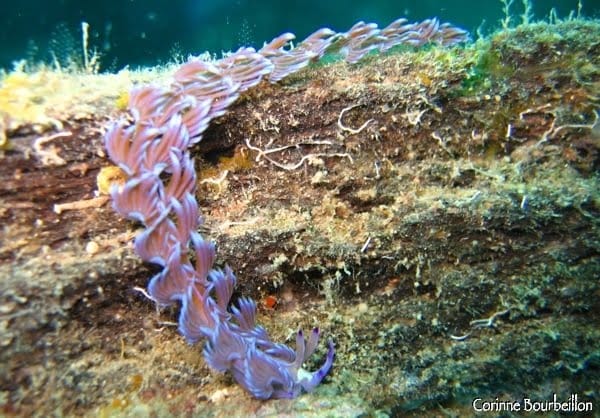
These critters are vague relatives of our land slugs, but much prettier. There are hundreds and hundreds of them, listed in a Bible called 1001 Nudibranchswhich we hasten to consult on our return to the dive shop.
The nudibranchs, there are big and small, long and short, leggy and thin, some with an "afro" cut, others covered with pustules. The whole thing is adorned with new and changing colors. A real festival.
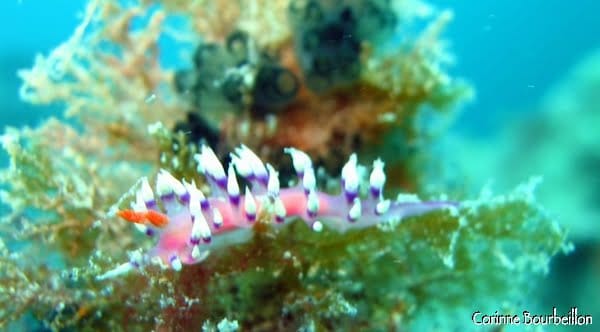


Ohhhh I love nudibranchs... It's so fascinating the shapes these little critters can take! And not to mention the colors...
And for the cold, I understand you. It's a problem for me too! 163 cm / 50k = blue lips and white hands coming back to earth! My thing: never without my hoodie, and so much for style 😉
@Caroline: For nude photos, I've made a lot of progress since then. Look here, for example:
https://petitesbullesdailleurs.fr/nudibranches-sulawesi-lembeh-bangka-20101025/
And there:
https://petitesbullesdailleurs.fr/le-petit-peuple-du-recif-20100705/
For the cold, phew, I feel less alone!
😉